Handling Client Requests for Specific Sites
What to do when a client names a specific site they want a link from, and how to push back when the request is a bad idea.

Sooner or later a client will ask for a link on a named site — a competitor’s guest post host, a site they read personally, or somewhere they saw a rival get featured. Sometimes it’s a great idea; sometimes it’s a request that will waste a week of outreach for no real benefit, or worse, land a link on a site with real quality problems. Handling this well is part diplomacy, part quality control.
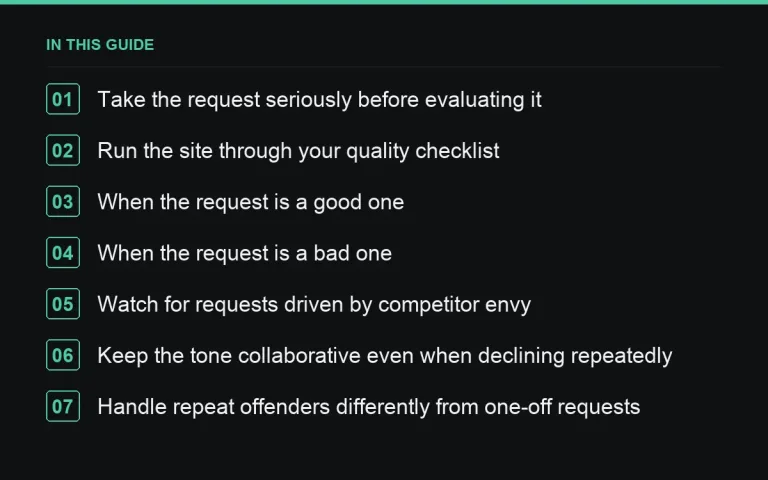
Take the request seriously before evaluating it
Even an unrealistic request usually comes from a legitimate instinct — the client noticed something and wants to act on it. Ask why they want that specific site before responding, since the underlying reason (a competitor got a link there, they read it personally, a colleague suggested it) affects how you frame your answer.
Run the site through your quality checklist
Before agreeing or declining, check the site against the same thresholds you’d apply to any prospect — traffic, spam score, topical relevance, editorial standards. A bulk domain check or a quick look at DA/DR and traffic data gives you an evidence-based answer rather than a subjective one, and it’s far easier to explain “the site gets almost no organic traffic” than “I don’t think it’s a good fit.”
When the request is a good one
If the site checks out, treat it like any other outreach target, but tell the client you’re pursuing it and give a realistic timeline, since a named-site request often carries more attention (and more disappointment if it doesn’t land) than a standard placement. Some publishers are harder to reach or have longer editorial queues, and it’s worth setting that expectation immediately.
When the request is a bad one
Don’t just say no — explain the specific reason using data, not opinion: low real traffic despite a decent DA number, a spam score outside your normal range, an off-topic audience, or a site known for accepting paid links indiscriminately (which can actually be a risk signal, not a benefit). Offer two or three comparable alternatives in the same reply so the conversation moves forward rather than stalling on the rejection.
Watch for requests driven by competitor envy
“Our competitor got featured there, we want one too” is common and not unreasonable, but it’s worth a quick sanity check on whether that placement is actually working for the competitor, or whether it’s just visible. Use the compare tool to look at the site properly rather than reacting to its mere existence in a competitor’s backlink profile.
Keep the tone collaborative even when declining repeatedly
It’s easy for repeated declines to start sounding curt, especially when the same conversation recurs across several months. Resist that drift — restate the reasoning fully each time rather than a clipped one-line rejection, since a terse tone reads as frustration even when none is intended, and can make an otherwise reasonable decision feel unnecessarily adversarial.
Handle repeat offenders differently from one-off requests
A client who names one questionable site is different from a client who repeatedly pushes low-quality suggestions after being shown the data each time. For the latter pattern, it’s worth a direct, calm conversation about the underlying quality standard itself, rather than re-litigating the same explanation site by site — the real issue may be a mismatch in expectations that needs addressing at the relationship level, not the individual-request level.
Set the expectation for this during onboarding, not in the moment
Clients are far more receptive to hearing “we’ll always check requested sites against these standards” during onboarding, when it’s a neutral policy, than hearing it for the first time as a rejection of their specific idea. Mention it explicitly and early, ideally alongside the quality thresholds covered in your scoping document, so a future decline feels like a policy being applied consistently rather than a judgment call invented on the spot.
Document the decision either way
Whether you pursue the site or decline it, note the reasoning in the client file. This protects you if the same request resurfaces months later from a different stakeholder on the client side, and it keeps your quality standards consistent across the team rather than dependent on who happened to answer that day. It’s also useful evidence to point to if a client later asks why a similar site was treated differently by a different account manager — see our broader guide on when to say no to a client for keeping this consistent across a whole team.
A quick response framework
| Situation | Response |
|---|---|
| Site meets quality bar | Pursue it, set a realistic timeline, confirm scope fit |
| Site fails traffic/spam checks | Decline with data, offer 2-3 alternatives |
| Site is off-topic for the client’s niche | Explain relevance risk, suggest a closer-fit option |
| Request driven by a competitor sighting | Evaluate independently before committing |
Where to go next
Handling these requests well depends on having a clear, written quality bar in the first place — see our scoping checklist — and a fast way to check any site a client names against real traffic and quality data before agreeing to pursue it.
Frequently asked questions
Should we ever agree to a site we know is low quality?
Generally no. Agreeing once sets a precedent, and it undermines the quality standard you're using to justify declining other requests later.
What if the client insists after we've explained the data?
Offer to pursue it as an exception outside the core package scope, clearly labelled, so it doesn't quietly lower the standard for the rest of the engagement.
How fast should we respond to a specific-site request?
Within a day or two with at least an initial read, even if full evaluation takes longer. A slow response reads as reluctance even when it isn't.
Is it worth explaining spam score to clients who aren't technical?
Yes, briefly — a plain-language version like 'this site shows signs of selling links indiscriminately, which can look risky to search engines' usually lands better than the raw metric name.
Put it into practice
Filter 54,483 websites by DR, traffic, niche and price, and order with escrow — you pay only after the link is live.
Browse the marketplace