How to Productize a Link Building Service
Turn custom link building work into repeatable packages clients can buy without a scoping call.
Most agencies start out selling link building as a custom quote for every client, which means every deal needs a scoping call, a bespoke proposal and a project plan built from scratch. Productizing the service means designing a small set of fixed packages, with clear inputs, outputs and turnaround times, that clients can choose off a page instead of negotiating from zero. It shortens sales cycles, makes delivery predictable and makes it much easier to train new staff.
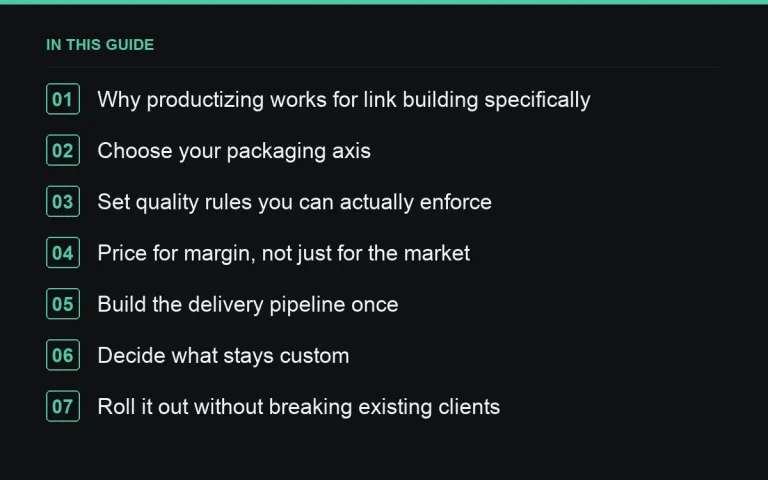
Why productizing works for link building specifically
Link building has a natural unit of output: a placed, live link on a real site, at a given quality tier. That makes it easier to productize than something like brand strategy. Once you have a delivery process you trust, you can wrap it in a small number of packages defined by monthly link volume and quality tier (for example, sites in a certain DA/DR and traffic band), rather than re-deriving scope for every client. Buyers also prefer this: a fixed package is easier to compare, budget for and get approved internally than a bespoke quote.
Choose your packaging axis
Most agencies productize around one or two of these variables, and no more:
- Volume — links per month (e.g. 4, 8, 15).
- Quality tier — minimum traffic, DA/DR band, or niche relevance rules.
- Link type — guest post, niche edit, or a mix.
- Reporting cadence — monthly summary vs. live dashboard.
Resist the urge to make every package fully customizable. The point of productizing is to remove decisions, not to offer a menu with fifty combinations.
Set quality rules you can actually enforce
A package is only credible if the quality bar behind it is real and consistently applied. Write down your minimum thresholds — for example, real organic traffic, a spam score ceiling, topical relevance to the client’s niche — and use the same filters every time you source sites, whether that’s through your own outreach list or a marketplace with built-in filters by DA, DR, traffic and spam score. Publish these rules internally so account managers can’t quietly downgrade quality to hit a deadline. See our piece on agency red flags for the quality shortcuts clients should watch for — the same list is useful as an internal checklist.
Price for margin, not just for the market
Productized pricing has to bake in your delivery cost per link, including outreach or marketplace fees, content, project management time and a margin buffer for the links that fall through. If you haven’t modelled this yet, read our guide on pricing link building services before you fix package prices, since underpricing a productized package is much harder to unwind later than it is for a one-off quote.
Build the delivery pipeline once
Productizing only pays off if delivery is genuinely repeatable. That means a documented sourcing process, a standard outreach or procurement template, a content brief template, and a QA checklist before anything goes live — see our SOPs guide for a fuller breakdown. Sourcing sites through a marketplace with bulk domain checking and saved searches removes a lot of the manual research each package would otherwise require, and lets a junior team member run sourcing against the same rules every month.
Decide what stays custom
Not everything should be productized. Anchor text strategy, target page selection and competitor gap analysis usually need a human decision per client, even inside a fixed package. Keep a short “included consultation” line item in each package for this, rather than pretending the whole engagement is templated. Clients researching options will often compare productized offers against building the function in-house, so be ready to explain why a fixed package still gets a tailored strategy layer on top.
Roll it out without breaking existing clients
Introduce packages for new clients first, and let existing custom contracts run their course rather than forcing a renegotiation. Update your onboarding process so new clients are sold directly into a package tier, with the scoping call reduced to confirming niche, target pages and reporting preferences rather than defining scope from scratch.
Write package pages that answer objections before they’re asked
A productized package page should do most of the selling work a scoping call used to do. Answer the obvious questions directly on the page: what counts as a qualifying site, what happens if a placement falls through, how reporting works, and what the client can expect in month one versus month three. Prospects comparing your packages against building the function in-house or against a competing agency will read this page closely, so vague language costs you conversions. Include a short FAQ section addressing turnaround time and cancellation terms, since those two questions come up in almost every sales conversation regardless of package tier.
Watch for the packages that quietly become bespoke again
Once packages exist, sales and account management teams will still face pressure to bend them for a specific prospect — one more link this month, a site outside the usual niche, a faster turnaround for an important client. Each exception is defensible alone, but a package that’s exception-laden within six months has effectively stopped being productized. Track how often each package needs a manual override, and treat a rising rate as a signal that either the package needs redesigning or the sales team needs clearer guardrails on what can and can’t be promised at the point of sale.
Where to go next
Productizing is one lever; pricing, reporting and QA are the others that make packages sustainable. Start with a pricing model, tighten your delivery SOPs, review your quality red-flag list so packages don’t quietly slip, and use a marketplace of vetted publisher sites to remove sourcing time from every package tier.
Frequently asked questions
Will clients accept a fixed package instead of a custom quote?
Most will, provided the package clearly states quality thresholds, turnaround time and what happens if a placement falls through. Buyers who want a fully bespoke strategy can still be sold a custom tier, but it should be the exception, not the default.
How many packages should we offer?
Two or three is usually enough — a starter, a growth, and a scale tier differentiated mainly by monthly link volume and quality band. More than that adds sales friction without adding much value.
Does productizing lower quality?
Not if the quality rules behind each package are enforced consistently. The risk is teams quietly cutting corners under deadline pressure, which is why a written QA checklist matters more once you productize, not less.
Can a freelancer productize link building too?
Yes, and it's often easier at that scale, since one person can enforce quality rules without needing to document them for a team first.
Put it into practice
Filter 54,483 websites by DR, traffic, niche and price, and order with escrow — you pay only after the link is live.
Browse the marketplace