Writing Link Building SOPs Your Team Will Actually Follow
How to document a link building process so a new hire can run it correctly without shadowing a senior teammate for weeks.

Most link building knowledge lives in senior staff members’ heads, which is fine until someone goes on leave, leaves the company, or a client roster grows past what one person can personally oversee. Standard operating procedures — written, specific, and kept current — are what let an agency scale delivery without scaling risk.
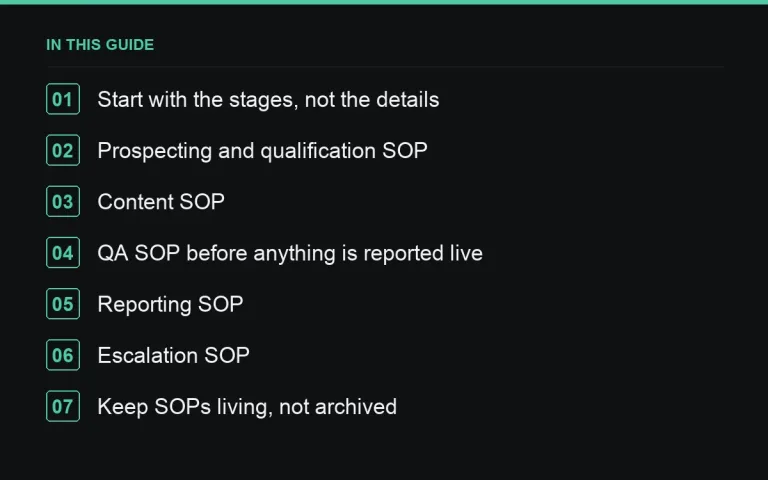
Start with the stages, not the details
Map the delivery pipeline at a high level first: prospecting, qualification, outreach, content, placement, QA, reporting. Write an SOP for each stage separately rather than one enormous document, so people can find and update the relevant section without wading through the whole process.
Prospecting and qualification SOP
Document exactly which metrics matter (traffic, DA/DR, spam score, niche relevance) and the specific thresholds used for each package tier. Include how sites are sourced — cold outreach lists, a marketplace with bulk domain checking, referrals — and how a saved search should be set up per client so a new hire doesn’t rebuild filters from scratch.
Content SOP
Specify brief templates, tone and style guidance per client (or a link to each client’s brand guide), the review chain before content goes to a publisher, and how revisions from editors are handled. This is also where anchor text rules belong — see our anchor planning guide for the kind of rules worth codifying.
QA SOP before anything is reported live
List the specific checks every placement must pass before it’s marked complete: link is live and indexable, anchor matches the agreed text, target page is correct, surrounding content is appropriate, and the page isn’t set to noindex or nofollow unless that was explicitly agreed. Our QA checklist guide covers this in detail — it’s worth pulling directly into your internal SOP rather than treating QA as an informal step.
Reporting SOP
Define the exact report structure, data fields, and delivery schedule so reporting doesn’t vary by which account manager is handling a client that month. Reference your reporting templates directly rather than each person building their own version.
Escalation SOP
Write down what a junior team member should do when something falls outside normal process: a client wants a rush placement, a publisher becomes unresponsive, a placement gets flagged as risky. A simple rule — “escalate to account lead if X” — prevents both paralysis and overconfident improvisation.
Keep SOPs living, not archived
Review each SOP at least twice a year, and immediately after any incident that reveals a gap (a quality miss, a missed deadline, a reporting error). An SOP that hasn’t been touched in two years is often quietly out of date with how the team actually works, which undermines trust in the whole document set.
Ask the team what’s missing, not just what’s wrong
When reviewing SOPs, ask staff directly what situations they’ve encountered that weren’t covered by any existing document, rather than only reviewing for accuracy of what’s already written. Gaps are often more valuable to close than small inaccuracies, since a missing SOP means someone is currently improvising a judgment call that should be standardized.
Version SOPs so changes are traceable
A dated change log at the top of each SOP — even a simple “updated March 2026: tightened spam score threshold” line — helps the team understand why a rule changed and prevents confusion when someone references an old printed copy or an out-of-date bookmark. It also creates a useful record if a client ever asks when and why a specific standard was adjusted.
Write SOPs for the exceptions, not just the happy path
Most delivery goes smoothly, so it’s tempting to document only the normal flow. The real value of an SOP shows up when something goes wrong — a publisher demands payment upfront against policy, a client requests a site that fails quality checks, a placement is discovered to have gone missing weeks after being reported live. Document these situations explicitly, cross-referencing guides like handling specific-site requests and reporting lost links, so a junior team member facing an unusual situation for the first time has somewhere concrete to look rather than guessing.
Make SOPs part of every new hire’s first week
An SOP that only lives in a shared drive nobody actually reads isn’t really operational. Build a short walkthrough of the core SOPs into onboarding for every new hire, and revisit them again after their first month once they’ve seen real situations the documents describe, so the content actually sticks rather than being skimmed once and forgotten.
A minimal SOP set to start with
- Prospecting and qualification thresholds
- Content brief and review process
- QA checklist before marking a placement complete
- Monthly reporting structure and schedule
- Escalation rules for out-of-process requests
Where to go next
SOPs are what makes hiring and training new staff tractable, and they pair naturally with sourcing tools like the API and marketplace filters, which turn a written qualification rule into an enforceable, repeatable filter rather than a judgment call every time.
Frequently asked questions
How detailed should an SOP be?
Detailed enough that a competent new hire can execute the stage correctly without asking a senior colleague every step, but not so granular that it becomes a burden to keep updated.
Who should own SOP updates?
One person per SOP, usually a senior team member closest to that stage of delivery, so updates don't get lost between multiple owners assuming someone else will do it.
Should SOPs be shared with clients?
A summarized version can build trust during sales or onboarding, but the full internal detail (thresholds, review chains) is usually kept internal.
What's the biggest risk of not having SOPs?
Inconsistent quality and delivery that depends entirely on which staff member handles a given account — which becomes a real business risk the moment that person is unavailable.
Put it into practice
Filter 54,483 websites by DR, traffic, niche and price, and order with escrow — you pay only after the link is live.
Browse the marketplace