A QA Checklist Before Sending Link Placements to Clients
The checks worth running on every placement before it goes into a client report, to catch the mistakes that erode trust fastest.
Nothing damages client confidence faster than a reported placement that turns out, on inspection, to have the wrong anchor, a nofollow tag nobody flagged, or a link the client’s own team finds broken a month later. A short, consistently applied QA checklist before a placement is marked complete catches almost all of this, and it takes a few minutes per link.
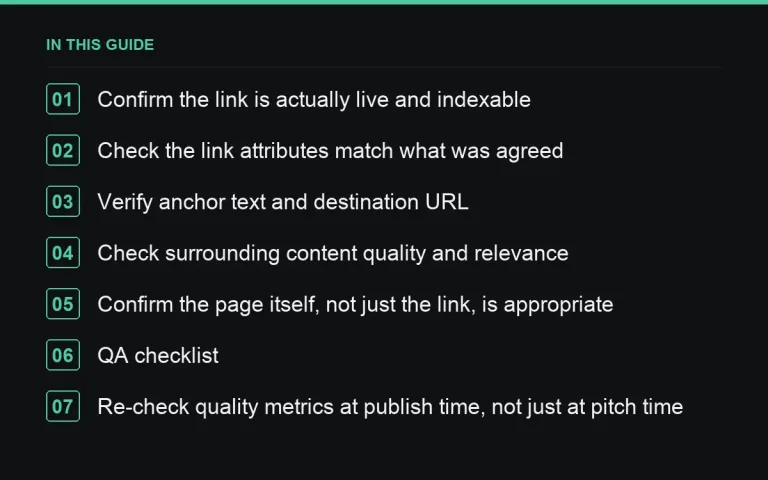
Confirm the link is actually live and indexable
Check the URL directly, not just a screenshot from the publisher. Confirm the page returns a normal status (not a redirect chain or a soft error), and that it isn’t accidentally blocked by robots.txt or set to noindex, which would defeat the purpose of the placement even though it “looks” live.
Check the link attributes match what was agreed
Verify whether the link is dofollow or nofollow, sponsored, or ugc, and whether that matches what was promised to the client. Some publishers apply nofollow or sponsored tags by default policy even when a placement was sold or arranged as an organic-looking guest contribution — this needs to be caught before reporting, not discovered by the client later.
Verify anchor text and destination URL
Confirm the anchor text is exactly what was agreed (not a close paraphrase a writer substituted) and that it points to the correct target page, not a similar or outdated URL. This is a surprisingly common slip when content goes through multiple editing rounds with a publisher.
Check surrounding content quality and relevance
Read the paragraph around the link, not just the link itself. A technically correct placement embedded in thin, oddly translated, or off-topic content reflects badly on the client and is worth flagging even if the mechanics are fine — occasionally worth pushing back to the publisher for a content quality fix before reporting it complete.
Confirm the page itself, not just the link, is appropriate
Scan the rest of the page for anything that would embarrass the client if they clicked through — adjacent ads for unrelated or inappropriate products, other links to clearly low-quality sites, or content that contradicts the client’s brand positioning. This is a fast visual check but an easy one to skip under time pressure.
QA checklist
- Link is live, returns a normal status, and is indexable
- Follow/nofollow/sponsored attribute matches what was agreed
- Anchor text matches exactly; destination URL is correct
- Surrounding content is relevant and reasonably well-written
- Rest of the page has no adjacent red flags
- Site and page still match the original quality thresholds (traffic, DA/DR, spam score) at time of publish, not just at time of pitching
Re-check quality metrics at publish time, not just at pitch time
A site can look fine when first evaluated and change by the time a placement actually goes live weeks later — traffic can drop, ownership can change, spam score can shift. A quick re-check with the same tools used during sourcing, including a fast bulk domain check if you’re batching several placements at once, catches this before it becomes a client-facing surprise.
Assign QA to someone other than the person who sourced the placement
A second set of eyes catches mistakes the original person is too close to notice. Even in a small team, rotating who does final QA — rather than always having the account manager check their own work — meaningfully improves the catch rate.
Log QA results, don’t just perform the check silently
A simple pass/fail log per placement, even a spreadsheet row, gives you data over time on where quality slips tend to happen (a specific publisher, a specific writer, a specific client’s rushed placements), which feeds directly back into your SOPs.
Don’t let deadline pressure erode the checklist
The moments QA matters most are exactly the moments it’s most tempting to skip — the last placement of the month, a rush request from a client under pressure themselves, a Friday afternoon when everyone wants to close things out. Build in a firm rule, ideally stated explicitly in your operating standards, that no placement is reported live without QA regardless of timing pressure, since the cost of an error found by the client is always higher than the small delay QA adds.
Feed QA findings into hiring and training decisions
A pattern of repeated QA failures traced back to a specific team member is useful, non-judgmental data for training conversations — it’s much easier to have a constructive discussion backed by a logged pattern than a vague sense that “something feels off” with a person’s work. Similarly, patterns tied to a specific writer feed directly into the decisions covered in our writer management guide.
Where to go next
A disciplined QA process is what makes your monthly reporting defensible, and it’s easiest to run consistently when placements are sourced from a marketplace with transparent, checkable metrics rather than opaque cold-outreach relationships.
Frequently asked questions
How long should QA take per placement?
A few minutes if the checklist is followed consistently. The cost is small compared to the reputational damage of reporting a placement that turns out to be wrong.
Should QA happen before or after telling the client it's live?
Always before. Reporting first and correcting later, if a QA issue is found, is far more damaging to trust than a short delay before reporting.
What's the most commonly missed QA check?
Re-verifying quality metrics at publish time rather than only at the point the site was first sourced — sites can change meaningfully in the weeks between pitching and publishing.
Can QA be automated?
Parts of it can — checking link status, attributes, and metrics via tools or an API — but the content and context review still benefits from a human read.
Put it into practice
Filter 54,483 websites by DR, traffic, niche and price, and order with escrow — you pay only after the link is live.
Browse the marketplace