Margin Models for Link Building Agencies
A framework for thinking about margin at the link, client and package level, not just overall agency profitability.

Agency owners often know their overall profit margin but not their margin per link, per client, or per package — which means a genuinely unprofitable client can hide inside healthy top-line numbers for a long time. Building a simple margin model, even a rough one, exposes these blind spots before they compound.
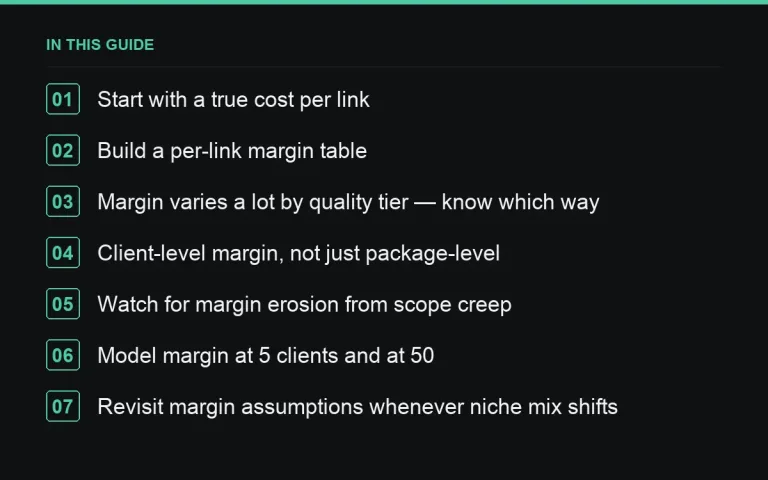
Start with a true cost per link
The cost of a single placement isn’t just the fee paid to a publisher (if any) or the marketplace price. It includes content creation or briefing time, outreach or sourcing time, account management time spent on that specific placement, and QA time. Estimate each component even roughly; most agencies underestimate the labor cost by a wide margin because it’s spread thin across many placements and never itemized.
Build a per-link margin table
| Cost component | Typical driver |
|---|---|
| Site/publisher cost | Marketplace price or outreach fee |
| Content | Writer rate x hours, or a flat content fee |
| Sourcing/outreach labor | Time to find and qualify a site |
| Account management | Time spent per placement on client communication |
| QA | Time to check placement before reporting it live |
Once you have a rough total cost per link, compare it to what you charge per link in each package tier from your pricing model. Some packages will look healthy on paper and thin once labor is properly counted.
Margin varies a lot by quality tier — know which way
Higher-tier placements (higher traffic, tighter niche relevance) often cost proportionally more to source but can carry better margin if priced right, because sourcing effort doesn’t scale linearly with site quality — a great site isn’t always ten times harder to find than an average one. Track this rather than assuming premium tiers are automatically your best or worst margin band; it differs by niche and by how saturated your existing site relationships are.
Client-level margin, not just package-level
Some clients cost far more to service than their package price reflects — frequent scope changes, slow approvals that create rework, heavy reporting customization, or a demanding communication cadence. Track actual hours spent per client against revenue quarterly. A client that looks profitable at the package level can be a net drag once real service time is counted.
Watch for margin erosion from scope creep
Small “just this once” favors — an extra report format, a rush placement, an off-package site request — add up. Each one is defensible in isolation but collectively erode margin if they’re not tracked or occasionally pushed back on. Revisit our guide on saying no for how to handle this without damaging the relationship.
Model margin at 5 clients and at 50
Margin drivers change with scale. At five clients, account management time per client is the dominant cost; at fifty, sourcing and QA throughput become the constraint, and small per-link savings compound significantly. See our note on scaling an agency for how margin assumptions need to shift as headcount and volume grow.
Revisit margin assumptions whenever niche mix shifts
An agency that starts mostly serving one industry and gradually adds clients in a more competitive or harder-to-source niche often sees average cost per link creep up without anyone noticing, since the shift happens gradually across many small decisions rather than one obvious event. Periodically break down margin by niche, not just by client or package, to catch this kind of drift early.
Don’t ignore the margin cost of approval delays
A client on a full pre-approval workflow who takes weeks to respond doesn’t just delay delivery — they tie up account management hours in chasing and rescheduling that a faster-approving client wouldn’t require. If you’re modelling margin honestly, this kind of friction cost belongs in the client-level calculation, not just the package-level one, since it’s a real driver of why two clients on the same package can have very different actual profitability.
Use margin data to decide what to cut, not just what to charge more for
A low-margin package or client isn’t automatically a pricing problem — sometimes the fix is reducing scope, tightening the approval workflow, or moving the account to a more automated reporting format rather than raising the price and risking the relationship. Look at the specific cost driver behind a thin margin before deciding whether the right response is a price increase, a scope change, or, per our guide on saying no, letting the account go entirely.
Practical steps to build your first margin model
- Track hours per placement for one month, honestly, including admin time
- Compare true cost per link against your package price per link
- Flag any client where service time looks disproportionate to package tier
- Revisit pricing or scope for anything running below your target margin
Where to go next
Margin modelling works best alongside disciplined pricing and a sourcing pipeline built on a marketplace that reduces manual outreach time, since sourcing labor is usually the single biggest hidden cost in a per-link margin model.
Frequently asked questions
How often should a margin model be updated?
Quarterly is usually enough for most agencies, though it's worth an ad hoc check any time you launch a new package tier or take on a client with unusual scope.
Is it normal for margin to vary a lot between clients?
Yes, and that's exactly why client-level tracking matters — average agency margin can look fine while individual accounts are quietly unprofitable.
Should account management time be included in per-link cost?
Yes. It's one of the most commonly under-counted costs, especially for high-touch clients with frequent calls or reporting customization.
What's a reasonable target margin for a link building package?
This varies widely by market and package tier, so there's no universal number — the useful discipline is comparing your own true cost per link to your own price, consistently, rather than benchmarking against unverifiable industry figures.
Put it into practice
Filter 54,483 websites by DR, traffic, niche and price, and order with escrow — you pay only after the link is live.
Browse the marketplace