Designing Client Approval Workflows for Link Placements
Three approval models for link placements, and how to pick the right one without slowing delivery to a crawl.
How much say a client gets over individual site choices is a decision that should be made once, explicitly, rather than negotiated ad hoc for every placement. Too little approval and clients feel out of control; too much and delivery slows to a crawl while every site sits in an inbox waiting for sign-off. Three broad models cover most situations.
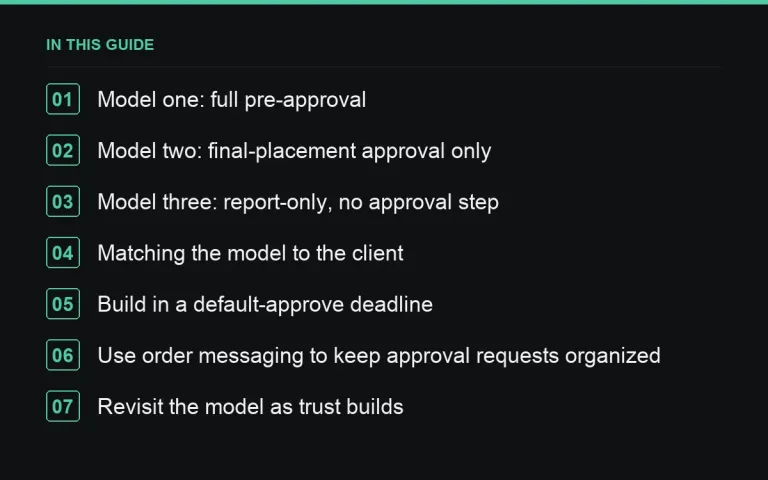
Model one: full pre-approval
Every prospective site is sent to the client before outreach begins, and nothing proceeds without a yes. This suits clients in regulated industries, those burned by a bad agency before, or brand-sensitive accounts where a wrong-fit placement is a real reputational risk. The cost is speed: batching approvals and waiting for responses adds real time to every placement, and needs to be priced and timelined accordingly.
Model two: final-placement approval only
Outreach and content happen without prior sign-off, but the client reviews and approves the finished draft or live URL before it’s considered complete. This is faster than full pre-approval and still gives the client a meaningful check, but requires trust that your site selection is already sound — which is easier to earn once a client has seen a few months of consistent quality.
Model three: report-only, no approval step
The agency has full autonomy within agreed quality thresholds, and the client sees results only in the monthly report. This is fastest and suits experienced clients or those who’ve delegated SEO decisions entirely, but it only works if the quality bar was defined precisely at scoping stage and has been consistently honoured — a client who feels blindsided by a placement under this model will usually revert to wanting pre-approval.
Matching the model to the client
| Client profile | Suggested model |
|---|---|
| Regulated industry, brand-sensitive | Full pre-approval |
| New client, building trust | Final-placement approval |
| Established client, high trust, wants speed | Report-only |
| Multiple internal stakeholders, slow to respond | Final-placement approval with a default-approve deadline |
Build in a default-approve deadline
Whichever model you use, set a rule that unanswered approval requests after a defined number of business days default to approved (unless the client opts out of this explicitly). Without this, a single slow approver can stall an entire month’s delivery, and the delay quietly becomes the agency’s problem to explain even though it wasn’t the agency’s fault.
Use order messaging to keep approval requests organized
Scattered email threads make it hard to track what’s pending, what’s approved, and what’s been silently ignored for three weeks. Centralizing requests — through a shared document, a project tool, or a marketplace’s order messaging where each placement has its own thread — keeps the audit trail clean and makes handoffs between account managers painless.
Revisit the model as trust builds
It’s reasonable to start a new client on full pre-approval and propose moving to final-placement approval after a quarter of consistent delivery. Frame this as a benefit to them (faster delivery, less inbox burden) rather than a reduction in oversight, and put the change in writing so expectations don’t drift back silently.
Handle disagreements at the approval stage without escalating unnecessarily
Occasionally a client will decline a site the team believes is a good fit. Rather than treating this as a dispute to win, ask for the specific reservation — sometimes it’s a legitimate concern the team missed (a past bad experience with that publisher, a subtle brand mismatch), and sometimes it’s a misunderstanding that a short explanation resolves. Reserve genuine pushback, backed by data from your qualification process, for cases where the client’s objection would meaningfully weaken the strategy, and pick your battles rather than contesting every declined site.
Communicate the model clearly at the very first kickoff call
Don’t leave the approval model to be discovered organically through the first few placements. State it explicitly at kickoff, including what happens if a request goes unanswered, and put a one-paragraph summary in the same document as your delivery cadence and reporting cadence, so all three timing expectations are set together rather than piecemeal.
Approval workflow and pricing are connected
Full pre-approval takes real account management time — chasing responses, batching requests, following up on silence — and that cost should be reflected somewhere in your pricing model, either as a built-in cost of a premium package tier or as a named add-on for clients who want heavier oversight than the standard package includes. Treating it as free overhead is a common way for margin to quietly erode on high-touch accounts.
What goes wrong without a defined workflow
- Sites sit in limbo for weeks with no clear owner of the decision
- Account managers make inconsistent calls about what needs approval
- Clients feel blindsided by placements they didn’t know were coming
- Delivery timelines slip and get blamed on “slow outreach” instead of the real cause
Where to go next
Approval workflow should be fixed during onboarding and referenced in your contract. Sourcing candidate sites from a marketplace with transparent metrics also makes any approval step faster, since the client can see the same data you’re using to make the case.
Frequently asked questions
Which approval model is most common among agencies?
Final-placement approval is the most typical middle ground — fast enough to deliver at pace, while still giving the client a meaningful check before anything goes live.
What happens if a client never responds to approval requests?
A default-approve deadline, agreed in writing up front, prevents this from stalling delivery indefinitely. Without one, unresponsive clients quietly become the agency's biggest bottleneck.
Can different pages or link types use different approval rules?
Yes — some agencies use full pre-approval only for a client's most sensitive pages (homepage, product pages) and report-only for lower-stakes blog content links.
Should approval workflow be in the contract or just a verbal agreement?
In the contract, or at minimum in a written scope document. Verbal-only agreements on approval process are a common source of disputes months into an engagement.
Put it into practice
Filter 54,483 websites by DR, traffic, niche and price, and order with escrow — you pay only after the link is live.
Browse the marketplace