Managing Writers and Editors for a Link Building Program
How to keep a freelance writer pool producing consistent, publishable content across many clients without constant rework.
Link building at any real volume depends on a steady supply of decent guest post content, and the quality of that content depends almost entirely on how well writers are briefed and managed. Agencies that treat writer management as an afterthought end up with high revision rates, missed deadlines and content that publishers reject — all of which slow delivery and burn account management time.
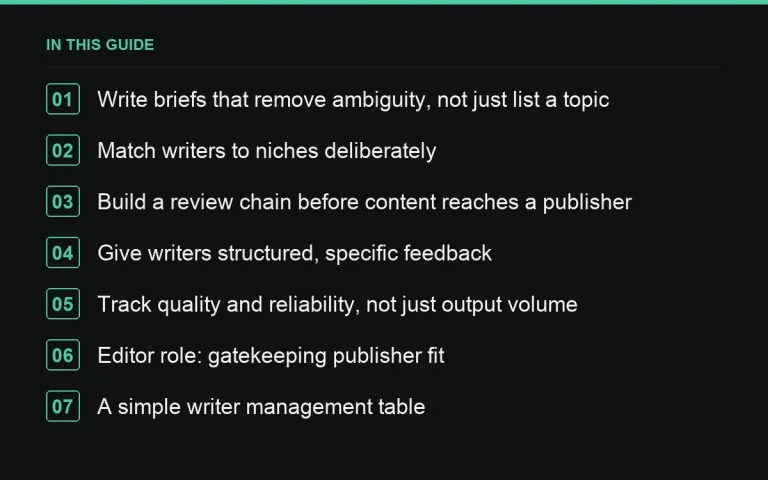
Write briefs that remove ambiguity, not just list a topic
A brief that says “write about SEO tips for the target site” leaves too much room for a writer to guess wrong. Include the target site’s tone and typical article length, the client’s target page and preferred anchor, any brand or disclosure language required, and specific points that must be covered. The more decisions made in the brief, the fewer rounds of revision later.
Match writers to niches deliberately
A writer who’s strong on general marketing content may produce weak, generic copy for a specialized niche like finance or medical content. Keep a simple internal record of which writers handle which niches well, and route briefs accordingly rather than assigning purely by availability.
Build a review chain before content reaches a publisher
At minimum: a first read for factual accuracy and brief adherence, then a second read for tone and publisher fit. Sending a first draft straight to a publisher without an internal review invites rejections and rework that costs more time than the review step would have.
Give writers structured, specific feedback
Vague feedback (“make it better”) produces vague revisions. Point to specific sentences or sections and explain what’s wrong and what’s wanted instead. Writers who get specific feedback consistently improve faster and need less oversight over time, which is the whole point of investing in management process.
Track quality and reliability, not just output volume
A writer who delivers on time but needs three rounds of revision every time isn’t actually faster than one who’s slightly slower but nearly always right first time. Track revision rounds and on-time delivery per writer, and use this to decide who gets the higher-stakes or higher-volume clients.
Editor role: gatekeeping publisher fit
An editor (in-house or senior freelance) should check content against each specific publisher’s style before submission, not just against general quality standards. Publishers reject content for house-style mismatches as often as for quality issues, and this check catches that before it costs a delay.
A simple writer management table
| Metric | Why it matters |
|---|---|
| On-time delivery rate | Predicts whether deadlines are realistic to plan around |
| Average revision rounds | Signals brief clarity and writer skill |
| Publisher rejection rate | Flags style-fit or quality issues before they recur |
| Niche strength | Guides which briefs go to which writer |
Pay promptly and fairly to retain good writers
Reliable writers are a genuine competitive advantage in link building, and they’re mobile — slow or disputed payment is one of the fastest ways to lose a good one to another agency. Treat writer retention with the same seriousness as client retention.
Give writers context on the client’s broader goals, not just the brief
A writer who understands why a client cares about a specific target page — what business outcome it supports — tends to write more purposeful, better-angled content than one working purely from a topic and word count. Share a short summary of the client’s situation alongside each brief where relevant, rather than assuming the brief alone conveys enough context for genuinely good work.
Set clear expectations around ownership and usage rights
Confirm with freelance writers, in writing, that content produced for a client engagement belongs to the client or agency once paid for, and that it won’t be resold or reused elsewhere. This is a basic but sometimes overlooked contract detail that avoids an awkward dispute if a piece of content later turns up duplicated on another site.
Align content quality with the sites you’re actually pursuing
A writer’s output needs to match the editorial bar of the specific publisher a placement is aimed at, which varies a lot across the inventory available on a marketplace — a site with a higher DR and stricter editorial process expects noticeably more polished content than a smaller niche blog. Share the target site’s own published articles with the writer as a style reference whenever possible, rather than relying on a generic brief alone, so the first draft is more likely to match what that specific publisher will accept.
Build a small internal style guide per major client
Beyond a single brief, a lightweight, reusable style guide per client — preferred terminology, things never to say, a rough tone description — saves briefing time on every subsequent piece and keeps output consistent even as different writers rotate through a client’s account. This pairs naturally with the escalation and review structure covered in our SOPs guide, and reduces the QA burden covered in our QA checklist, since fewer drafts arrive with basic tone or terminology mismatches.
Where to go next
Good writer management directly improves your QA pass rate and reduces delays covered in timeline planning. For agencies without in-house writers, writing services or AI-assisted content support through the services marketplace can supplement a freelance pool during busy periods.
Frequently asked questions
Should agencies use AI-assisted writing for guest posts?
It can speed up first drafts, but content still needs human review for accuracy, tone and publisher fit before submission — treat it as a drafting aid, not a replacement for editorial oversight.
How many revision rounds is normal?
One round is common and healthy; a writer who consistently needs three or more likely needs a clearer brief, different niche assignment, or isn't the right fit for that client.
Should writers see the client's brand directly, or work only through the agency?
Usually through the agency, with a clear brand guide provided, to keep a single point of communication and avoid inconsistent direction reaching the writer from multiple sources.
Is it worth building a bench of writers per niche?
Yes, especially once an agency serves clients across several distinct industries — niche-matched writers consistently produce content publishers accept faster.
Put it into practice
Filter 54,483 websites by DR, traffic, niche and price, and order with escrow — you pay only after the link is live.
Browse the marketplace