Setting Realistic Timeline Expectations for Link Building
Why link building timelines are ranges, not dates, and how to explain that to clients without sounding evasive.

Timeline disputes are one of the most predictable sources of client frustration in link building, mostly because agencies describe delivery in terms the client interprets as guarantees. “We’ll get you links this month” sounds like a promise of a specific date; in reality, placement timing depends on publisher response rates that no agency fully controls. Setting expectations properly at the start avoids most of this friction.
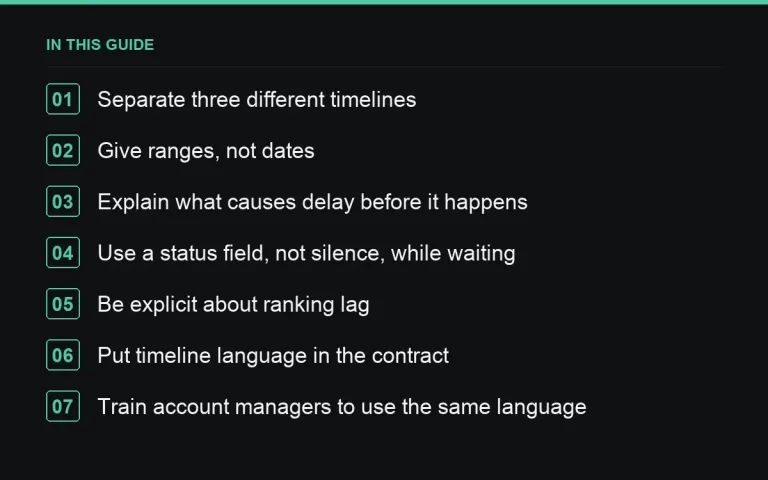
Separate three different timelines
Clients often conflate three distinct clocks, and it helps to name them separately in your communication:
- Outreach-to-placement time — how long from first contact to a live, published link.
- Delivery cadence — how many links land per month, on average, not on a fixed schedule.
- Ranking impact time — how long after links go live before search visibility moves, which is slower and less predictable than either of the above.
Explaining these as separate timelines, rather than one bundled promise, makes the eventual reality much easier for a client to accept.
Give ranges, not dates
Instead of “your link will be live in two weeks,” say “typical placements land within two to five weeks depending on the publisher’s editorial queue.” Ranges are more honest and, counterintuitively, build more trust than a specific date that then slips. Publisher response time varies a lot by niche and site size, and a client who understands that variance is less likely to escalate over a normal delay.
Explain what causes delay before it happens
Set expectations proactively for the common causes of slower turnaround: a publisher’s editorial backlog, content revision cycles, seasonal slowdowns (holidays, industry conferences), and the fact that some publishers batch guest content monthly rather than weekly. A client who’s heard this in month one won’t read a slow month three as a sign something’s wrong.
Use a status field, not silence, while waiting
Nothing damages trust in a timeline faster than a client hearing nothing for three weeks. Report interim status — “outreach sent to 12 sites, 4 replied, content in progress for 2” — even before anything is live. If you use a marketplace workflow with order messaging, forward relevant publisher updates so the client sees the work happening in the background, not just the end result.
Be explicit about ranking lag
Even a perfectly placed link doesn’t move rankings overnight. Set expectations that visible ranking movement, if it happens at all from a given batch of links, typically shows up over a longer window than the placement itself, and that it sits alongside other ranking factors you don’t control (content quality, technical SEO, algorithm updates). This is worth restating in your monthly reporting rather than assuming it was absorbed once at kickoff.
Put timeline language in the contract
Your link building contract should state delivery cadence as an average over the engagement period, not a per-week guarantee, and should describe ranking outcomes as directional, not promised. This protects both sides and gives you language to point back to when a client pushes for a hard date.
Train account managers to use the same language
Timeline expectations set well by one account manager can be undone in a single careless reply from another — “should be live by Friday” from someone trying to be reassuring creates exactly the promise you spent the kickoff call avoiding. Build the range-based phrasing into your SOPs so every client-facing person uses consistent language, and review actual client emails periodically to catch drift back into overpromising under pressure to keep a client happy in the moment.
Distinguish delays you caused from delays outside your control
If your own team is the bottleneck — a slow content review, a late brief — say so plainly rather than blending it into “publisher response time” as a catch-all excuse. Clients generally forgive an honest admission of an internal delay far more readily than they forgive a vague explanation that turns out, on inspection, to have been within the agency’s control all along.
Use past delivery data to make ranges more credible
A generic range (“two to five weeks”) is useful, but a range grounded in your own historical data for a similar niche or publisher type is more convincing and more accurate. If you’ve been tracking placement timing across clients, share an approximate, honest range based on recent experience rather than a boilerplate estimate — this also gives you an early warning system, since a niche that’s consistently running slower than usual is worth flagging to affected clients before they ask.
What to say when a client asks “why is this taking so long”
| Client says | Useful response |
|---|---|
| “It’s been three weeks and nothing is live” | Share current outreach status and expected response window for the specific publishers contacted |
| “Can you guarantee links by end of month?” | Explain the placement range and offer a status update instead of a hard promise |
| “Rankings haven’t moved” | Separate placement timeline from ranking timeline and review other ranking factors |
Where to go next
Timeline expectations work best alongside a solid scoping process and clear reporting. If turnaround speed matters to a client, sourcing through a marketplace with visible publisher turnaround data can also set more grounded expectations than cold outreach alone.
Frequently asked questions
Should we ever promise a hard delivery date?
No. Promise a cadence and a range instead. A hard date you can't fully control is the single most common source of client escalation in link building.
How do we handle a client who insists on a guarantee?
Explain the mechanics — publisher response time isn't something any agency controls — and offer a written range instead. If they insist on a guarantee you can't honestly give, it's worth reconsidering the engagement.
What if a publisher goes silent after agreeing to a placement?
Follow up once or twice, then substitute another site of equal quality and tell the client what happened rather than letting the slot silently disappear from the report.
How often should timeline expectations be restated?
At kickoff, in the first monthly report, and any time a client raises concern about pace. It rarely needs restating more than that once trust is established.
Put it into practice
Filter 54,483 websites by DR, traffic, niche and price, and order with escrow — you pay only after the link is live.
Browse the marketplace