Managing Client Link Building Budgets with an Escrow Wallet
How an escrow-style wallet simplifies managing multiple client budgets, with funds released only when placements are approved.

Agencies running link building for several clients at once face a recurring headache: money moves in and out for outreach fees, content and publisher payments, but clients want assurance that funds are only spent on delivered, approved work. An escrow-style wallet — where funds are held and only released when a placement is confirmed live — solves a real trust problem, and also simplifies the agency’s own bookkeeping across multiple accounts.
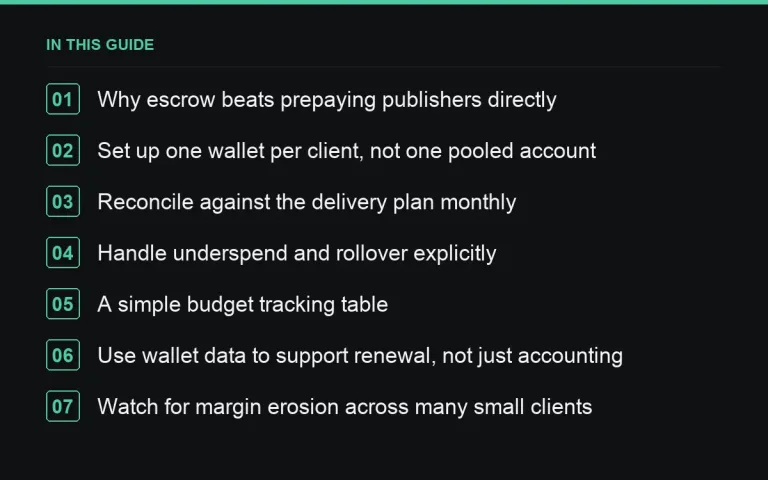
Why escrow beats prepaying publishers directly
Paying a publisher upfront and hoping the content goes live, on time, at the agreed quality, puts all the risk on the buyer. With an escrow model, funds are released only once the buyer confirms the live URL, which protects the agency from publishers who take payment and delay or never deliver, and gives the client (or the agency, on the client’s behalf) a much stronger negotiating position throughout.
Set up one wallet per client, not one pooled account
Mixing budgets across clients in a single account makes it hard to answer a simple client question — “how much of my budget is left this quarter?” — without manual reconciliation. Structuring funds per client, even inside the same marketplace account, keeps reporting clean and avoids ever accidentally spending one client’s budget on another client’s placement.
Reconcile against the delivery plan monthly
At the same time you send the monthly report, reconcile wallet spend against the plan: budget allocated, spend committed to in-progress placements, spend confirmed on live links, and remaining balance. This turns budget management into a routine five-minute task rather than a scramble when a client asks about it unexpectedly.
Handle underspend and rollover explicitly
Some months, outreach moves slower than planned and budget goes unspent. Decide up front — and put it in the contract — whether unspent monthly budget rolls forward, is refunded, or is simply reallocated to a bigger next-month push. Clients dislike surprises here more than almost anywhere else in the relationship.
A simple budget tracking table
| Category | This month | Notes |
|---|---|---|
| Allocated budget | $X | Per contract |
| Committed (in progress) | $X | Outreach accepted, awaiting publish |
| Released (live, approved) | $X | Confirmed placements |
| Remaining balance | $X | Carries or refunds per contract terms |
Use wallet data to support renewal, not just accounting
A clean spend history is itself a trust signal at renewal time — it shows the client exactly where their money went and what it bought, which supports the broader case made in your value reporting. Clients who’ve seen transparent budget handling for a year are far less likely to shop around at renewal purely on price.
Watch for margin erosion across many small clients
When you’re running budgets for a large roster of clients, it’s easy to lose track of your actual margin per account if wallet management eats staff time disproportionate to the account’s size. Revisit your margin model periodically to make sure smaller accounts aren’t quietly becoming loss leaders once admin time is factored in.
Plan for the end of an engagement, not just the middle
When a client relationship ends, decide in advance how any remaining wallet balance is handled — refunded, applied to a final batch of placements, or held briefly in case of a late dispute. Address this in the original contract rather than negotiating it under the pressure of an actual offboarding, when both sides are more likely to disagree about what’s fair.
Handle currency and multi-market clients carefully
Agencies running campaigns across multiple countries or currencies for one client need extra care in wallet tracking, since exchange rate movement and multi-currency publisher payments can otherwise make budget reconciliation confusing. Keep a single reporting currency for client-facing summaries even if underlying payments happen in several currencies, so the client always sees one consistent number.
Use wallet transparency as part of onboarding, not an afterthought
Explain the escrow model to new clients during onboarding, in plain terms — funds are held, not spent, until a placement is confirmed live and approved. Clients who’ve had a bad experience with a previous agency or freelancer that took payment upfront with no such protection tend to respond very well to this explanation, and it can be a genuine differentiator worth mentioning early in a sales conversation, not just buried in a contract clause.
Keep a simple audit trail for every release
Every time funds are released from a client’s wallet, note which placement it corresponds to and the date it was confirmed live. This sounds like basic bookkeeping, but it’s what lets you answer, in seconds rather than after a scramble, a client’s question about a specific charge months after the fact — and it’s the same data that feeds your monthly reporting without needing a separate reconciliation exercise each time.
Where to go next
Escrow-based budget management pairs naturally with sourcing through a marketplace, where release-on-approval is built into the order flow rather than something you have to construct manually with each individual publisher.
Frequently asked questions
Does escrow slow down publisher payments?
It adds a short delay compared with prepayment, since release is tied to confirmation of the live URL, but this is usually a small trade for the risk reduction it provides.
Should each client see their own wallet balance directly?
It's good practice to share a summary in reporting even if they don't have live access, since it reinforces transparency without needing to give clients direct platform logins.
What happens if a publisher never delivers after being paid into escrow?
Escrow specifically protects against this — funds aren't released until the buyer confirms the placement, so an underdelivering publisher simply doesn't get paid.
Is per-client wallet tracking worth it for a two-person agency?
Yes, arguably more so, since a small team has less capacity to absorb the confusion of reconciling mixed budgets manually across clients.
Put it into practice
Filter 54,483 websites by DR, traffic, niche and price, and order with escrow — you pay only after the link is live.
Browse the marketplace