Why Link Building Clients Churn, and How to Prevent It
The recurring reasons link building clients leave, and the fixes that catch most of them before renewal.
Client churn in link building rarely comes from one dramatic failure. It’s usually a slow accumulation of small disappointments — vague reporting, a missed expectation never addressed, a sense that nothing changed month over month. Understanding the common patterns makes it possible to intervene before a renewal conversation turns into a loss.
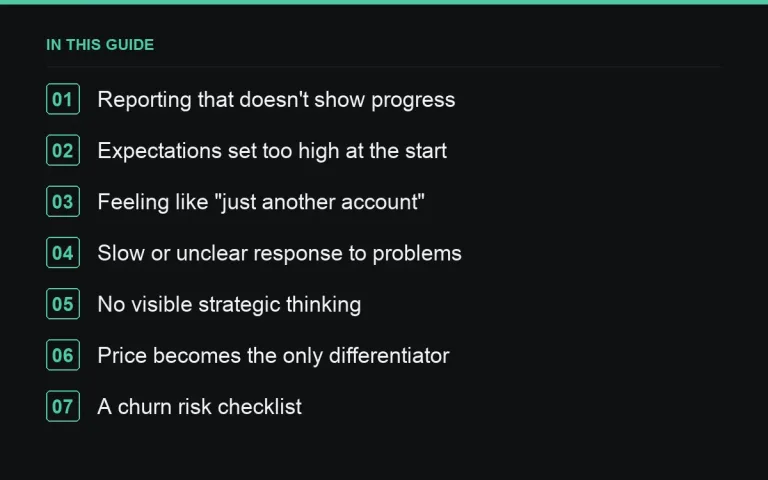
Reporting that doesn’t show progress
Clients who can’t tell, from the reporting they receive, whether things are getting better start to disengage quietly long before they formally cancel. See our value reporting guide and reporting templates for formats that make progress visible rather than assumed.
Expectations set too high at the start
An overpromised sales pitch creates a client who’s disappointed by perfectly reasonable results, simply because they were told to expect more. Revisit how your sales process describes outcomes — see our timeline expectations guide — and make sure account managers aren’t quietly re-promising things sales already overstated.
Feeling like “just another account”
Generic monthly updates with no reference to the client’s specific goals or competitors read as impersonal, even when the underlying work is solid. Referencing discovery notes and named competitors in every report, as covered in our discovery questions guide, keeps the relationship feeling attentive rather than templated.
Slow or unclear response to problems
When something goes wrong — a link gets removed, a placement is delayed, a site turns out lower quality than expected — the speed and honesty of the response matters more than the problem itself. A client who hears about an issue proactively, with a plan attached, is far less likely to churn than one who discovers it themselves or gets a defensive response.
No visible strategic thinking
If every monthly report reads the same regardless of what’s happening in the client’s market, the client starts to wonder what they’re actually paying for beyond execution. Periodically include a short strategic note — a shift in competitor activity, a new content opportunity, a change in approach — even in an otherwise standard month.
Price becomes the only differentiator
When a client has stopped noticing anything distinctive about the service, price is the only lever left, and a cheaper competitor will eventually win that comparison. See our positioning guide for how to keep the conversation on outcomes and quality rather than only cost.
A churn risk checklist
- Has the client asked a clarifying question about reporting in the last quarter? (A lack of engagement can itself be a warning sign.)
- Has anything gone wrong recently, and was it flagged proactively?
- Does the last three months of reporting look interchangeable?
- Has the client mentioned budget or price recently unprompted?
- Is the main point of contact on the client side still engaged, or have they gone quiet?
Run a churn-risk review before renewal, not during it
The best time to address these signals is a month or two before a renewal decision, not during the renewal call itself. Build a short quarterly review into your process — even fifteen minutes per account — to check the list above and act on anything that’s slipping.
Ask directly, occasionally, rather than only inferring
A short, low-pressure check-in question — “how do you feel this quarter went, honestly” — sometimes surfaces a concern that would otherwise stay unspoken until a renewal decision. Not every client will answer candidly, but the ones who do give you a much earlier warning than any indirect signal, and the question itself signals that feedback is welcome.
Watch the handoff moments closely
Churn risk spikes around staffing transitions — a new account manager taking over, or a client-side stakeholder change. Treat every handoff as a mini re-onboarding: a short call to confirm goals haven’t shifted, a recap of what’s been delivered so far, and a chance for the new person on either side to ask questions before assumptions calcify into misunderstanding.
A slow-motion churn signal worth watching: shrinking scope requests
A client who asks to pause a report field, reduce link volume “for now,” or delay a quarterly review is often signalling reduced confidence before they say so directly. Treat a scope reduction request as a prompt to schedule a candid check-in, rather than simply accommodating it and moving on, since it’s a far cheaper moment to address concerns than after a formal cancellation notice arrives.
Separate churn caused by service quality from churn caused by internal client changes
Not every loss reflects on the agency — a client’s internal reorganization, a budget cut mandated from above, or a change in marketing leadership with different priorities can end an engagement regardless of how well it was run. Distinguishing these honestly in a churn review, rather than assuming every loss points to a service failure, keeps the review useful rather than becoming an exercise in unwarranted self-blame that doesn’t actually improve anything.
Where to go next
Reducing churn starts with the fundamentals covered in onboarding and scoping, and is reinforced by consistent quality sourcing from a marketplace so results don’t quietly degrade as an account matures.
Frequently asked questions
Is churn always preventable?
No — some clients leave for reasons unrelated to the agency, like budget cuts or an internal reorganization. The goal is to eliminate the preventable causes, not assume every loss can be avoided.
How early should churn risk be assessed?
A quarterly review is a reasonable cadence for most accounts; higher-value clients can be reviewed monthly.
Does discounting help retain an at-risk client?
Rarely on its own. If the underlying issue is unclear value or poor communication, a discount treats the symptom, not the cause, and often just delays the same conversation.
Should account managers be measured on churn?
It can be a useful signal, but pair it with leading indicators (reporting quality, response time to issues) rather than judging solely on the lagging churn number.
Put it into practice
Filter 54,483 websites by DR, traffic, niche and price, and order with escrow — you pay only after the link is live.
Browse the marketplace