Discovery Questions to Ask New Link Building Clients
The questions to ask in a first call so your proposal is grounded in the client's real situation, not assumptions.
A discovery call is not a sales pitch — it’s the point where you gather the facts that determine whether link building is even the right lever, and what shape it should take. Skipping it, or treating it as a formality before sending a generic proposal, is one of the most common reasons agency engagements underperform in the first quarter.
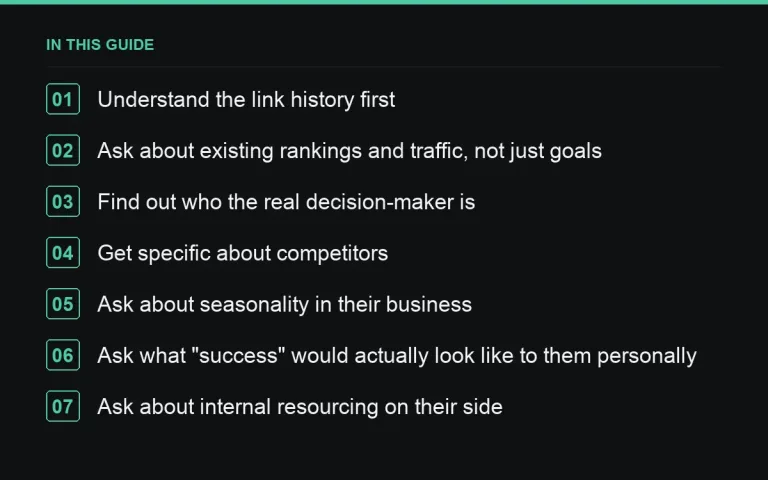
Understand the link history first
Before proposing anything new, find out what’s already been done. Ask whether the site has run any link building before, in-house or through another agency, and whether that included any tactics that would now be considered risky — link networks, heavily exact-match anchors, or bulk low-quality placements. This shapes both your strategy and your risk assessment; see our penalty handling guide for what to do if the history turns out to include a manual action or algorithmic hit.
Ask about existing rankings and traffic, not just goals
Get access to (or ask for a summary of) current rankings for priority keywords and organic traffic trends over the last year. A client asking for “more links” when their real problem is a technical crawl issue or thin content needs a different conversation before link building even starts.
Find out who the real decision-maker is
In agencies working with in-house marketing teams, the person on the call is often not the final approver. Ask directly who signs off on reported results and who has authority to approve individual sites, since this affects your approval workflow design and how you handle reporting.
Get specific about competitors
Ask for three to five competitors the client actually cares about beating, not a generic industry list. This tells you which niches and site types to prioritize, and gives you a natural comparison point for reporting later — use the compare tool to size up competitor-relevant sites directly once you have names to work from, rather than guessing at a generic industry benchmark.
Ask about seasonality in their business
Retailers, travel brands and B2B companies tied to a fiscal year each have periods where visibility matters far more than others. Ask when the client’s busiest or highest-stakes period is, so placement timing and reporting emphasis can be planned around it rather than treated as a flat, even cadence all year — a placement that lands two months before peak season is worth more than the same placement landing two months after.
Ask what “success” would actually look like to them personally
Beyond the business metric, ask the person on the call what result would make them personally look good to their own manager or client. This is a slightly different question from “what’s the goal,” and it often surfaces the real pressure behind the engagement — a specific keyword the CEO checks weekly, a competitor comparison that comes up in board meetings, a past agency failure they don’t want repeated. Understanding this shapes not just strategy but also how you frame your monthly reporting, since the report should speak directly to the pressure the client is actually under, not just to a generic KPI.
Ask about internal resourcing on their side
Link building often depends on the client’s own team for things like content approval, access to analytics, or sign-off on target pages. Ask who on their side is responsible for turning around these requests, and how quickly, since a slow internal approver on the client’s team is a common, under-discussed cause of delivery delays that gets blamed on the agency later. Setting this expectation during discovery, rather than during a frustrated month-two conversation, is worth the extra five minutes on the call.
Clarify brand and legal constraints
Ask about anchor text rules, disclosure requirements, regulated-industry restrictions (finance, health, gambling), and any domains that must never be used (direct competitors, sites the client has had disputes with). This avoids an awkward retraction after a link is already live.
Establish budget range early, tactfully
You don’t need an exact number in the first call, but you do need a range, because it determines whether you’re proposing a handful of premium placements or a broader mix. Asking “what outcome would make this worth the spend” often gets further than asking for a number directly.
Discovery question set
- What link building has been done before, and by whom?
- Which pages and keywords matter most right now?
- Who approves sites, budget and final reporting?
- Which competitors do you track most closely?
- Are there anchor text, disclosure or industry restrictions we need to follow?
- What’s the rough monthly budget range you’re working with?
- What would “this worked” look like in six months?
Write it down and reference it later
Keep discovery notes in the client file and reference them explicitly in your first proposal — “based on what you told us about X” builds more trust than a generic template. This documentation also becomes useful during renewal conversations and when explaining scope decisions months later, which is covered further in our scoping checklist.
Where to go next
Good discovery feeds directly into scoping and onboarding. Once you know the constraints, use the marketplace‘s niche and language filters to shortlist sites that actually match what the client told you, rather than a generic starting list.
Frequently asked questions
Should discovery happen before or after a proposal is priced?
Before. A proposal priced before discovery is really just a guess, and clients notice when the strategy doesn't reflect anything specific about their site.
What if the client won't share analytics access?
Ask for a summary instead — top pages, top keywords, and rough traffic trend. Some clients are cautious about access in a first call; you can request full access once the contract is signed.
How do we handle a client who doesn't know their competitors?
Suggest three based on your own quick research and ask them to confirm or correct it. It's a faster way to get a useful answer than an open-ended question.
Is a written discovery brief necessary for small engagements?
Yes, even a short one. A five-line summary of what was discussed prevents disagreements later about what was actually agreed in the first call.
Put it into practice
Filter 54,483 websites by DR, traffic, niche and price, and order with escrow — you pay only after the link is live.
Browse the marketplace