Link Building for Sports and Fitness Websites
Sports and fitness audiences are passionate and well served by specialist blogs. Here's how to earn a place in them.
Sports and fitness span everything from marathon training to local football clubs to home gym equipment. What they share is passionate audiences and a large number of specialist publications. Links follow useful, credible content and genuine involvement in the sport, more reliably than in most other niches.
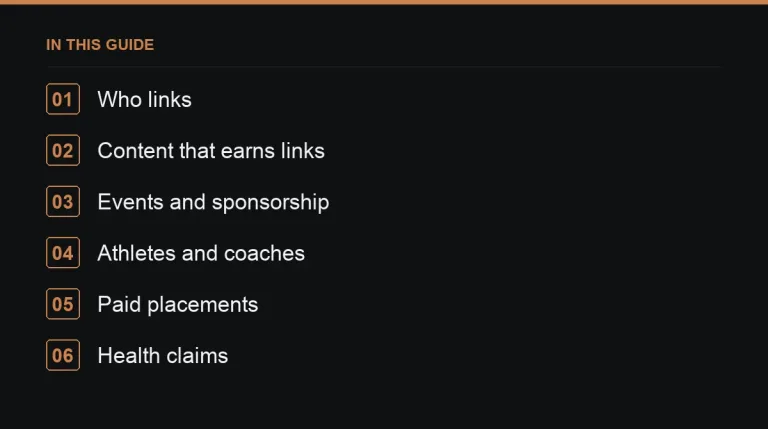
Who links
- Sport-specific blogs and magazines — running, cycling, climbing, martial arts and dozens of others, each with its own dedicated readership.
- Clubs, leagues and event organisers who list sponsors and partners.
- Coaches and trainers who run their own sites and reference tools they use.
- Health and nutrition publications that overlap with fitness content.
Content that earns links
- Training plans — free, structured plans for specific goals, such as a first 10K or a strength programme for complete beginners.
- Calculators — pace, heart-rate zone, calorie or one-rep-max calculators that people bookmark and return to.
- Gear testing — first-hand comparisons backed by real data from actual testing, not rewritten spec sheets.
- Research explainers — accurate summaries of new sports science findings, with sources clearly cited.
Events and sponsorship
Sponsoring local races, clubs and tournaments often comes with links from event and club websites, plus coverage in local press. Choose events your actual customers take part in rather than the biggest event you can afford, since relevance tends to matter more than reach here.
Athletes and coaches
Partnerships with athletes and coaches can earn coverage and links from their own sites and the publications that cover them regularly. Disclose paid partnerships clearly — sports audiences are attentive to this and quick to notice when it’s missing.
Paid placements
The sports niche includes a wide range of sites at very different levels of quality. Match the specific sport where you can: a link from a running blog is far more relevant to running shoes than a link from a general sports news site (why topical relevance matters more than raw metrics). Adjacent niches like health also work well for fitness brands whose content touches on wellbeing more broadly.
Matching content to audience
| Business type | Strongest content angle |
|---|---|
| Gym or studio | Local sponsorships, community events, expert quotes for local press |
| Equipment retailer | Gear testing, buying guides, comparison content |
| Coach or trainer | Free training plans, calculators, research explainers |
| Sports nutrition brand | Evidence-based explainers, athlete partnerships with disclosure |
Health claims
Fitness content often touches on health, so treat claims about results or medical benefits with real caution. Avoid unsupported statements and have content reviewed by qualified professionals wherever it gives health advice (health niche link building standards), since the same scrutiny that applies to health content applies here whenever the two overlap.
Measuring beyond link count
A sports or fitness campaign’s value shows up in referral traffic and brand searches as much as in the raw number of links earned, particularly for content distributed through communities and forums where individual links may carry limited direct weight. Track traffic and branded search volume alongside links when judging whether a campaign worked (measuring link building ROI).
Seasonality in sports content
Interest in a given sport or activity spikes predictably — running content around New Year’s resolutions and spring marathon season, winter sports content ahead of the season starting, tournament-related content around major competitions. Publishing and pitching a few weeks ahead of these predictable spikes gets far more attention than the same content released off-season.
Working within a specific sport’s community
Most sports have their own tight-knit online community — clubs, regional leagues, dedicated forums — that a general marketing approach easily misses. Spending time genuinely participating in that community, rather than only reaching out when you want something, tends to produce better links and better relationships over a longer period than a purely transactional outreach campaign ever will.
Choosing between local and national coverage
A single-location gym or studio gets far more value from local press and community sponsorship than from a national fitness publication, however impressive the traffic number looks (local business link building). A supplement brand or equipment retailer selling nationally should weight things the other way, favouring specialist sport and fitness publications over local coverage that won’t reach a national customer base. Decide which applies to you before setting an outreach budget.
Evaluating fitness sites before paying
Fitness and wellness attract their share of thin, sponsored-post-only sites, much like beauty and supplements more broadly. Check that a site’s recent output is genuinely about training or sport, that it has a real author byline, and that its audience matches the sport or activity you’re targeting rather than fitness in the abstract (a full evaluation checklist).
Where to go next
Start with one durable asset — a training plan or calculator — before spending time on outreach, since it gives sites a concrete reason to link rather than a vague request. Then use the sports niche marketplace to find genuinely relevant publications for paid placements, and browse health niche sites if your content crosses into wellness more broadly.
Frequently asked questions
What's the best link source for a gym?
Local ones: community sponsorships, local press, club partnerships and a strong local business profile tend to outperform national coverage for a single-location gym.
Do training plans really earn links?
Free, well-structured plans for popular goals are widely shared and linked by blogs and forums, especially when they're specific rather than generic.
Should fitness brands work with athletes?
It can work well for coverage and links, provided partnerships are disclosed clearly and the athlete's audience genuinely matches your customer base.
Are supplement claims a link building risk?
Yes. Overstated efficacy claims can get content rejected by reputable publishers and create regulatory risk, so keep any nutrition claims evidence-based.
Put it into practice
Filter 54,483 websites by DR, traffic, niche and price, and order with escrow — you pay only after the link is live.
Browse the marketplace