Link Building for Dental and Medical Clinics
Dental and medical clinics compete locally on trust.
Dental and medical clinics compete locally on trust. The strongest links come from the local community and from patient education that’s accurate and reviewed by clinicians.
Why dental and medical clinics link building is different
A single-location practice doesn’t need national authority; it needs to outrank three or four competitors within a twenty-minute drive, and to reassure prospective patients who are often anxious before they even search. That changes the calculus: a handful of genuinely local, genuinely relevant links usually beats a pile of generic health-niche placements, and the content that earns them has to be accurate enough to survive a clinician’s read-through. Practices also underestimate how much a well-run local outreach effort can substitute for paid placements entirely: a single relationship with a local health editor, built over a year of useful comment, tends to outlast any one-off sponsored post. Treat the first few links as relationship-building rather than a one-time transaction, and the pipeline gets easier every quarter.
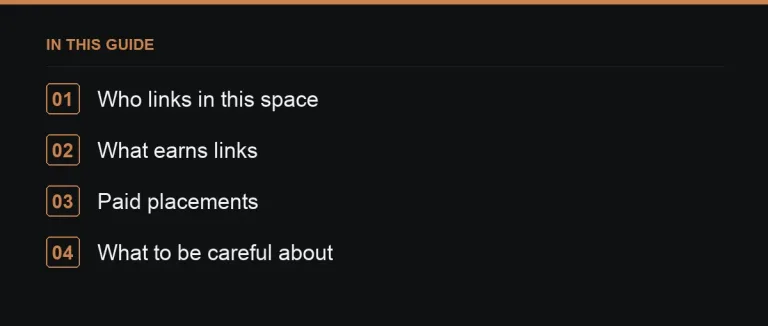
Who links in this space
- Local news and community sites
- Professional bodies and health directories
- Local schools, sports clubs and charities
- Health information sites and patient communities
- Other local businesses you refer patients to or from
What earns links
- Patient education — clinician-reviewed guides to procedures, costs and aftercare that local blogs and forums reference (health link building).
- Community health — school talks, free screening events and sports club partnerships that local press covers.
- Local expert comment — seasonal advice and reactions to health news, offered to local journalists (getting quoted).
- Local foundations — directories, business profiles and associations that most practices skip (local businesses).
- Referral partners — GPs, pharmacies and specialists you already have working relationships with.
A worked example
A three-partner dental practice publishes a clinician-reviewed guide to the real cost of a specific procedure in its region, with a plain breakdown of what’s typically covered by insurance and what isn’t. A local lifestyle site picks it up for a “what does X actually cost” feature and links to the guide; the practice then pitches the same clinician for a seasonal oral-health comment slot ahead of a local sports season, earning a second, unrelated local link a few months later.
Common mistakes
The most common mistake is publishing generic content lifted from elsewhere and adding a location name to it — readers and journalists both notice. The second is chasing national health directories with no local audience instead of the three or four local sites that actually influence a patient’s decision. The third is overpromising in patient education content, which creates compliance risk long before it creates an SEO problem.
Measuring what’s working
Track referring domains from your own postcode area or city, not just the raw count of new links (referring domains explained), and watch whether branded search volume rises after a local feature runs — that’s a better signal of real reach than any single link’s metrics (brand search and SEO). It also helps to track new-patient enquiries against the weeks a piece of content or a press mention actually ran, since local health decisions often take weeks to convert from first read to booked appointment, and a single month’s link count tells you almost nothing about that lag.
Paid placements that fit the niche
Health-focused sites in the health niche can support patient guides; local relevance matters more than national reach for a single practice. Vet every site for relevance, real traffic from your market and editorial quality (evaluation checklist), and keep anchors natural and varied (anchor text strategy) rather than repeating the same commercial phrase on every placement.
What to be careful about
Healthcare advertising is regulated in many countries: avoid testimonials or outcome claims that breach professional rules, and keep medical content accurate and reviewed (YMYL). Get every patient case study signed off before it goes anywhere near a pitch. It’s worth building a short internal checklist before any patient-facing content goes out: has a clinician reviewed the clinical claims, has the patient (or their guardian) signed a specific release for this exact use, and does the piece avoid implying a guaranteed outcome. Practices that formalise this into a two-minute pre-publish routine avoid most of the compliance headaches that otherwise surface only after a piece has already been picked up by a local paper.
Where to go next
Start by auditing what your practice already has to offer a journalist or local editor — a clinician willing to comment, a genuinely useful cost guide, a community programme worth writing up — before you approach any site. Then build a short shortlist of local and health-niche publishers rather than a long one; a dozen well-matched relationships, maintained over a year, will do more for a single-location practice than a hundred cold, unread emails ever will. Compare shortlisted publishers side by side before you commit budget (compare tool), and browse https://successtoroad.com/marketplace/ once you know which niches and price bands fit your plan.
Frequently asked questions
What links matter most for a dental practice?
Local ones: community partnerships, local press, directories and professional bodies matter far more than generic national health sites with no local readership.
Can clinics use patient testimonials in content?
Check professional and advertising rules in your country first; many restrict or ban outcome claims and testimonials in healthcare marketing.
How many links does a local practice actually need?
Far fewer than you'd think — a steady handful of relevant local and health-niche links usually outperforms dozens of unrelated ones.
Should a practice pay for guest posts on health sites?
Only on sites with real health-topic audiences and editorial standards; check traffic and recent content quality first.
Put it into practice
Filter 54,483 websites by DR, traffic, niche and price, and order with escrow — you pay only after the link is live.
Browse the marketplace