Writing Buying Guides That Rank and Convert
A buying guide helps someone choose. Done honestly, it ranks, earns links and sends qualified visitors to your products.
Buying guides answer “how do I choose…?” questions. They rank well for research-stage searches, attract links from bloggers and forum discussions pointing people toward a trustworthy resource, and pass both visitors and internal authority through to product and category pages when linked well.
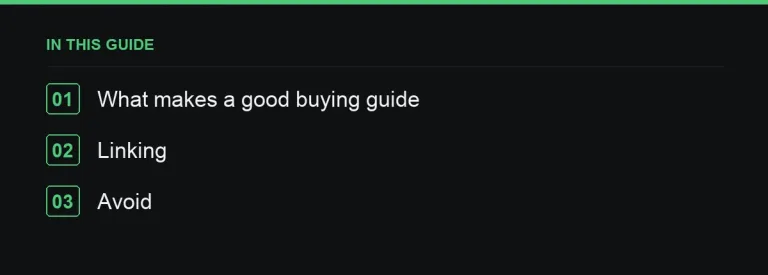
What separates a good buying guide from a thin one
- Criteria first — explain what actually matters when choosing, and why, before recommending anything specific.
- Honest trade-offs — what a buyer gives up at each price point or feature level, stated plainly rather than glossed over.
- First-hand testing where possible — direct experience with the products involved supports both usefulness and E-E-A-T.
- Recommendations by need — “best for beginners”, “best on a budget”, “best for heavy use” rather than one single verdict for everyone.
- Clear, current information — dated, with a visible note on when it was last reviewed.
Structuring the guide for both readers and search
Open with the criteria section so readers understand your framework before the recommendations, then move into specific picks organised by need. This order also tends to perform well for featured snippets, since the criteria section often answers “what to look for in X” as a standalone, quotable unit — see featured snippets and authority.
Linking the guide into your site
Link from the guide directly to the relevant categories and specific products it recommends (see internal linking). Buying guides are also excellent outreach targets for external placements, since they’re genuinely useful reference material rather than thinly veiled advertising — see link building for ecommerce for how this fits a broader campaign.
Common mistakes to avoid
- Recommending only your own products without explaining the reasoning, which reads as a catalogue rather than a guide.
- A thin list of products with no real guidance connecting them, which fails the “how do I choose” intent even if it technically lists options.
- Outdated prices and discontinued models left in place long after they stopped being accurate.
A publisher’s approach versus a retailer’s approach
| You are | Recommend |
|---|---|
| A retailer | What you actually sell, with honest guidance on trade-offs between your own options |
| An independent publisher | Whatever is genuinely best across the market, disclosed if any relationship exists |
Keeping a buying guide current without constant rewrites
Rather than rewriting the whole guide each time something changes, maintain the criteria section as mostly stable and update only the specific recommendations and pricing sections as products change. This keeps the review burden manageable while still giving readers accurate, current picks.
Sourcing genuine first-hand experience on a budget
Not every publisher can afford to buy and test every product in a category. Where full testing isn’t realistic, be transparent about the basis for a recommendation — aggregated user feedback, manufacturer specifications, or hands-on experience with some but not all options — rather than implying first-hand testing that didn’t happen. Readers generally respond well to this kind of honesty, and it’s far less risky than an implied claim that later turns out to be false.
Handling affordable versus premium picks fairly
A common trap is treating the most expensive recommendation as automatically “best” without justifying why, which readers on a budget will notice and distrust. Explain specifically what the extra cost buys, and be willing to genuinely recommend a budget option as the right choice for a stated use case rather than always steering toward the highest price point.
Buying guides for services, not just products
The same format applies well beyond physical products — “how to choose a web host”, “how to choose an accountant” follow the same criteria-first, honest-trade-offs structure. Service-based buying guides often have an advantage: fewer specific numeric specs to keep updated, though pricing and terms still need periodic checking.
Building trust before the recommendation section
A reader who lands on a buying guide is often deciding, consciously or not, whether the author actually knows the category before they’ll trust any specific pick. A short line establishing relevant experience or how the picks were chosen — even briefly — before the recommendations start goes a long way toward that trust, especially for higher-cost purchases where a wrong recommendation carries real consequences for the reader.
Revisiting a guide after a category shifts significantly
Occasionally an entire product category changes enough — a new technology standard, a regulatory shift, a wave of new entrants — that incremental updates to an existing guide aren’t enough, and a substantial rewrite is warranted rather than another round of small edits. Recognise this rather than continuing to patch a guide whose underlying criteria section no longer reflects how the category actually works.
Where to go next
Buying guides pair naturally with comparison pages for readers further along in their decision, and with a broader content cluster around the product category. For outreach to sites that might reference your guide, browse https://successtoroad.com/marketplace/ or check https://successtoroad.com/niche/shopping/.
Frequently asked questions
Should a buying guide recommend competitors' products?
If you're a retailer, recommend what you sell with honest guidance between your own options; if you're an independent publisher, recommend whatever is genuinely best.
Do buying guides help ecommerce SEO specifically?
Yes. They rank well for research-stage searches and pass both visitors and internal authority through to product and category pages.
How often should a buying guide be updated?
Whenever recommended products or prices change meaningfully, and at minimum once a year even if nothing obvious has changed.
What's the most common weakness in buying guides?
A thin list of products with little real guidance connecting them, which fails the underlying 'how do I choose' intent even if products are listed.
Put it into practice
Filter 54,483 websites by DR, traffic, niche and price, and order with escrow — you pay only after the link is live.
Browse the marketplace