Measuring the Impact of Link Building on SaaS Sign-Ups
Counting backlinks tells you nothing about whether they are actually bringing in sign-ups.

Most SaaS teams track link building success by counting new referring domains, which measures activity but not impact. The more useful question is whether those links are actually sending qualified visitors who go on to sign up, and answering that does not require an expensive attribution platform for most small teams.
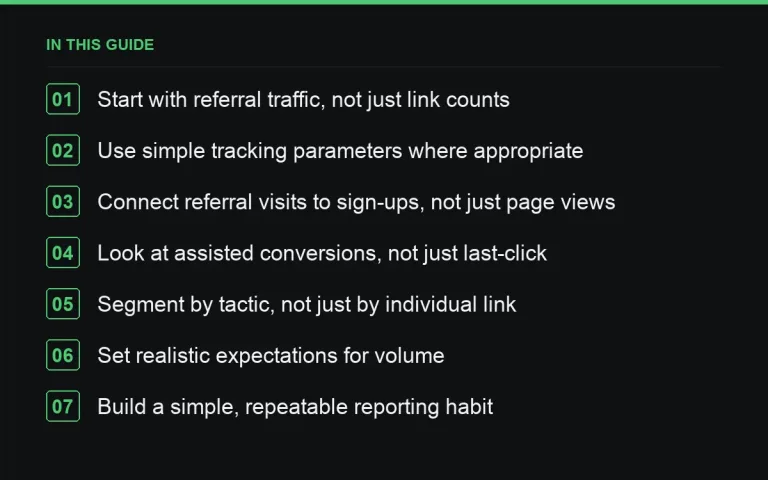
Start with referral traffic, not just link counts
Your analytics tool already segments traffic by referral source. Check which specific acquired links are sending real visits, not just whether the link exists, since a live link that sends no traffic is providing minimal direct value regardless of the domain it sits on.
Use simple tracking parameters where appropriate
For guest posts and placements where you control the link, a basic tracking parameter lets you see referral traffic in your analytics tool even when the platform’s own referral data is incomplete or blocked by browser privacy settings. Keep this modest and consistent rather than over-engineering a tracking scheme.
Connect referral visits to sign-ups, not just page views
A visit that never converts is a much weaker outcome than one that leads to a trial or sign-up. Set up a simple funnel view that shows, for each major referral source, how many visits progressed to a sign-up, even if the absolute numbers are small for any single link.
Look at assisted conversions, not just last-click
Many sign-ups are influenced by a link they clicked weeks earlier, not the last thing they clicked before converting. If your analytics tool supports multi-touch or assisted-conversion views, use them to avoid undervaluing content and links that build awareness rather than driving an immediate click-to-signup.
Segment by tactic, not just by individual link
- Compare referral quality from guest posts against free tools, podcasts, and press coverage as categories.
- Look for patterns in which tactics consistently bring higher-intent visitors, not just more visitors.
- Reallocate effort toward the tactics showing the best conversion, not just the highest raw traffic.
Set realistic expectations for volume
Individual links rarely produce large numbers of direct sign-ups on their own; the value is often cumulative across many links and touchpoints over time. Avoid judging a single guest post’s success purely by its immediate conversion numbers.
Build a simple, repeatable reporting habit
A short monthly summary covering new links acquired, referral traffic trends, and any notable conversion patterns keeps the whole team honest about what is and is not working. This does not need to be an elaborate dashboard; a simple recurring spreadsheet review is often enough for a small team to stay grounded in real results rather than assumptions.
Do not let measurement replace judgment entirely
Some valuable link building work, such as founder-led PR or community trust-building described in https://successtoroad.com/blog/founder-led-pr-for-startups/ and https://successtoroad.com/blog/community-and-forum-presence-saas/, is genuinely hard to measure precisely in the short term. Use data to guide decisions where it is available, but do not abandon tactics with clear qualitative value just because they resist tidy attribution.
Share results in a format non-marketers understand
When reporting link building results to founders, sales, or investors, translate the numbers into business terms — sign-ups influenced, cost per qualified visitor — rather than SEO jargon like domain rating or referring domains, which means little outside a marketing team. This framing helps the rest of the company understand and continue supporting the effort.
Revisit your tracking setup periodically
Analytics platforms, browser privacy defaults, and consent requirements all change over time, which can quietly degrade the accuracy of a tracking setup built years earlier. Review your measurement approach at least annually to confirm it still captures referral traffic and conversions as reliably as it did when first configured.
Accept that some value will always be invisible
A reader who sees your brand mentioned in an article, does not click through immediately, but signs up weeks later after a direct search is a real outcome that most attribution setups will never capture cleanly. Acknowledge this gap honestly rather than assuming your measured numbers represent the full picture of a link’s value.
Review measurement expectations with new hires
Anyone joining the marketing team should understand from the start how link building results are measured and what a realistic timeline for impact looks like. Setting this expectation early avoids a new hire quietly judging their own work, or a colleague’s, against an unrealistic standard borrowed from a previous role at a different kind of company.
Combine quantitative data with occasional direct feedback
Every so often, ask new sign-ups directly how they first heard about you, either through a short onboarding question or a brief survey. This kind of direct, qualitative input often surfaces a link or mention your analytics missed entirely, particularly for word-of-mouth references that never involved an actual click.
Where to go next
This measurement approach supports every tactic described in https://successtoroad.com/blog/saas-link-building-guide/, and it is especially useful for evaluating the launch spike described in https://successtoroad.com/blog/launch-pr-for-saas-products/ against the steadier returns from evergreen assets. When choosing where to invest next, browse https://successtoroad.com/niche/technology/ and https://successtoroad.com/niche/software-development/ publishers, or check https://successtoroad.com/marketplace/.
Frequently asked questions
Is counting referring domains a bad metric entirely?
Not bad, but incomplete. It is useful as a leading indicator, but it should be paired with referral traffic and conversion data to understand actual impact on the business.
Do small SaaS teams need expensive attribution software to measure link impact?
No. Most standard analytics tools, combined with simple tracking parameters and funnel views, are enough to get a reasonably clear picture without a dedicated attribution platform.
How long should you wait before judging whether a link is working?
Give it at least a few weeks to a couple of months, since referral traffic from a guest post or press mention can take time to build as the piece gets shared and indexed further.
Should every guest post be judged individually on conversion?
Not strictly. Judging tactics in aggregate, across many placements, gives a more reliable picture than scrutinising each individual link's performance in isolation.
Put it into practice
Filter 54,483 websites by DR, traffic, niche and price, and order with escrow — you pay only after the link is live.
Browse the marketplace