Agency vs In-House Link Building for SaaS Companies
The right choice depends less on budget size and more on how repeatable your link building process needs to be.
SaaS companies eventually face the same decision: hire an agency to handle link building, build the function in-house, or run some hybrid of the two. There is no universally correct answer, but the trade-offs are predictable enough to reason through deliberately rather than defaulting to whatever a competitor does.
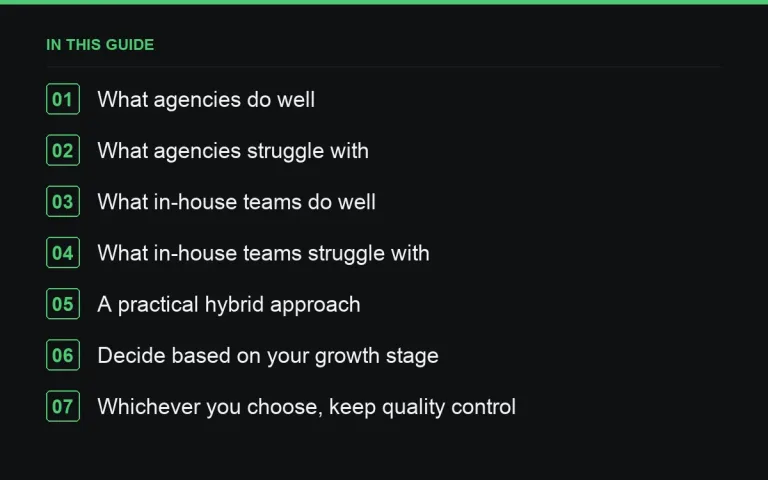
What agencies do well
An established link building agency typically brings existing publisher relationships, a repeatable outreach process, and enough volume experience to move faster than a small in-house team starting from zero. This is often the better choice when you need to scale link acquisition quickly and do not yet have the internal expertise to run outreach well.
What agencies struggle with
Agencies rarely understand your product as deeply as your own team, which can lead to generic pitches and content that misses the nuance a knowledgeable in-house writer would capture. Product-led content, described in https://successtoroad.com/blog/product-led-content-for-saas/, is usually harder for an outside agency to execute well without close collaboration with your product team.
What in-house teams do well
An in-house link building function benefits from deep product knowledge, direct access to founders for PR opportunities, and full control over content quality and timing. This tends to produce more differentiated content, particularly for the founder-led and product-led tactics covered elsewhere in this series.
What in-house teams struggle with
Building genuine publisher relationships and outreach expertise from scratch takes time, and a small in-house team can plateau at a modest volume of links without the networks an established agency already has. Hiring for this skill set specifically is also harder than it looks, since strong outreach experience is a narrow, specific skill.
A practical hybrid approach
- Keep founder-led PR, product-led content, and community participation in-house, since these depend on genuine product and company knowledge.
- Use an agency or a marketplace for volume outreach tactics like guest posting once you have a clear content strategy to feed them.
- Review agency-placed content for accuracy and tone before it goes live, since an off-brand piece can do more harm than the link is worth.
Decide based on your growth stage
Very early-stage companies, covered in https://successtoroad.com/blog/early-stage-link-building-no-budget/, usually cannot afford an agency and should build lean in-house habits first. Growth-stage companies with more budget can layer in agency support for scale while keeping the most differentiated tactics internal.
Whichever you choose, keep quality control
Regardless of who executes the outreach, maintain oversight of publisher quality, content accuracy, and brand tone. A high volume of low-relevance links can do more harm to your credibility and search performance than a smaller number of well-placed ones.
Ask the right questions before signing an agency contract
Ask prospective agencies how they source publishers, whether they disclose paid placements appropriately, and whether they can show examples of past work in a genuinely comparable industry. Vague answers about proprietary networks or guaranteed link counts without any quality detail are a warning sign worth taking seriously.
Revisit the decision as the company matures
The right choice at ten employees is not necessarily the right choice at a hundred. Revisit this decision periodically rather than treating it as fixed, since growth typically shifts the balance toward being able to afford stronger in-house capability while still using outside help for pure volume tasks.
Set a trial period before committing long term
Whether hiring in-house or engaging an agency, agree on a defined trial period with clear success criteria before signing a long-term commitment. This gives both sides a fair chance to prove the arrangement works without either party being locked into a poor fit for a full year based on early promises alone.
Keep institutional knowledge inside the company
Whichever model you choose, make sure key relationships and strategic decisions are documented somewhere the company controls, not only inside an agency’s own systems or a single freelancer’s memory. This protects continuity if a vendor relationship ends or a team member moves on unexpectedly.
Communicate the choice clearly to the rest of the company
Whichever model you settle on, make sure sales, product, and leadership understand who owns link building decisions and how to route requests or ideas to them. Ambiguity here often leads to duplicated effort or missed opportunities that fall between an agency’s scope and the in-house team’s own priorities.
Revisit the arrangement after major company changes
A change in leadership, a shift in target market, or a significant product pivot are all good moments to revisit whether your current agency or in-house arrangement still fits. Treat the decision as tied to the company’s actual needs at a given time rather than a permanent structural choice made once and never questioned again.
Where to go next
Read the broader plan in https://successtoroad.com/blog/saas-link-building-guide/, and see https://successtoroad.com/blog/scaling-links-with-a-small-team/ for how a lean in-house team can still scale meaningfully. To evaluate publisher options directly, browse https://successtoroad.com/niche/software-development/ and https://successtoroad.com/niche/startups/ listings, or check https://successtoroad.com/marketplace/.
Frequently asked questions
Is an agency always more expensive than in-house link building?
Not necessarily once you account for salary, tools, and the time it takes an in-house hire to build outreach relationships from scratch; the true cost comparison depends heavily on your specific situation.
Can a small SaaS team run link building without any outside help at all?
Yes, especially at an early stage, though it usually means a narrower set of tactics executed consistently rather than trying to match an agency's volume.
How do you evaluate whether an agency is doing good work?
Look at the relevance and quality of the publishers they place content on, not just the raw number of links delivered, and review the actual published content for accuracy and tone.
Should founder-led PR ever be outsourced to an agency?
Rarely fully outsourced, since it depends on the founder's genuine voice and expertise, though an agency or PR consultant can help with pitching and scheduling logistics around it.
Put it into practice
Filter 54,483 websites by DR, traffic, niche and price, and order with escrow — you pay only after the link is live.
Browse the marketplace