How to Run a Link Audit for a Startup
A link audit tells you what is actually working before you spend more effort building new links.
Before investing further in new link building, it is worth understanding what you already have. A link audit for a startup is usually simpler than for an established enterprise site, but it still surfaces useful information: what is working, what is wasted, and where there might be quality problems worth fixing.
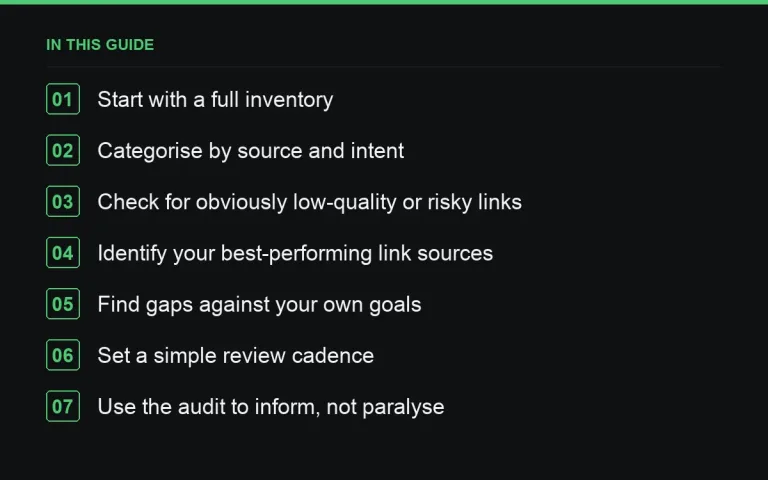
Start with a full inventory
Pull a complete list of referring domains and links pointing to your site using a standard backlink tool. For a young startup this list is often short enough to review manually rather than needing heavy automation, which is itself an advantage worth using.
Categorise by source and intent
- Editorial links from guest posts, press coverage, and genuine mentions.
- Directory and profile links from tool listings, marketplaces, or integration partners.
- Community links from forums and social platforms, mostly nofollow but still worth noting.
- Any links that look spammy, unrelated, or potentially harmful to your site’s reputation.
Check for obviously low-quality or risky links
Look for links from sites with no real content, clearly unrelated topics, or patterns that suggest automated link schemes rather than genuine placements. For a young site, the volume here is usually small, but it is worth clearing out or disavowing anything that looks actively harmful.
Identify your best-performing link sources
Cross-reference your link inventory with the referral traffic and conversion data covered in https://successtoroad.com/blog/measuring-link-impact-on-signups/ to see which sources are not just present but actually valuable. This tells you which tactics and publisher types to prioritise going forward, rather than assuming all links are equally worth repeating.
Find gaps against your own goals
Compare your current link profile against the tactics laid out in https://successtoroad.com/blog/saas-link-building-guide/: do you have any developer-audience links if you have an API? Any comparison-page citations? Any founder-driven press mentions? Gaps here point directly to where to focus next.
Set a simple review cadence
A quarterly review is usually enough for an early-stage startup, checking for new low-quality links, broken or lost links worth reclaiming, and whether your evergreen assets from earlier audits are still attracting new links over time.
Use the audit to inform, not paralyse
A link audit is meant to sharpen your next moves, not to become an ongoing project of its own. Spend a bounded amount of time on it, act on the clearest findings, and get back to building rather than auditing indefinitely.
Involve more than one person in the review
A second set of eyes, even from outside marketing, often catches things a single reviewer misses, whether that is a partner link that quietly broke or an obviously spammy placement someone once thought was a good idea. A short shared review session, even thirty minutes, tends to surface more useful findings than one person working through the list alone.
Turn findings into a short action list, not a long report
Resist the temptation to produce an exhaustive audit document nobody reads in full. A short list of the three or four most impactful actions — reclaim this lost link, retire this low-quality placement, invest more in this clearly working tactic — is more likely to actually get acted on than a lengthy write-up.
Reclaim lost links where it is worth the effort
Occasionally a link disappears because a partner redesigned their site or a blog post was taken down, even though the underlying relationship is still fine. A brief, polite email asking whether the link could be restored sometimes succeeds with little effort, particularly for placements you know were genuinely earned rather than purchased in bulk.
Compare your profile against a couple of close competitors
A light look at where a similar-stage competitor is earning links, without copying their approach wholesale, can reveal channels or publisher types you had not considered. Use this as inspiration for gaps in your own strategy rather than as a scoreboard to be anxious about.
Keep the audit lightweight enough to actually repeat
An audit process so elaborate that nobody wants to redo it quarterly defeats its own purpose. Favour a simple, repeatable checklist over an exhaustive one-time deep dive, since consistency in reviewing your link profile over time matters more than the thoroughness of any single audit.
Share a short summary with the wider team
A brief recap of the audit’s key findings, shared with founders or other stakeholders outside marketing, keeps everyone aligned on what is actually working. It also creates useful context for future budget or headcount conversations, since decisions grounded in real data are easier to defend than ones based on impression alone.
Use the process to sharpen future publisher selection
Patterns from an audit, such as noticing that links from a particular type of publisher consistently perform better, should directly inform which sites you prioritise the next time you are choosing where to place a guest post or pursue a placement, closing the loop between measurement and future decisions.
Where to go next
Read the broader strategy in https://successtoroad.com/blog/saas-link-building-guide/, and use the findings here to prioritise between the specific tactics covered throughout this series, such as https://successtoroad.com/blog/guest-posting-tech-blogs-saas/ or https://successtoroad.com/blog/developer-audience-link-building/. To fill gaps with new, relevant publishers, browse https://successtoroad.com/niche/software-development/ and https://successtoroad.com/niche/startups/ listings, or check https://successtoroad.com/marketplace/.
Frequently asked questions
How often should a startup run a link audit?
Quarterly is usually sufficient for an early-stage company, since the link profile changes more slowly than at a larger, established site with heavier outreach volume.
What is the biggest risk a link audit typically uncovers for startups?
Usually not malicious spam, but wasted effort: directory or profile links that carry little real value and low-quality placements that would be better spent on more targeted outreach going forward.
Should startups worry about disavowing low-quality links?
Only if there is clear evidence of harmful, spammy patterns. For most young sites, a small number of low-value links are not worth the effort of a disavow process and can simply be ignored.
Can a link audit reveal which tactics to prioritise next?
Yes, this is one of its most useful outputs: comparing which existing link sources actually drive traffic and sign-ups tells you which tactics deserve more investment going forward.
Put it into practice
Filter 54,483 websites by DR, traffic, niche and price, and order with escrow — you pay only after the link is live.
Browse the marketplace