Scaling SaaS Link Building With a Small Team
Scaling link building with a small team means choosing leverage points carefully, not just working more hours.
A small SaaS marketing team cannot match an agency’s raw outreach volume, but that does not mean link building has to stay small. Scaling with limited headcount is mostly about choosing tactics with high leverage — where one piece of work keeps paying off — rather than trying to do everything a larger team would do.
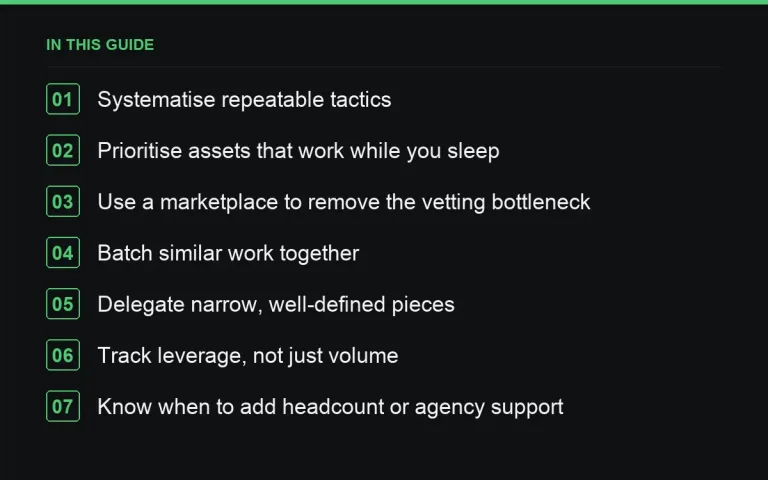
Systematise repeatable tactics
Guest posting, once you have a working pitch template and a target publisher list, becomes largely a matter of throughput rather than fresh strategic thinking each time. Build reusable templates and checklists for the tactics you run often, described in https://successtoroad.com/blog/guest-posting-tech-blogs-saas/, so execution does not depend entirely on one person’s memory.
Prioritise assets that work while you sleep
Free tools, templates, and evergreen comparison pages, covered in https://successtoroad.com/blog/free-tools-as-link-assets/ and https://successtoroad.com/blog/templates-and-resources-for-links/, keep earning links without ongoing outreach effort once built. A small team gets more leverage from a handful of durable assets than from constant active outreach alone.
Use a marketplace to remove the vetting bottleneck
Manually vetting publisher quality, checking metrics, and negotiating placements takes real time that a small team often does not have. A guest post marketplace with pre-vetted publishers, filterable by niche and metrics, removes a significant chunk of that overhead, letting a small team place content faster without sacrificing quality control.
Batch similar work together
- Write several guest post pitches in one sitting rather than context-switching between different task types throughout the week.
- Schedule a monthly block for outreach follow-ups instead of checking constantly.
- Group content updates for evergreen pages into a periodic review cycle rather than ad hoc edits.
Delegate narrow, well-defined pieces
Freelancers or part-time contractors can handle narrowly scoped tasks — drafting a guest post from a clear brief, formatting a template — even if the overall strategy stays with the core team. This works especially well when paired with the brief-writing discipline used for any outsourced content.
Track leverage, not just volume
Review periodically which tactics are producing the most result per hour invested, not just which produced the most links this month. Redirect effort toward what is actually working rather than maintaining every tactic equally out of habit.
Know when to add headcount or agency support
When your evergreen assets and systematised tactics are running well but you are still leaving good opportunities on the table due to time constraints, that is a signal to consider the hybrid approach described in https://successtoroad.com/blog/agency-vs-in-house-link-building-saas/ rather than continuing to stretch the same small team further.
Use lightweight tools instead of building your own
A small team rarely has time to build custom internal tooling for outreach tracking or publisher research. Off-the-shelf spreadsheets, simple project boards, and a vetted marketplace for finding publishers usually cover what a lean team needs without diverting engineering time away from the product itself.
Protect against burnout on a small team
A small team stretched across many link building tactics at once is at real risk of burnout, which quietly degrades content quality and outreach tone long before anyone notices the team is struggling. Build in slower weeks deliberately, and treat sustainable pace as part of the strategy, not a luxury to address only after something breaks.
Document processes so knowledge does not walk out the door
A small team is especially vulnerable to losing momentum when one person who held all the outreach relationships and process knowledge leaves. Write down enough of the process — target lists, pitch templates, relationship notes — that a replacement or a freelancer could pick up the thread without starting completely from scratch.
Automate the administrative parts, not the judgment calls
Scheduling reminders, tracking outreach status, and generating basic reports are all reasonable to automate with simple tools, freeing up time for the parts of link building that genuinely need human judgment, such as choosing which publishers to prioritise or how to frame a specific pitch.
Set a realistic ceiling for what a small team can sustain
Be honest about how many active outreach threads, content pieces, and relationships one or two people can genuinely maintain at a high standard. Pushing past that ceiling without adding capacity tends to reduce quality across everything rather than simply producing more of the same standard of work.
Revisit priorities every few months, not just once
A small team’s priorities from six months ago may no longer match where the company or the product has moved to since. A short recurring review of which tactics still deserve the limited time available keeps a lean team’s effort aligned with current goals rather than coasting on an outdated plan.
Invest in a small number of durable relationships
Rather than spreading thin across dozens of shallow publisher contacts, a small team benefits disproportionately from a handful of genuinely strong relationships with editors or partners who reliably say yes. These relationships compound in value over time in a way that a large but shallow contact list rarely matches.
Where to go next
Read the full plan in https://successtoroad.com/blog/saas-link-building-guide/, and revisit https://successtoroad.com/blog/early-stage-link-building-no-budget/ if you are scaling up from a zero-budget starting point. To find efficient, pre-vetted publishers, browse https://successtoroad.com/niche/software-development/ and https://successtoroad.com/niche/startups/ listings, or check https://successtoroad.com/marketplace/.
Frequently asked questions
What is the biggest lever for a small team trying to scale link building?
Building durable, evergreen assets that keep earning links without ongoing active effort, since a small team cannot match a larger team's outreach volume hour for hour.
Should a small team try to do every link building tactic described in this series?
No. Pick a small number of tactics that fit your product and audience well, systematise them, and add more only once the current ones are running smoothly.
Is a guest post marketplace worth it for a small team specifically?
Often yes, because it removes a large chunk of the time spent vetting and negotiating with individual publishers, which is exactly the kind of overhead a small team can least afford.
How do you know when a small team needs to bring in outside help?
When well-run, systematised tactics are still leaving clear opportunities unaddressed due to time constraints, rather than a lack of ideas or strategy.
Put it into practice
Filter 54,483 websites by DR, traffic, niche and price, and order with escrow — you pay only after the link is live.
Browse the marketplace