Link Building for Hotels and Tourism Businesses
Hotels compete with booking platforms for their own name in search. Local links and travel press are how independent properties win it back.
Hotels and tourism businesses face a link building problem most other industries don’t: booking platforms and review sites frequently outrank the property’s own website, even for searches on its own name. That’s not a content problem you can write your way out of; it’s an authority problem, and the fix is the same one that works for any competitive niche: relevant, local links that a giant aggregator site can’t easily replicate.
Why OTAs outrank your own site
Booking platforms have enormous domain authority built over years of aggregating thousands of properties, reviews and searches. Your hotel’s own site, however well designed, starts from a much smaller base of links and signals. Winning back your own brand search means out-competing that authority specifically for your property’s name, which is a narrower and more achievable goal than trying to outrank OTAs generally.
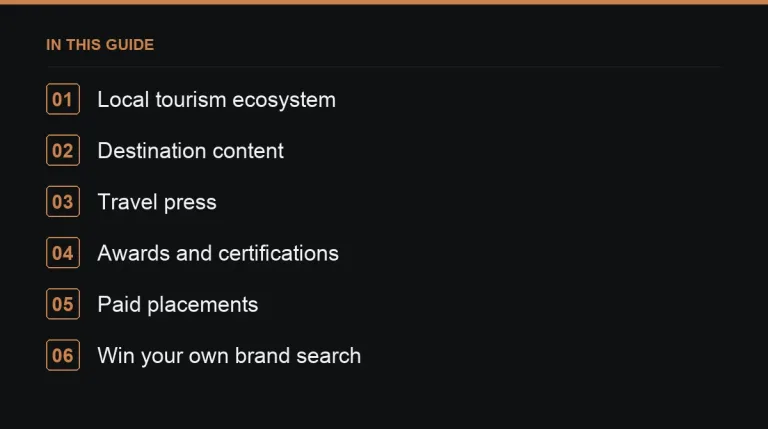
The local tourism ecosystem
- Tourism boards and destination sites — official accommodation and attraction listings, often free to join and usually linked.
- Local attractions and restaurants — “where to stay nearby” partnerships and reciprocal recommendations.
- Event organisers — official accommodation partner status for weddings, conferences, festivals and sports events in your area.
- Local press and community sites — openings, refurbishments, ownership changes and local milestones are genuine local news.
- Chambers of commerce and business associations — member directories that link to local business websites.
Destination content that ranks and gets linked
Your knowledge of the local area is a genuine asset that OTAs can’t easily replicate at the same depth. Detailed guides to the neighbourhood, walking routes, seasonal events, and honest recommendations of where locals actually eat rank well for trip-planning searches and get picked up by travel bloggers researching the destination, a topic covered more broadly in our travel link building guide. Avoid generic “top 10 things to do” content that could describe any city; specificity is what makes destination content linkable.
Working with travel press
Travel writers are looking for a story, not a room rate. A distinctive angle — an unusual building history, a design detail, a sustainability initiative, an experience genuinely unlike other properties in the area — gives them something to write about. Press trips and hosted stays remain common in this industry; when you offer one, be upfront that disclosure of the arrangement is expected and normal, not a sign the coverage is compromised.
Awards, certifications and quality schemes
Sustainability certifications, regional tourism awards and quality assurance schemes typically publish a directory of participating or winning properties, often with a link back to each one’s site. These are low-effort to apply for relative to the link and credibility they provide, and they double as a genuine trust signal for guests browsing your site directly.
Choosing paid placements sensibly
The travel niche in any marketplace includes a huge range of blogs of wildly varying quality; prioritise ones with a real, engaged readership in the markets your guests actually come from rather than chasing the highest domain rating on paper. If a meaningful share of your guests come from a specific country, add a language filter, for example German-language travel sites for a hotel that attracts a lot of German visitors, rather than only browsing sites in your own language.
| Source | Effort | Typical link value |
|---|---|---|
| Tourism board listing | Low | Moderate, but highly relevant |
| Local press feature | Medium | High, and often reused by others |
| Hosted travel blogger stay | Medium-high | Variable — depends on blogger’s real audience |
| Paid guest post on travel blog | Low | Depends heavily on vetting |
Winning your own brand search
Make sure your own site is the strongest possible result for your hotel’s name: a complete, accurate Google Business Profile, consistent name, address and phone details across every directory, and links from local partners that use your actual brand name rather than a generic anchor. This overlaps heavily with standard local SEO link building, and is often the single highest-leverage project a small hotel can run.
Common mistakes to avoid
The most frequent mistake independent hotels make is chasing generic travel blog placements with impressive-looking metrics but no readers in the countries guests actually travel from. A backlink from a site with a large but irrelevant international audience does little for a property trying to win bookings from a specific region. The second common mistake is neglecting the unglamorous local partnerships — tourism board listings, chamber of commerce directories, event partner pages — in favour of chasing press coverage that may never materialise. Build the reliable local foundation first, then layer press and blogger outreach on top of it.
A third mistake is letting seasonal content go stale. A destination guide written three years ago, listing restaurants that have since closed and events that no longer run, actively damages trust with both readers and the sites that linked to it. Treat destination content as something to revisit at least once a season, not something you publish once and forget.
Where to go next
For general local link tactics that apply beyond tourism, see our guide to local business link building, and for pitching journalists directly, read about getting quoted as an expert source. When you’re ready to look beyond your immediate local network, browse relevant sites in the marketplace and filter by the countries your guests travel from.
Frequently asked questions
Why do booking sites outrank hotels for their own name?
OTAs have accumulated enormous domain authority over years of aggregating properties and reviews, far more than most individual hotel websites. Strong local links, a complete Google Business Profile and consistent branding across directories help your own site compete specifically for brand searches.
Are press trips worth it for hotels?
For genuinely distinctive properties with a real story to tell, yes — they generate coverage and links that are hard to get otherwise. Always disclose hosted stays clearly, since undisclosed arrangements risk both the relationship and the coverage's credibility.
What local links should a hotel prioritise first?
Tourism board listings, nearby attraction and restaurant partnerships, and event organiser accommodation status, alongside accurate directory listings everywhere your business appears. These are the lowest-effort, highest-relevance links available to most independent properties.
Do sustainability certifications actually help SEO?
Indirectly, yes. Most certification schemes publish a directory of participating properties with a link, and the credibility signal to human visitors researching your hotel is arguably as valuable as the link itself.
Should a small hotel bother with paid guest posts?
Only on well-vetted travel sites with a real, relevant readership rather than high metrics alone. For most independent hotels, free local partnerships and press coverage deliver more relevant links per hour invested than paid placements.
Put it into practice
Filter 54,483 websites by DR, traffic, niche and price, and order with escrow — you pay only after the link is live.
Browse the marketplace