Link Building for Nonprofits and Charities
Nonprofits are among the easiest organisations to link to. Here's how to make sure partners and press actually follow through.
Nonprofits have a structural advantage that most commercial link builders would envy: people genuinely want to support them. Corporate partners, supporters, journalists and community organisations are frequently happy to link to a good cause, often without being asked twice. The real work isn’t persuasion so much as making it easy for people who are already willing, and asking at the moments they’re most likely to say yes.
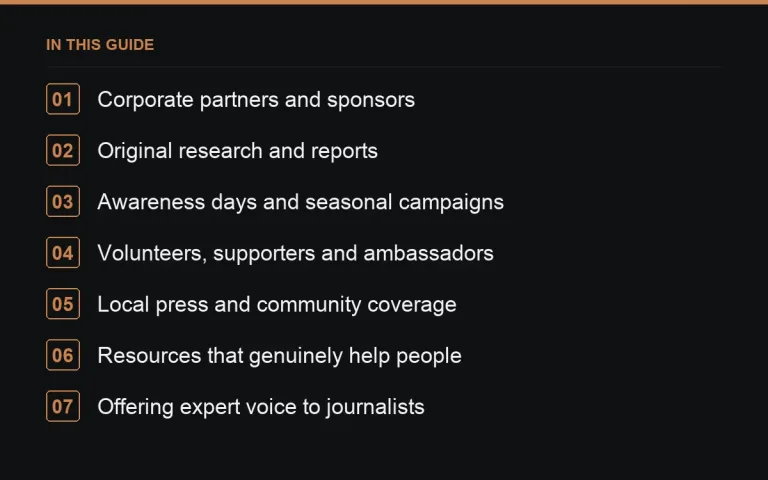
Corporate partners and sponsors
Businesses that donate, sponsor events or send volunteer teams often want to publish that involvement somewhere visible, usually on a CSR page, a community page or an annual impact report. Make this easy for them: provide a short, ready-to-use description of the partnership, a logo, and a suggested link to the specific campaign or programme involved rather than just your homepage. Partners are far more likely to follow through when you’ve removed every point of friction.
Original research and reports
Charities frequently hold unique data about the issues they work on — beneficiary surveys, service usage patterns, outcome tracking — that no one else has published. Turning that into an accessible report earns links from journalists covering the issue, policymakers citing evidence, and educators building lesson materials, in the same way described in our data-driven PR campaigns guide. This is often the single highest-value content a nonprofit can produce, because it’s genuinely unique rather than another opinion piece on a well-covered topic.
Awareness days and seasonal campaigns
Recognised awareness days give journalists an editorial hook and a reason to run a story they might otherwise skip. Prepare your angle, spokesperson availability and supporting resources well in advance rather than scrambling on the day itself; most media outreach around these dates happens on a tight, predictable calendar, and being first to pitch matters.
Volunteers, supporters and ambassadors
Fundraisers, long-term volunteers and public ambassadors often want to write about their involvement on their own blogs, LinkedIn or local community pages. Give them a simple one-page resource — key facts, a suggested paragraph, your logo and a link — and most will use at least part of it. This works especially well around big fundraising events like challenge runs or sponsored activities.
- Provide a ready-made “why I support this cause” template supporters can adapt.
- Ask fundraising page creators to link back to your main site, not just the fundraising platform.
- Feature supporter stories on your own site and let them share the resulting page.
- Send a short thank-you post-event with an easy link to share, while the story is still fresh.
Local press and community coverage
Local charities in particular tend to get strong coverage from local news outlets and community sites: openings, milestones, volunteer days and stories of individual impact are exactly the kind of human-interest content local editors are short of. This overlaps with general local link building, but nonprofits typically have an easier time of it because there’s no obvious commercial angle for editors to be wary of.
Resources that genuinely help people
Support guides, information sheets and directories of services relevant to your cause tend to get linked by schools, health services, libraries and other community organisations looking for reliable resources to point people to. The bar here is accuracy and being kept current — an outdated resource gets quietly removed from other people’s link lists, so treat maintenance as part of the job, not an afterthought.
Offering expert voice to journalists
Charity staff are frequently genuine subject-matter experts on the issue they work on, and journalists covering that beat need commentary. Make yourself available for comment on relevant breaking news, following the approach in our guide to getting quoted, and you’ll often pick up links from articles that have nothing to do with a specific campaign.
| Tactic | Cost | Typical link source |
|---|---|---|
| Original research report | Staff time | Journalists, policymakers, educators |
| Corporate partner asks | Minimal | Company CSR pages |
| Supporter templates | Minimal | Personal blogs, social profiles |
| Expert commentary | Staff time | News coverage of your issue area |
Paid link building is rarely a good use of charitable funds when the tactics above cost little beyond staff time and tend to produce stronger, more relevant links. If you do consider a paid placement — for instance to support a specific fundraising push — vet it as carefully as any commercial buyer would, using our guest post red flags checklist.
Setting realistic expectations
A small charity with limited staff time can’t run every tactic above at once, and shouldn’t try to. Pick the one or two that fit your organisation’s actual strengths: a charity with a strong data set should prioritise research reports, while one with a large volunteer base should prioritise supporter templates and local press. Trying to run a full programme with no dedicated capacity usually produces a handful of mediocre attempts rather than one or two things done well enough to actually earn links.
Where to go next
For measuring whether any of this is working, see our digital PR metrics guide, and for building a proper research campaign from scratch, read data-driven PR campaigns. Should you need occasional paid coverage support, the public service niche in the marketplace includes relevant publishers, or browse the full marketplace directly.
Frequently asked questions
Should charities pay for backlinks?
Rarely, and only after careful vetting. Partnerships, original research and press coverage usually earn stronger, more relevant links at little cost beyond staff time, which makes better use of limited charitable funds.
How do we get corporate sponsors to link to us?
Ask directly, and make it easy by providing a short description, logo and a suggested link to the specific campaign rather than just your homepage. Most partners want to publicise the relationship but won't do the writing themselves.
What charity content earns the most links?
Original research on the issue you work on, since it's genuinely unique, alongside practical support resources that other organisations want to point people towards. Both outperform generic opinion or campaign content.
Do awareness days actually help with link building?
Yes, because they give journalists an editorial reason to run a story on your issue that they might otherwise skip. Prepare your pitch, spokesperson and resources well ahead of the date rather than on the day itself.
How do we get volunteers to link to us online?
Give them a simple, ready-to-use template with key facts, a suggested paragraph and a link, then ask directly around a specific event. Most supporters are willing but won't write from scratch unprompted.
Put it into practice
Filter 54,483 websites by DR, traffic, niche and price, and order with escrow — you pay only after the link is live.
Browse the marketplace