Link Building for Law Firms
Legal search is competitive and closely regulated. Here's how law firms build authority without breaking professional rules.

Legal services are among the most competitive local searches, and law is a topic where trust matters enormously to both readers and search engines. Law firms also operate under professional conduct rules that affect advertising and endorsements in ways most other niches don’t. Good link building for firms works within both constraints at once, rather than treating them as separate problems.
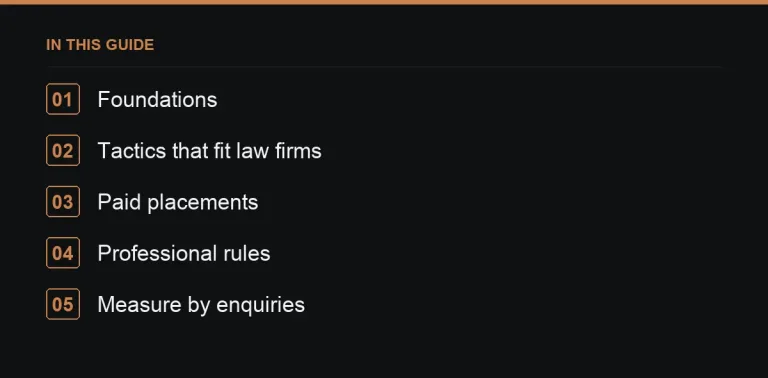
Foundations
- Consistent listings in reputable legal directories and your bar or law society profile, kept accurate and up to date.
- Business profiles and local directories with accurate details across every listing (local SEO links explained).
- Attorney bio pages that show credentials, admissions and real experience (why E-E-A-T matters for link building).
Tactics that fit law firms
Expert commentary
Journalists regularly need lawyers to explain rulings, new legislation and the legal aspects of news stories. A lawyer who responds quickly with clear, careful explanations gets quoted often, and repeat coverage builds a reputation that compounds over time (getting quoted as an expert source).
Practical legal guides
Plain-language guides — what to do after a car accident, how probate works in your state, tenant rights in your area — earn links from community sites, local media and other professionals. Keep them accurate, dated, and reviewed by a qualified lawyer before publishing.
Community and education
Free legal clinics, talks at community organisations and scholarship programmes, where genuine and not purely promotional, earn local links and reflect real involvement in the community you serve.
Professional relationships
Accountants, financial advisers, estate agents and other professionals often maintain referral or resource pages that a relevant law firm can be added to with a simple, direct request.
Paid placements
Guest posts on relevant sites — local news, business publications, sites in the law niche — can support informational guides tied to your practice areas. Target informational content rather than pitching links straight to service pages, and keep anchor text natural throughout (a full anchor text guide).
Professional rules to check first
Advertising and solicitation rules vary considerably by jurisdiction. Check your bar’s guidance on sponsored content, testimonials, claims of expertise and paying for recommendations before running any campaign involving paid placements. When in doubt, favour earned coverage and clearly labelled content over anything that could be read as an undisclosed endorsement.
A quick pre-campaign checklist
| Question | Why it matters |
|---|---|
| Does your jurisdiction restrict paid endorsements by lawyers? | Avoids a professional conduct issue |
| Is the content informational rather than a direct service pitch? | Fits editorial standards and reader expectations |
| Has a qualified lawyer reviewed the legal claims made? | Protects accuracy and firm reputation |
| Is any sponsorship or partnership clearly disclosed? | Meets both advertising and search engine guidance |
Measure by enquiries, not just rankings
Rankings for “[practice area] lawyer [city]” matter, but consultations booked are what actually count for the business. Track calls and form submissions from organic traffic alongside your ranking positions, so you can tell whether visibility is converting (measuring link building ROI).
Building long-term authority, not just links
Legal search rewards demonstrated expertise more than most niches, since both readers and search engines weigh credentials heavily on Your Money or Your Life topics. A firm that consistently publishes accurate, dated guides and responds to press enquiries over a year or two builds a body of coverage that’s far harder for a newer competitor to replicate quickly than a short burst of guest posts (why E-E-A-T matters for link building).
Working with legal marketing agencies
Some firms outsource content and outreach to legal marketing specialists rather than handling it in-house, which can work well provided the agency understands the professional conduct rules that apply and isn’t simply applying a generic tactic borrowed from an unrelated industry. Ask any agency you work with for examples of legal content they’ve placed and check it against your own bar’s guidance before committing to a retainer.
Choosing which cases to write about
Not every settled case makes good content, and confidentiality obligations rule out plenty of the most interesting ones anyway. The cases and topics worth writing up publicly are usually the ones that illustrate a common situation many potential clients face — not the unusual, headline-grabbing outcome, which readers can rarely relate their own situation to and which risks confidentiality problems if handled carelessly.
Working with multiple offices or practice areas
Firms with several offices or practice areas often make the mistake of building one generic link profile for the whole firm. It’s usually more effective to build location- and practice-specific content and links — a local guide for each office’s area, expert commentary tied to each practice’s specialism — so that search visibility matches the way clients actually search, by location and by legal need combined.
Where to go next
Start with your directory and bio-page foundations, then layer in expert commentary and one or two well-chosen guest placements in the law niche marketplace. Confirm your jurisdiction’s advertising rules before committing to anything paid, and see local SEO links if you serve a specific city or region.
Frequently asked questions
Are legal directory links worth it?
Reputable legal directories help with visibility and trust. Avoid low-quality directories that exist only to sell links and add little real traffic or credibility.
Can law firms buy guest posts?
It depends on your jurisdiction's advertising rules. Where allowed, keep the content informational, clearly labelled, and check your bar's specific guidance before running a campaign.
What content earns links for law firms?
Accurate, plain-language guides to common legal situations, reviewed by qualified lawyers, plus expert commentary on relevant news and rulings.
Do client testimonials help with links?
Testimonials mainly support conversion rather than link building, and many jurisdictions regulate how they can be used. Check your professional rules before publishing them.
Put it into practice
Filter 54,483 websites by DR, traffic, niche and price, and order with escrow — you pay only after the link is live.
Browse the marketplace