Link Building for Consumer Electronics and Gadget Brands
Tech reviewers want early access, hard data and honest specs. Here's how gadget brands give them reasons to link.
Consumer electronics is covered by a large, demanding tech press and an army of independent reviewers. They link to products they’ve genuinely tested, data they trust, and tools they find useful in their own work. Marketing copy doesn’t get linked; specs, benchmarks and honest access do.
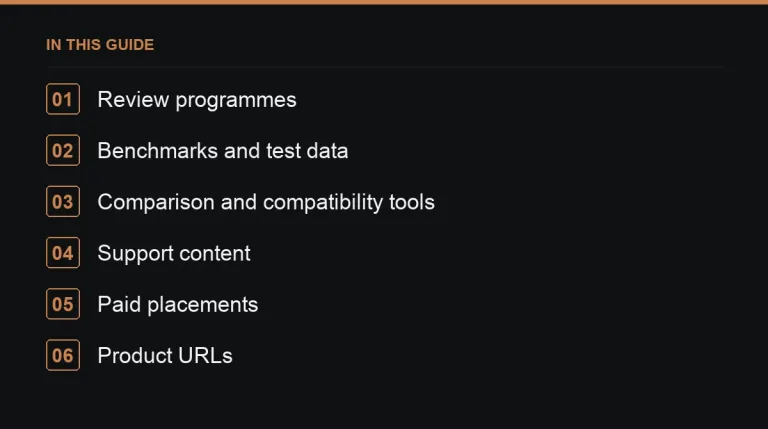
Review programmes
Send review units to relevant reviewers well before launch, with clear specs, pricing and embargo dates spelled out from the start. Reviews typically link to the product page or manufacturer site directly. Don’t demand positive coverage as a condition of the review unit; reviewers who feel pressured tend to stop covering a brand entirely rather than risk their own credibility.
Benchmarks and test data
Publish transparent test methodology alongside results — battery life, performance, durability — rather than headline numbers alone. Reviewers and forums reference credible manufacturer data readily, especially when it’s independently reproducible by someone else running the same test.
Comparison and compatibility tools
Compatibility checkers, spec comparison tables and buying guides attract links from forums and tech blogs answering “which one should I buy” for their own readers (linkable assets that keep earning links).
Support content
Excellent troubleshooting guides and manuals rank well for support-related searches and get linked from communities helping each other fix the same problem. Good support content is consistently underrated as a source of durable links.
Paid placements
The gadgets, technology and computers niches are large and varied in quality. Prefer sites that actually test products over those that mostly rewrite press releases without hands-on use (a full evaluation checklist).
Product URLs
Keep product URLs stable across model years where possible, or redirect discontinued models to their successors, so review links earned at launch keep working for years afterward (ecommerce link building).
Launch-week checklist
| Task | Timing |
|---|---|
| Send review units with full specs | 2–4 weeks before launch |
| Publish benchmark methodology and data | At or just before launch |
| Publish comparison tools versus predecessor and competitors | At launch |
| Set up redirects from any discontinued predecessor page | At launch |
Working with crowdfunded and pre-order products
This applies equally to established brands announcing a genuinely new product category, where early scepticism is common and transparency about development progress builds the same kind of trust with reviewers.
Crowdfunded gadgets face a distinct trust problem, since backers and press alike have seen enough delayed or abandoned campaigns to be cautious by default. Publishing honest, regular progress updates, including setbacks, tends to earn more press goodwill and links over the course of a campaign than only posting good news, since it demonstrates the kind of transparency that helps distinguish a genuine project from a risky one.
Supporting long-term ownership content
Reviewers cover a product heavily at launch and rarely revisit it, yet real owners keep searching for information months and years later — battery degradation over time, software update history, how repairable it turns out to be. Publishing this kind of long-term ownership content, even informally as a blog update, fills a gap independent reviewers usually leave open and tends to earn links from forums where existing owners discuss the product long after launch coverage has ended.
Managing embargoes carefully
A broken embargo, whether accidental or from a reviewer jumping the gun, can sour relationships with an entire outlet rather than just one journalist. Send embargo terms clearly in writing with every review unit, and follow up promptly if a piece goes live early rather than escalating publicly, which tends to damage the relationship further without fixing anything.
Supporting international reviewers
Global product launches often focus review unit distribution on a handful of major English-language outlets, leaving reviewers in other regions to buy the product retail or skip coverage entirely. Extending review programmes to well-regarded regional tech publications, with localised specs and pricing, opens up an entire additional set of relevant, linkable coverage that a single global press list tends to miss.
Working with independent testing labs and communities
Beyond individual reviewers, some communities and independent labs run their own standardised testing programmes and publish comparative results across many products. Getting a product into these programmes, even without direct sponsorship, tends to produce some of the most credible and heavily linked coverage available, precisely because the testing is seen as independent of the brand.
Handling negative reviews constructively
Not every review will be positive, and a defensive public response to fair criticism tends to damage a brand’s standing with the wider reviewer community far more than the original negative review did. Reviewers talk to each other, and a brand known for handling criticism professionally continues to get review units and coverage long after a single bad review has been forgotten.
Where to go next
Build your review programme and benchmark methodology before your next launch, since both are reusable across future products. Use the gadgets niche marketplace to find genuinely hands-on reviewers for paid placements alongside earned review coverage.
Frequently asked questions
How do gadget brands get reviewed?
Early review units with clear specs and embargo dates, sent to reviewers who cover similar products and have a track record of hands-on testing.
Should brands pay tech reviewers?
Paid reviews must be disclosed and are viewed sceptically by audiences. Review units provided without conditions attached tend to build more credible, durable coverage.
What happens to review links when a model is discontinued?
Redirect the old product URL to its successor or category page so the links earned at launch keep counting rather than pointing at a dead page.
Are independent testing labs worth pursuing?
Yes, where relevant to your product category. Their results are seen as unusually credible and tend to attract heavier linking than a standard press review.
Put it into practice
Filter 54,483 websites by DR, traffic, niche and price, and order with escrow — you pay only after the link is live.
Browse the marketplace