Link Building for Construction and Trades Companies
Construction and trade businesses win work on trust and local reputation.
Construction and trade businesses win work on trust and local reputation. Links from associations, suppliers, projects and local press reflect exactly that.
Why construction and trades companies link building is different
Most construction and trades link building fails because it’s aimed at the wrong audience: national home-improvement blogs that have no interest in a regional contractor. The links that actually move the needle for a trades business come from a narrower, more relevant set — associations, suppliers and local press — built around real, documented work. The firms that get this right tend to treat documentation as part of the job, not an afterthought bolted on once a project is finished. A foreman taking progress photos on a phone costs nothing and turns into the raw material for a case study, a supplier pitch and a local press story, often from the same single project. Reviewing which past projects generated real media or association interest, and which didn’t, over a year or two is a better guide to where to invest documentation effort next than any generic content calendar borrowed from another industry. Reviewing which past projects generated real media or association interest, and which didn’t, over a year or two is a better guide to where to invest documentation effort next than any generic content calendar borrowed from another industry.
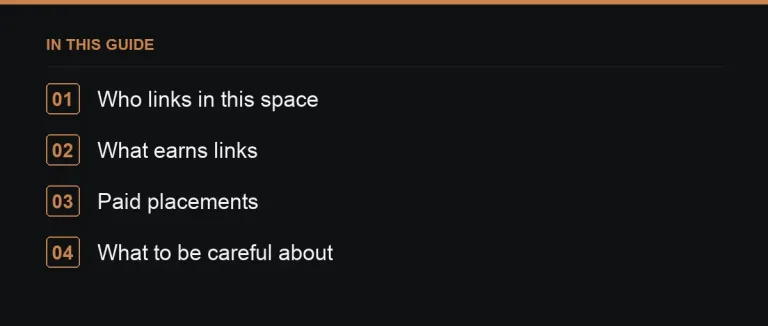
Who links in this space
- Trade associations and certification bodies
- Suppliers and manufacturers
- Local and regional press
- Property and home publications
- Architects and specifiers who reference completed projects
What earns links
- Project case studies — completed projects with real details, photos and challenges overcome (case studies).
- Certifications and associations — member directories worth joining for both credibility and the link (directories).
- Cost guides — realistic price ranges drawn from your own quotes, not generic averages (home improvement).
- Local press — notable projects and community work covered by regional outlets (local PR).
- Supplier and manufacturer pages — case studies featuring products you’ve installed.
A worked example
A construction firm documents a tricky renovation project in detail — the constraint that made it hard, the solution used, real photos at each stage — and pitches it both to a trade association’s project showcase and to the manufacturer of a specific product used on the job. Both organisations link to the write-up independently, and the firm reuses the same material for a local press pitch about the finished building a month later.
Common mistakes
A common mistake is displaying certifications the firm no longer actually holds, which is both a compliance risk and, if discovered, a serious trust problem. Another is publishing cost guides with rounded, generic figures instead of real ranges from actual quotes, which readers and journalists increasingly discount. A third is under-documenting projects as they happen, leaving nothing usable for a case study once the work is finished. A simple habit of assigning one person on site to take a handful of photos at the start, middle and end of any notable job removes the dependency on remembering to do it later.
Measuring what’s working
Track referring domains from your specific region and trade, separate from general construction-niche noise (referring domains), and keep a simple log of which completed projects generated media interest so you can repeat what worked.
Paid placements that fit the niche
The construction and repairs and real estate niches fit; for local firms, regional relevance matters more than niche breadth. A national trade publication is worth less to a single-region contractor than a smaller, genuinely regional property or local news site with a readership that could actually become a client. Vet every site for relevance, real traffic from your market and editorial quality (evaluation checklist), and keep anchors natural and varied (anchor text strategy) rather than repeating the same commercial phrase on every placement.
What to be careful about
Only display certifications you currently hold, and keep cost guides realistic and dated; misleading figures damage trust and, in regulated trades, can create liability. A short internal habit, checking that every displayed certification and every published price range is still current before a new piece of content goes live, costs almost nothing and avoids the much larger cost of a journalist or competitor publicly pointing out that a claim no longer holds.
Where to go next
Pick one recent or upcoming project worth documenting properly, photograph it at each stage, and line up the association, supplier and local press pitches before the work is even finished. Once that first project earns coverage across two or three of those channels, turn the documentation habit into a standard step on every job worth featuring, rather than a special effort reserved for the biggest contracts. Compare shortlisted publishers side by side before you commit budget (compare tool), and browse https://successtoroad.com/marketplace/ once you know which niches and price bands fit your plan.
Frequently asked questions
What links matter most for construction companies?
Associations, suppliers, local press and well-documented project case studies — more than generic national home blogs.
Do cost guides earn links for trades?
Yes, when based on real, dated figures from actual quotes rather than rounded industry averages.
Should trades join every relevant certification body?
Join the ones relevant to your work and region; each is both a credibility signal and a legitimate directory link.
How should a firm document a project for future PR?
Photograph key stages as the work happens and note the specific challenge solved — that detail is what makes a case study linkable later.
Put it into practice
Filter 54,483 websites by DR, traffic, niche and price, and order with escrow — you pay only after the link is live.
Browse the marketplace