Link Building for Healthtech SaaS Products
Healthtech link building rewards caution: overstated claims cost more in trust than they gain in coverage.
Healthtech SaaS products sit at the intersection of two demanding audiences: buyers who need to trust the product with sensitive information, and publishers who are understandably cautious about hosting content that makes health-related claims. Link building here needs to lean on credibility and restraint rather than aggressive claims.
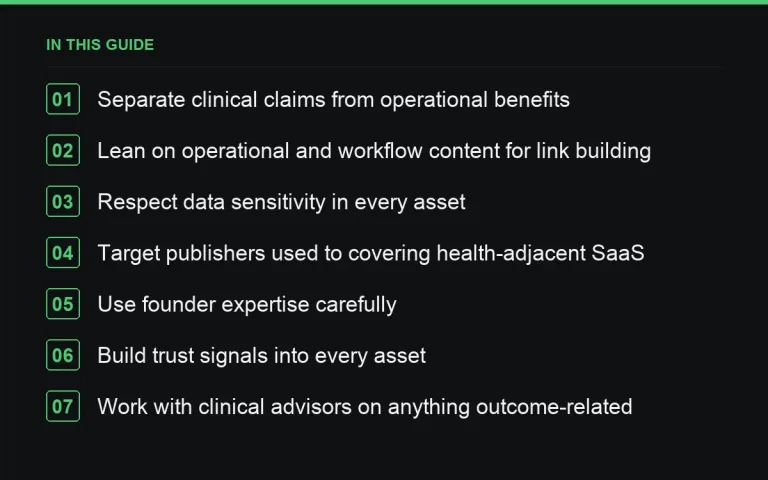
Separate clinical claims from operational benefits
A healthtech SaaS product that manages scheduling, records, or workflow is different from one that makes claims about clinical outcomes. Be precise in your own content about which category your product falls into, and avoid implying clinical benefit if your product’s actual function is operational or administrative.
Lean on operational and workflow content for link building
Content about how healthtech tools improve administrative efficiency, reduce scheduling friction, or support compliance workflows is generally easier to get published and to substantiate than content making clinical claims, and it still resonates with the buyers who matter for a B2B healthtech sale.
Respect data sensitivity in every asset
The product-usage data report tactic from https://successtoroad.com/blog/product-data-reports-saas/ needs particular care in healthtech: never publish anything derived from patient-level data without rigorous anonymisation and a clear legal review, and consider whether the aggregate finding is worth the compliance overhead before pursuing it.
Target publishers used to covering health-adjacent SaaS
General health publications may be reluctant to cover a software product without a clear clinical hook, while health IT and healthcare business publications are typically more receptive to operational and workflow-focused stories. Match your pitch to the publication’s usual coverage rather than pitching broadly.
- Prioritise health IT and healthcare business trade publications for product-focused stories.
- Use general business or tech press for company milestones like funding rounds.
- Avoid pitching clinical claims to any publication without appropriate clinical review and evidence.
Use founder expertise carefully
Founders with a clinical or healthcare operations background are strong candidates for expert commentary, following the general approach in https://successtoroad.com/blog/founder-led-pr-for-startups/, but should stay within their genuine area of expertise and avoid commenting on clinical topics outside it.
Build trust signals into every asset
Security and compliance certifications relevant to health data, clearly explained rather than just listed as badges, can themselves become a linkable resource for buyers researching vendor trustworthiness, tying into the broader trust story your comparison and feature pages should tell.
Work with clinical advisors on anything outcome-related
If your company has clinical advisors or a medical team, involve them directly in reviewing any content that touches on outcomes or patient impact, rather than leaving that review entirely to marketing or even general compliance staff. Clinical nuance is easy to get subtly wrong without someone with the right background checking the final wording.
Be mindful of accessibility in published content
Healthtech audiences often include readers who rely on accessible formatting, larger text, and screen-reader-friendly structure more than the average SaaS audience. Simple choices, such as clear heading structure and plain language, make your content more usable for this audience and are generally good practice regardless of the category.
Engage respectfully with skeptical audiences
Healthcare professionals are often understandably cautious about new software vendors, having seen tools oversold before. Content and outreach that acknowledges this skepticism directly, rather than dismissing it, tends to build more credibility than content that assumes an easy, uncritical audience from the outset.
Coordinate launches around clinical review cycles
Healthcare buyers, particularly at institutional level, often evaluate new tools on longer timelines tied to internal review committees and procurement cycles. Time press and content pushes with an awareness of these longer decision cycles rather than expecting the same fast conversion pattern common in consumer-facing SaaS categories.
Consider peer-reviewed or clinician-authored content carefully
If your company has genuine clinical expertise available, content co-authored or reviewed by a qualified clinician can carry real weight with a skeptical healthcare audience, provided their credentials are represented accurately and their involvement is genuine rather than a name attached loosely for credibility.
Keep security and compliance documentation current
Healthtech buyers frequently ask for detailed information on data handling and relevant certifications before signing off on a purchase. Keeping this documentation genuinely up to date, and easy for a prospective buyer’s own compliance team to review, removes a common friction point in an already lengthy sales process.
Support content with honest patient or user framing
Where content touches the experience of the people ultimately affected by a healthtech product, whether patients or the clinicians treating them, keep the framing grounded in real, defensible descriptions rather than emotionally manipulative language designed purely to generate shares or attention.
Coordinate messaging across regions carefully
Healthcare regulation and terminology differ meaningfully between countries, so content built for one market rarely transfers cleanly to another without review. Treat any expansion into a new healthcare market as requiring its own compliance and messaging pass rather than a simple translation of existing material.
Where to go next
Read the general plan in https://successtoroad.com/blog/saas-link-building-guide/, and revisit https://successtoroad.com/blog/saas-feature-page-links/ with a focus on operational rather than clinical framing. For relevant publishers, browse https://successtoroad.com/niche/health/ listings, or check https://successtoroad.com/marketplace/ for the wider catalogue.
Frequently asked questions
Can healthtech SaaS companies make claims about patient outcomes in marketing content?
Only with appropriate clinical evidence and review; most healthtech SaaS content is safer and more defensible when it focuses on operational, administrative, or workflow benefits instead.
Are general health publications a good target for healthtech SaaS link building?
Sometimes, but health IT and healthcare business trade publications are often a better fit for software-focused stories that lack a direct clinical outcome hook.
How should healthtech companies handle data reports for link building?
With extreme caution around patient data: only aggregate, thoroughly anonymised statistics should ever be considered, and legal review should happen before any external publication.
Does a healthtech SaaS company need special certifications to be seen as credible by publishers?
Relevant compliance certifications help establish credibility with both publishers and buyers, and explaining them clearly can itself become useful, linkable content.
Put it into practice
Filter 54,483 websites by DR, traffic, niche and price, and order with escrow — you pay only after the link is live.
Browse the marketplace