Guest Posting on Arabic-Language Websites
Arabic spans more than twenty countries with different media landscapes. Here's how to build Arabic links that fit your region.
Arabic is spoken across the Gulf, the Levant, Egypt and North Africa, each region with its own media landscape, spending patterns and online habits. Arabic link building works well once you choose a specific region rather than treating “Arabic” as a single homogeneous market, publish properly formatted Arabic content, and target publishers actually read by your audience.
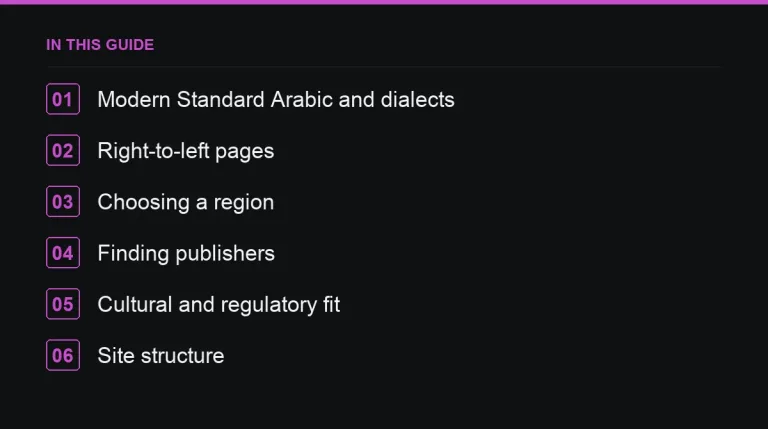
Modern Standard Arabic versus dialects
Most professional publications use Modern Standard Arabic for written content, while regional dialects dominate social media and some lifestyle sites. For guest posts, Modern Standard Arabic written by a native writer familiar with your target region is the safe default, since it reads naturally across countries while dialect content can feel out of place outside its home region.
Right-to-left pages need real attention
Your Arabic landing pages must render correctly right to left: layout, navigation, numerals and any mixed Arabic and Latin text all need checking, not just the body copy. Poorly formatted RTL pages undermine trust from readers who click through from a guest post, no matter how good the article itself was — see technical SEO before links for a fuller pre-launch checklist.
Choosing a region deliberately
| Region | Notes |
|---|---|
| Gulf (UAE, Saudi Arabia, Qatar, Kuwait) | High spending power, active business and lifestyle media |
| Egypt | Very large audience, strong general and news media |
| Levant (Jordan, Lebanon) | Smaller but well-educated audiences, active in tech and business |
| North Africa (Morocco, Tunisia, Algeria) | French is also widely used alongside Arabic; check which language your audience actually reads |
Pick publishers actually read in your target countries, checking traffic by country rather than assuming an Arabic-language site’s audience matches your intended region.
Finding publishers
Use the Arabic language filter in the marketplace and check audience by country before committing budget (see organic traffic as a metric for why this matters more than a headline authority score).
Cultural and regulatory fit
Content should respect local norms and regulations, which vary noticeably by country even within the Arabic-speaking world. Some product categories and topics are restricted or sensitive in some markets but not others, so a brief written for one region may need real changes before it works for another.
Working with agencies across the region
Because vetting a publisher’s audience and editorial standards across several unfamiliar Arabic-speaking countries at once is time-consuming, many brands entering the region for the first time work with a local PR contact or small agency who already has relationships with editors in their target country. This is not a substitute for the vetting principles above, but it can meaningfully speed up the process of building an initial shortlist you can trust.
Seasonal and cultural calendar considerations
Ramadan and other religious observances significantly affect publishing schedules, advertising spend and reader attention across much of the Arabic-speaking world, and campaigns timed around these periods need different expectations for turnaround and pickup than during the rest of the year. Building a rough content calendar aware of these periods avoids the common mistake of launching a campaign right when editorial attention is elsewhere.
Anchor text and brand naming
Brand names transliterated into Arabic can vary between publishers, so agree on a consistent Arabic rendering of your brand name before commissioning content across several sites, rather than letting each writer choose their own transliteration. Inconsistent brand naming across a set of Arabic-language links makes it harder for readers to connect separate mentions to the same company, which undermines part of the point of building several links in the first place.
Working across a fragmented media landscape
Unlike a single-country market, Arabic-language link building often means managing relationships across several distinct national media landscapes at once, each with its own editors, pricing norms and content expectations. It helps to treat each country as its own mini-campaign with its own shortlist, rather than trying to run one undifferentiated “Arabic” outreach list across the whole region.
Pricing and negotiation norms
Pricing conventions vary noticeably between Gulf publishers, who often price closer to Western European rates given the region’s advertising spend, and publishers in North Africa or the Levant, where rates tend to be lower. As with any market, price alone should never be the deciding factor — verified traffic from your target country and genuine editorial standards matter more (see guest post pricing).
Site structure and hreflang
Use hreflang for Arabic versions — a general “ar” code, or country-specific codes such as “ar-AE” or “ar-SA” where you maintain separate regional pages — and point each region’s links at the correct version. See hreflang and links for the mechanics and common mistakes, and international link building for how Arabic-speaking regions fit into a wider multi-market plan.
Where to go next
If you are also targeting other multilingual, multi-country markets, the Indian market guide covers a similarly diverse landscape, and guest post red flags is worth re-reading before you finalise a shortlist of Arabic-language publishers. The Arabic-language filter in the marketplace is the fastest way to start building that shortlist.
Frequently asked questions
Should Arabic guest posts use a regional dialect?
Most professional publications use Modern Standard Arabic; use a native writer familiar with your target region to keep the tone natural without leaning on dialect.
What matters most for Arabic landing pages?
Correct right-to-left layout and formatting, along with fast mobile performance, since readers will judge the linked page as much as the article itself.
Which Arabic markets have the strongest publishers?
Gulf markets and Egypt have large, active media landscapes; choose based on where your actual customers are rather than language alone.
Is one Arabic-language campaign enough for the whole region?
Usually not. Treat Gulf, Levant and North African audiences as distinct regions with their own publishers, norms and sometimes languages.
Put it into practice
Filter 54,483 websites by DR, traffic, niche and price, and order with escrow — you pay only after the link is live.
Browse the marketplace