Link Building for the Indian Market
India is enormous, mobile-first and multilingual. Here's how to build links that reach the audience you actually want there.
India is one of the largest online markets in the world, mobile-first by default and multilingual in a way few other single countries are. English-language publications reach urban and professional audiences, while Hindi and regional languages reach a far larger share of the population. Choosing the right language and the right publishers is the first decision, and it shapes everything that follows.
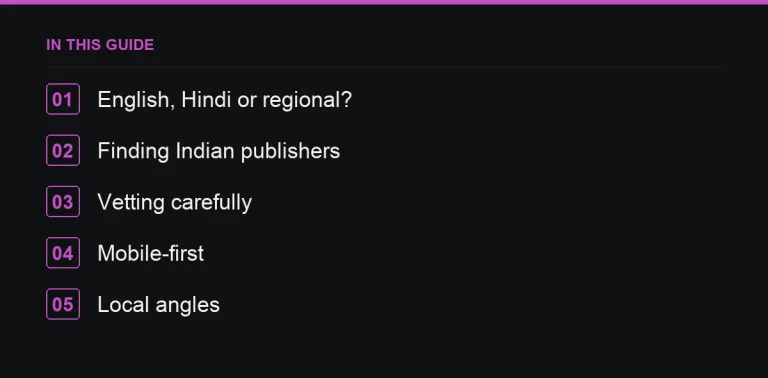
English, Hindi, or a regional language?
- English — reaches business, technology and professional audiences, largely concentrated in urban areas.
- Hindi — reaches a very large audience across northern and central India.
- Regional languages — Tamil, Telugu, Bengali, Marathi and others each have strong local media with genuinely large, loyal audiences.
Match language to where your actual customers are, and create localised landing pages for each language you target rather than routing everyone to one English page — see international link building for the structural side of this decision.
Finding Indian publishers
Many English-language sites in the marketplace have large Indian audiences even when they’re not exclusively India-focused. Check traffic by country to confirm this, and look specifically for sites ranking for India-specific keywords in your niche rather than judging purely on domain metrics.
Vetting carefully in a market this size
India has genuinely high-quality publishers alongside a large number of sites that exist mainly to sell guest posts at scale. Apply the guest post red flags checklist and read recent content on any site before committing, since the gap between the best and worst options here is wider than in most smaller markets.
Mobile-first, and often on slower connections
Most Indian users browse on phones, and a meaningful share are on slower or less consistent connections than users in wealthier markets. Linked pages must be fast and light, not just mobile-responsive in a technical sense — see technical SEO before links for a practical pre-launch checklist.
Local angles that drive pickup
Prices quoted in rupees, Indian examples and institutions, and city-level data all make content noticeably more relevant to Indian readers and editors. Data campaigns broken down by city or state tend to get particularly strong pickup, since India’s regional media landscape is large and genuinely active (see data-driven PR campaigns for how to structure this kind of story).
A quick market comparison
| Language | Typical audience | Competition for placements |
|---|---|---|
| English | Urban, professional, tech-savvy | High |
| Hindi | Very large, northern/central India | Moderate |
| Regional (Tamil, Telugu, Bengali, etc.) | Large, loyal, geographically concentrated | Lower, but requires genuine local expertise |
Planning content around Indian festivals and seasons
Major festivals and shopping seasons drive a large share of consumer attention and media coverage in India, and content or data campaigns timed around these periods tend to get stronger pickup than the same content published at a random point in the year. Building a simple annual calendar of the key dates relevant to your niche helps time outreach for maximum editorial interest rather than competing for attention during a quieter news period.
Sector strength across languages
Some sectors, such as personal finance and education, have strong publisher coverage in nearly every major Indian language, while others, like enterprise technology, are far more concentrated in English-language publications. Checking which sectors have genuine multilingual coverage before committing to a regional-language campaign avoids discovering too late that your niche simply doesn’t have enough credible publishers in that language yet.
Working with Indian influencers and communities
Beyond traditional guest posting, India has active online communities and forums by city, profession and interest that shape purchase decisions well before a search happens. These communities aren’t a direct link building channel, but visibility there often supports the same campaigns, since readers frequently cross-reference a brand mentioned in a forum against what comes up when they search for it directly afterward.
Metro versus tier-two cities
Publisher quality and pricing in India often follow a similar pattern to city tier: publications based in the largest metro areas tend to have more established editorial processes, while smaller regional outlets can offer genuinely engaged local audiences at a lower cost, provided you check their traffic carefully. Neither tier is automatically better — the right choice depends on where your specific customers actually are.
Working with a language-first brief
Whichever language you choose, build the brief around that language’s readership rather than translating an English brief afterwards. A Tamil-language brief written for Tamil Nadu readers, for instance, should reference regional examples and pricing distinct from a Hindi brief aimed at Delhi or Uttar Pradesh readers, even for the same underlying product (see writing a guest post brief for the wider template this adapts).
Where to go next
If you’re planning a wider Asian expansion, read guest posting on Indonesian sites alongside this guide, and revisit organic traffic as a metric before finalising any Indian publisher shortlist. The Hindi-language filter and English filter in the marketplace can be used side by side to build both shortlists at once.
Frequently asked questions
Should I build links in English or Hindi for India?
It depends on your audience. English reaches professional and urban readers; Hindi and regional languages reach a much larger share of the overall population.
Are Indian guest post sites reliable?
Quality varies widely, from strong editorial operations to sites built purely to sell placements, so vet traffic, content and outbound links carefully.
Why does page speed matter more for Indian audiences?
Most users are on mobile, and a meaningful share are on slower connections, so linked pages need to be genuinely fast and light.
Is it worth targeting regional Indian languages, not just Hindi?
Yes, if your customers are concentrated in a specific region; regional-language media often has large, loyal audiences that English or Hindi content won't reach.
Put it into practice
Filter 54,483 websites by DR, traffic, niche and price, and order with escrow — you pay only after the link is live.
Browse the marketplace