Link Building for Edtech SaaS Products
Edtech link building benefits from resources educators actually want to bookmark and share with colleagues.

Edtech SaaS products serve an audience — teachers, administrators, and sometimes students or parents — that already actively shares useful resources with each other through established professional networks. This makes edtech a category where genuinely useful free resources can travel unusually far with the right initial push.
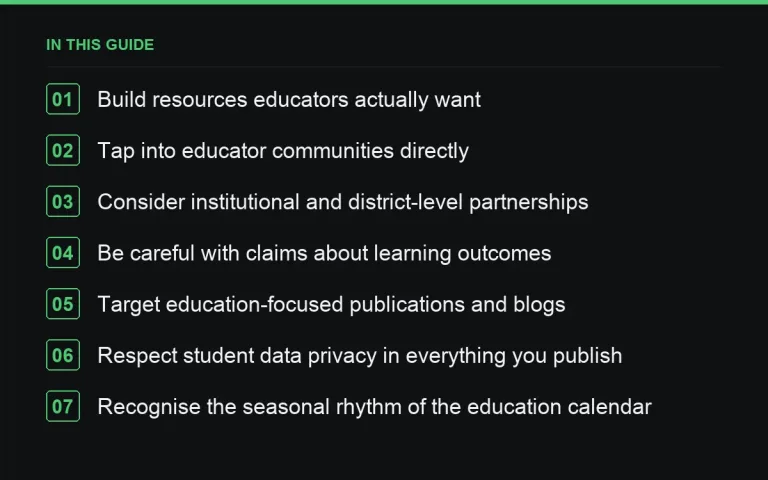
Build resources educators actually want
Templates, lesson planning tools, and printable resources tied to your product’s core use case are a natural fit for the tactics described in https://successtoroad.com/blog/templates-and-resources-for-links/ and https://successtoroad.com/blog/free-tools-as-link-assets/. Educators actively look for and share this kind of material within their own professional communities.
Tap into educator communities directly
Teachers and administrators maintain active online communities and forums where useful tools and resources circulate quickly. Genuine participation here, following the approach in https://successtoroad.com/blog/community-and-forum-presence-saas/, can produce disproportionate reach relative to the effort involved, because educators actively recommend tools to each other.
Consider institutional and district-level partnerships
If your product serves schools or districts rather than individual teachers, partnerships with education associations, professional bodies, or district technology offices can produce both credibility and links from institutional websites, similar in spirit to the partner approach in https://successtoroad.com/blog/saas-integrations-partner-links/.
Be careful with claims about learning outcomes
Claims about improved test scores, learning outcomes, or academic performance need real evidence behind them; general statements about time saved, engagement, or ease of use are safer and still compelling to the buyers who evaluate edtech tools.
- Avoid presenting anecdotal results from a single classroom as broadly representative.
- Frame outcome-related claims cautiously and back them with genuine evidence where you have it.
- Lean on workflow and time-saving benefits when outcome evidence is not available.
Target education-focused publications and blogs
Education trade publications, teacher blogs, and edtech-focused outlets are generally more receptive to product-adjacent content than general tech press, provided the content genuinely serves an educator’s practical needs rather than reading as a sales pitch.
Respect student data privacy in everything you publish
Any content referencing usage data must be fully anonymised and aggregated, with particular care given that some of your users may be minors. Review relevant education-specific privacy regulations before publishing anything derived from usage patterns.
Recognise the seasonal rhythm of the education calendar
Educator attention follows the academic calendar closely, with distinct peaks around the start of a school year, the run-up to exams, and summer planning periods. Time your outreach and content pushes around these natural windows rather than treating every month as equally receptive to edtech content.
Build relationships with education influencers, not just outlets
Individual teachers and administrators with a large following in their own professional networks can be as influential as a traditional publication, and often more receptive to a genuine, low-pressure conversation than a formal press pitch. Treat these relationships with the same care described in https://successtoroad.com/blog/founder-led-pr-for-startups/ for building visibility over time.
Offer genuinely useful professional development content
Educators regularly seek content that counts toward their own professional development or simply helps them do their job better, independent of any specific tool. Publishing genuinely useful guidance on topics adjacent to your product, without a heavy sales angle, tends to earn more trust and links from this audience than product-first content.
Consider accessibility requirements from the start
Many schools and districts have specific accessibility requirements for the tools they adopt. Addressing this clearly in your own content and product pages, rather than treating it as an afterthought, both serves a genuine need and signals seriousness to institutional buyers evaluating multiple vendors.
Respect the boundaries of parental and student privacy
Where a product touches student data at all, be explicit in your public content about what is and is not collected, since parents, schools, and education press are all understandably attentive to this question. Clarity here builds trust that pays off well beyond the immediate content or link building goal.
Offer content in formats teachers can share easily in class
A printable one-pager or a simple slide summarising a resource is often more useful to a busy teacher than a long blog post they would need to adapt themselves. Formats built for immediate classroom use tend to circulate further within teacher networks than standard web content alone.
Support smaller schools with limited budgets
Some of the most vocal advocates for an edtech product come from smaller or under-resourced schools who genuinely appreciate a tool that fits a constrained budget. Content that speaks honestly to this reality, rather than assuming every buyer has generous institutional funding, resonates with a meaningful part of the audience.
Recognise the difference between teacher and administrator buyers
A teacher choosing a classroom tool cares primarily about ease of use and immediate classroom value, while an administrator evaluating a district-wide purchase weighs cost, reporting, and integration with existing systems more heavily. Tailor content and outreach to whichever of these two audiences a given piece is actually meant for.
Where to go next
Combine this with https://successtoroad.com/blog/product-led-content-for-saas/ and the wider plan in https://successtoroad.com/blog/saas-link-building-guide/. To find publishers covering education technology, browse https://successtoroad.com/niche/education/ listings, or check https://successtoroad.com/marketplace/ for the full catalogue.
Frequently asked questions
Do edtech companies need to be cautious about outcome claims in marketing?
Yes. Claims about improved academic performance need solid evidence; general claims about time saved or ease of use are safer defaults without that evidence in hand.
Are free resources especially effective for edtech link building?
Yes, more so than in many other categories, because educators actively seek out and share useful free resources with colleagues through established professional networks.
Should edtech companies pursue district-level partnerships for link building?
If the product serves institutions rather than individual teachers, yes; institutional partnerships often provide both credibility and links from respected education-sector websites.
What privacy considerations apply to edtech usage data reports?
Full anonymisation and aggregation are essential, with extra care given that some users may be minors, and relevant education-specific privacy regulations should be reviewed before publication.
Put it into practice
Filter 54,483 websites by DR, traffic, niche and price, and order with escrow — you pay only after the link is live.
Browse the marketplace