Link Building for Developer Audiences: Docs, Repos, and Tutorials
Developers link to things that solve a real technical problem; marketing language gets ignored or actively distrusted.
Developers are a distinct link-earning audience because they cite sources based on technical usefulness, not marketing polish. If your SaaS product has an API, SDK, CLI tool, or any open-source component, you have access to link opportunities that purely marketing-driven products do not.
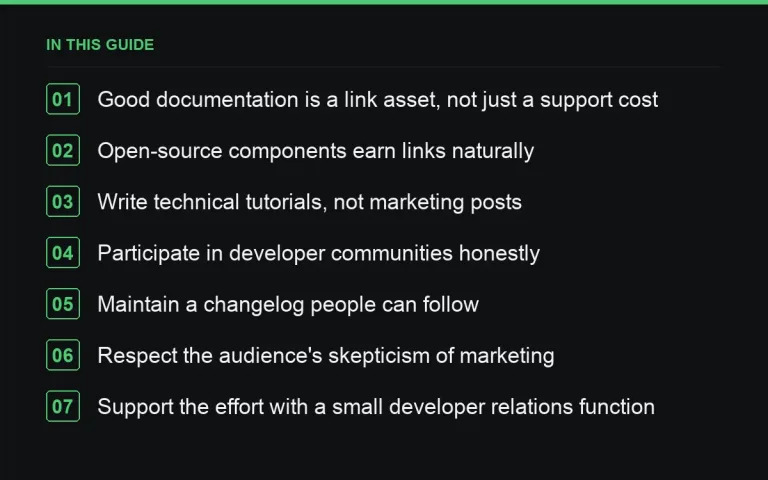
Good documentation is a link asset, not just a support cost
Developers writing their own tutorials frequently link to the official documentation of the tools they are using, as long as that documentation is clear, accurate, and reasonably complete. Treat your docs as public-facing content worth investing in, not an afterthought maintained only when support tickets pile up. https://successtoroad.com/blog/api-documentation-link-asset/ goes deeper on this specifically for API docs.
Open-source components earn links naturally
If any part of your product can reasonably be open-sourced — a small library, a CLI utility, a code sample repository — hosting it publicly gives developers something concrete to link to from their own projects and tutorials, distinct from your marketing site entirely.
Write technical tutorials, not marketing posts
A tutorial that walks through a real integration or use case, written in a genuinely technical register with working code samples, earns links from other developers solving the same problem. A tutorial that reads like a sales page, even with code in it, gets ignored by this audience.
Participate in developer communities honestly
- Answer technical questions on relevant forums and Q&A sites without turning every answer into a pitch.
- Only link to your own docs or product when it is the most useful answer available, not by default.
- Contribute to discussions about the broader problem space, not only questions that mention your product.
This connects with the broader community approach in https://successtoroad.com/blog/community-and-forum-presence-saas/, but developer communities have a lower tolerance for self-promotion than most general audiences, so restraint matters more here.
Maintain a changelog people can follow
A clear, regularly updated changelog gives developers a reason to check back and occasionally link to specific updates relevant to their own work, particularly for breaking changes or new capabilities they have been waiting on.
Respect the audience’s skepticism of marketing
Developers are quick to notice when technical content is thin cover for a product pitch, and that recognition damages trust faster with this audience than with almost any other. Keep genuinely useful technical depth as the priority, and let product mentions be incidental rather than central.
Support the effort with a small developer relations function
Even a part-time developer relations role, rather than a full team, can make a meaningful difference: someone who monitors community questions, contributes to open-source discussions, and keeps documentation current turns this from an occasional effort into a sustained one. Without that ownership, developer-facing link building tends to happen in bursts around launches and then go quiet.
Be patient with a slower trust-building cycle
Developers are typically more skeptical of new tools than other audiences and take longer to publicly endorse or link to something new. Consistent, genuinely useful presence over months tends to convert into organic mentions and links eventually, even when early efforts seem to produce little visible return.
Sponsor developer events and content thoughtfully
Sponsoring a relevant conference, meetup, or newsletter aimed at developers can produce a link and some goodwill, but only if the sponsorship feels like genuine support rather than an intrusive advert. Prefer sponsorships that come with a natural, non-intrusive mention over ones that require disruptive placement, since developer audiences are quick to resent the latter.
Let engineers represent the company sometimes
A developer-facing audience often responds better to hearing from an actual engineer on your team than from a marketing spokesperson, even if the marketing team prepares the surrounding material. Giving engineers occasional visibility, through a technical blog post or a conference talk, lends credibility that marketing-authored content alone cannot fully replicate with this audience.
Keep marketing and engineering communication open
Marketing teams often miss genuinely interesting technical stories simply because engineering never thought to mention them. A regular, brief sync between the two teams can surface useful material for developer-facing content long before it would otherwise surface through a formal content planning process.
Give back to the open-source projects you depend on
If your product relies on open-source libraries or frameworks, contributing back, whether through code, documentation, or financial sponsorship, builds genuine goodwill within that specific developer community and occasionally leads to natural mentions from other projects and contributors in that ecosystem.
Keep technical content honest about trade-offs
Developers respect technical writing that acknowledges limitations, alternative approaches, and situations where a different tool might genuinely be a better fit. This kind of honesty is unusual enough in vendor-produced content that it tends to stand out and get shared specifically because it does not read like typical marketing.
Where to go next
Pair this with https://successtoroad.com/blog/api-documentation-link-asset/ and the wider strategy in https://successtoroad.com/blog/saas-link-building-guide/. For publishers covering developer tools and open-source projects, browse https://successtoroad.com/niche/programming/ and https://successtoroad.com/niche/software-development/ listings, or search https://successtoroad.com/marketplace/ for more options.
Frequently asked questions
Does open-sourcing part of a product risk giving away a competitive advantage?
Usually not if you open-source a supporting utility rather than the core product logic. Many companies open-source small tools specifically because the goodwill and links are worth more than keeping that narrow piece proprietary.
How technical does a tutorial need to be to earn developer links?
It needs to include working, accurate code and address a real technical problem in enough depth that another developer can follow it and solve their own version of the same issue.
Are developer forums worth the time investment for a small team?
Yes, in moderation. Even a few genuinely helpful answers a month can build a reputation that pays off later in links, mentions, and inbound interest from the exact audience you want.
Should marketing or engineering own developer-facing content?
Ideally a mix: engineering ensures technical accuracy, while marketing or content teams handle structure, promotion, and finding the right topics to prioritise.
Put it into practice
Filter 54,483 websites by DR, traffic, niche and price, and order with escrow — you pay only after the link is live.
Browse the marketplace