Churn-Proof Content vs Trend Content: What to Prioritise for SaaS Links
Trend content earns links fast and loses them fast; evergreen content earns links slowly but keeps them.
Every SaaS content and link building calendar eventually faces the same tension: chase a trending topic for a quick spike of attention, or invest in evergreen content that earns links slowly but keeps earning them for years. Both have a place, but conflating them leads to wasted effort on either side.
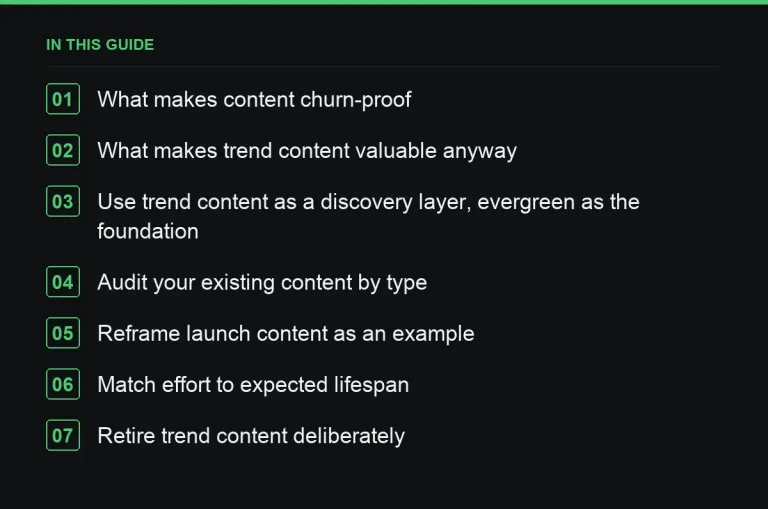
What makes content churn-proof
Churn-proof content answers a question that will still be asked in three years, using language and framing that does not depend on a specific tool version, news event, or short-lived trend. A guide to “how to structure a SaaS pricing page” ages far better than “how AI is changing SaaS pricing in [a specific year].”
What makes trend content valuable anyway
Trend content captures attention during a narrow window when interest in a topic spikes, often producing a burst of links and traffic that evergreen content could never achieve on its own in the same timeframe. The value is real, but it is front-loaded and fades quickly once the trend passes.
Use trend content as a discovery layer, evergreen as the foundation
A practical calendar keeps a foundation of evergreen assets — feature pages, comparison pages, help-centre content, described throughout https://successtoroad.com/blog/saas-feature-page-links/ and https://successtoroad.com/blog/help-centre-content-that-earns-links/ — and layers occasional trend-responsive pieces on top to capture short windows of attention and introduce new readers to the evergreen core.
Audit your existing content by type
- Identify which published pieces are genuinely evergreen and check they are still accurate.
- Identify trend pieces that have served their purpose and either update, redirect, or retire them.
- Note any gaps where you have only trend content on a topic that deserves an evergreen anchor page too.
Reframe launch content as an example
The launch tactics in https://successtoroad.com/blog/launch-pr-for-saas-products/ are inherently trend-shaped: they capture a moment in time. Pair every launch with at least one evergreen asset — a feature page, a comparison page — so the trend-driven attention has somewhere durable to land.
Match effort to expected lifespan
Invest more editorial polish and structural care in content you expect to still be relevant in two years, and treat trend content as lower-cost and disposable by comparison, since its value window is inherently short regardless of how much effort goes into it.
Retire trend content deliberately
A trend piece that has clearly aged out of relevance, with outdated screenshots or references to a moment that has passed, should either be updated with fresh framing or retired with a redirect to a more current, relevant page. Leaving it live indefinitely in an obviously stale state does more harm to your credibility than removing it.
Use analytics to confirm your assumptions
Do not assume a piece is evergreen just because it was written to be; check whether it is still attracting organic traffic and links a year or two after publication. Some pieces intended as evergreen quietly become trend-limited anyway because the underlying topic shifted faster than expected, and only your own data will reveal that.
Give evergreen pieces a periodic refresh, not just a rewrite
Refreshing an evergreen page does not need to mean a full rewrite each time; often it means updating a handful of outdated references, adding a new section covering something that has changed, and confirming internal links still point somewhere current. This lighter-touch maintenance keeps a page accurate without the cost of treating it as a brand-new project each cycle.
Let trend content point toward evergreen depth
A trend piece can openly acknowledge it is covering a moment in time while linking to a more thorough evergreen resource for readers who want lasting depth on the underlying topic. This gives the reader a clear next step and gives the evergreen page a steady stream of internal traffic each time a new trend piece goes live.
Assign a rough budget split in advance
Deciding ahead of time roughly what share of your content budget goes to evergreen versus trend work, even loosely, prevents the calendar from drifting entirely toward whatever feels most urgent or exciting in a given month at the expense of the steadier, longer-term assets that keep earning links quietly in the background.
Involve the whole team in spotting emerging trends
Trend awareness should not rest solely with whoever manages content; sales, support, and product teams often notice a shift in customer conversation before it shows up in broader industry commentary. A simple channel for flagging these observations keeps your trend content genuinely timely rather than reactive to what everyone else is already covering.
Avoid chasing every trend that appears
Not every passing trend is worth a dedicated piece of content, even if it is generating noise elsewhere. Reserve trend content for topics with a genuine, direct connection to your product or audience, rather than stretching to cover something tangential purely because it happens to be popular that week.
Where to go next
Read the fuller framework in https://successtoroad.com/blog/saas-link-building-guide/, and combine this thinking with https://successtoroad.com/blog/product-data-reports-saas/, which can straddle both categories depending on whether you repeat the report periodically. For publishers covering both trend and evergreen software topics, browse https://successtoroad.com/niche/technology/ listings, or check https://successtoroad.com/marketplace/.
Frequently asked questions
Should a SaaS content calendar be mostly evergreen or mostly trend-driven?
Most sustainable calendars lean primarily evergreen, with trend content used deliberately and sparingly to capture short-term attention rather than as the main strategy.
How can you tell in advance if a topic will be evergreen or trend-limited?
Ask whether the core question would still make sense to a reader in three years without needing a specific date or tool version attached to it. If not, it is likely trend-limited.
Is it worth updating old trend content instead of retiring it?
Sometimes, if the underlying topic has lasting relevance and just needs refreshed framing; otherwise, retiring or redirecting outdated trend content is usually more efficient than repeatedly patching it.
Do trend pieces still deserve internal links to evergreen pages?
Yes, this is one of the best uses of trend content: capturing short-term attention and directing it toward the evergreen pages that will keep earning links long after the trend fades.
Put it into practice
Filter 54,483 websites by DR, traffic, niche and price, and order with escrow — you pay only after the link is live.
Browse the marketplace