API Documentation as a Link-Earning Asset for SaaS Companies
Clear API docs get cited constantly by developers writing their own tutorials and integration guides.

If your SaaS product has a public API, the documentation for it is one of the most consistently cited assets you have, because developers writing tutorials, integration guides, and their own documentation routinely link out to the official docs of any API they reference.
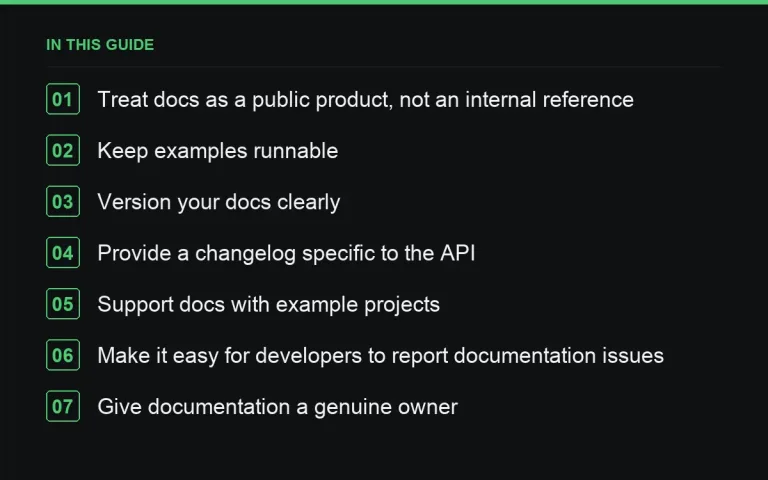
Treat docs as a public product, not an internal reference
API documentation is often written primarily for existing customers already inside the product. Writing it with an external, first-time reader in mind — clear authentication steps, complete request and response examples, and honest notes on rate limits or quirks — makes it far more useful to link to from an outside tutorial.
Keep examples runnable
Code samples that are copy-pasteable and actually work, in more than one common language where practical, get referenced far more often than pseudocode or incomplete snippets. A developer writing their own guide will link directly to a working example rather than retype your example from scratch.
Version your docs clearly
When your API changes, keep old versions of the documentation accessible and clearly labelled rather than deleting them outright. Broken links to deprecated documentation frustrate developers and can cost you the citation entirely if the old page simply disappears.
Provide a changelog specific to the API
A dedicated API changelog, separate from your general product changelog, lets developers subscribe to exactly the updates relevant to their integration, and gives them a specific page to link to when discussing a particular change in their own writing.
Support docs with example projects
- Publish a small sample application or repository demonstrating real usage of the API.
- Link the sample project from the docs and vice versa.
- Keep the sample updated as the API evolves, since a broken example undermines trust in the whole documentation set.
Make it easy for developers to report documentation issues
A visible way to flag unclear or incorrect documentation, even something as simple as a feedback link on each page, both improves the docs over time and signals to developers that the documentation is actively maintained, which supports the broader approach in https://successtoroad.com/blog/developer-audience-link-building/.
Give documentation a genuine owner
Documentation quality tends to drift when it is treated as a shared responsibility with no single owner, since everyone assumes someone else will notice gaps. Assign clear ownership, even part-time, for keeping the docs accurate and complete, and treat documentation debt with the same seriousness as code debt rather than as a lower priority.
Watch for signals docs need attention
Repeated support tickets about the same API endpoint, community questions asking for clarification, or third-party tutorials correcting your own examples are all signs the documentation needs revisiting. Treat these as free, direct feedback rather than something to be defensive about.
Offer multiple entry points for different skill levels
A quick-start guide for developers who just want to see something working, alongside a fuller reference for those building a production integration, serves two genuinely different needs that a single dense page cannot satisfy equally well. Separating these clearly also gives you two distinct pages that can each attract their own external links.
Publish an SDK or client library if it fits
An officially maintained client library in a popular language reduces friction for developers trying your API and gives them another concrete, citable resource beyond the raw documentation. Even a simple, well-documented library can become one of your most linked developer-facing assets over time.
Show real error messages and how to resolve them
Developers frequently search for the exact wording of an error message rather than a general description of the problem. A documentation page or troubleshooting section that includes verbatim error text alongside a clear explanation of the cause and fix tends to rank and get referenced for exactly the queries developers actually type.
Keep a public status and changelog page linked from the docs
Linking your API status page and changelog directly from the main documentation navigation means developers debugging an issue can quickly check whether it is a known, ongoing problem rather than something specific to their own integration. This small convenience reduces support load and reinforces the docs as a genuinely reliable reference.
Solicit direct feedback from active integrators
Reach out periodically to developers who have built substantial integrations against your API and ask what confused them early on. Their answers are usually more specific and actionable than general documentation best practice advice, since they describe exactly where your own docs fell short for a real project.
Make search inside the documentation genuinely good
A developer who cannot quickly find the specific endpoint or parameter they are looking for will leave the docs frustrated and less likely to link to them positively. Invest in decent internal search functionality within your documentation site, since this is often a bigger factor in developer satisfaction than the writing quality of any individual page.
Where to go next
Pair this with https://successtoroad.com/blog/help-centre-content-that-earns-links/ and the broader plan in https://successtoroad.com/blog/saas-link-building-guide/. To find publishers covering developer tools and APIs, browse https://successtoroad.com/niche/programming/ and https://successtoroad.com/niche/software-development/ listings, or check https://successtoroad.com/marketplace/ for more.
Frequently asked questions
Do API docs need marketing content mixed in to be effective link assets?
No, and mixing marketing language into technical documentation usually reduces its usefulness and trustworthiness to the developer audience it needs to serve.
Should API documentation live on a separate subdomain?
Either a subdomain or a subdirectory can work; what matters more is that the URL structure is stable and does not change unnecessarily, since developers link to specific pages.
How often should API documentation be reviewed for accuracy?
Whenever the API changes, and periodically even without changes, since developer feedback often reveals unclear sections that were not obvious to the original author.
Can outdated API docs actively hurt link building?
Yes. Developers who find inaccurate documentation lose trust quickly and are unlikely to link to or recommend it, and existing links to broken or outdated pages waste the SEO value already earned.
Put it into practice
Filter 54,483 websites by DR, traffic, niche and price, and order with escrow — you pay only after the link is live.
Browse the marketplace