Link Building for AI Products: Standing Out Without Overclaiming
AI products face heavy competition for attention; specificity and honesty about limitations earn more trust than hype.
AI-powered SaaS products face a specific link building challenge: the category is crowded, journalists and bloggers are fatigued by hype, and vague claims about “AI-powered” capabilities without concrete specifics get ignored. Standing out requires more specificity and more honesty about limitations than most companies in this space currently offer.
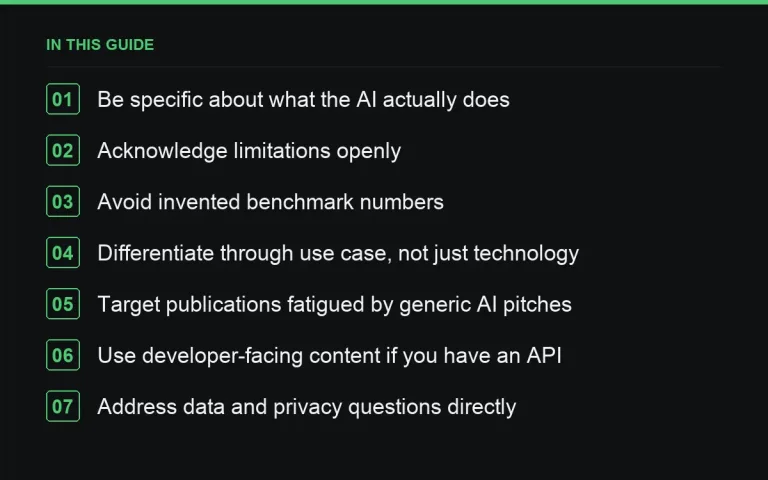
Be specific about what the AI actually does
“AI-powered” as a phrase alone means very little to a skeptical reader or editor at this point. Explain the actual mechanism in plain language: what the model does, what input it needs, and what kind of output it produces, in terms a non-technical reader can follow without jargon standing in for substance.
Acknowledge limitations openly
Content and pitches that acknowledge where the AI component genuinely struggles or needs human oversight read as more credible than ones that claim uniform, flawless performance. This kind of honesty is what separates content editors are willing to run from the generic hype pitches they reject daily.
Avoid invented benchmark numbers
Never fabricate or exaggerate accuracy percentages, speed comparisons, or benchmark results in outreach content. If you do not have independently verifiable figures, describe capabilities qualitatively instead of inventing a number that sounds precise but is not defensible.
Differentiate through use case, not just technology
Since many products now use similar underlying models, the genuinely differentiating story is usually the specific problem you solve and the workflow you support, not the technology itself. Frame content and pitches around the concrete outcome for the user, following the same logic as https://successtoroad.com/blog/product-led-content-for-saas/.
Target publications fatigued by generic AI pitches
- Lead with the specific problem solved, not the fact that AI is involved.
- Offer a concrete example or demonstration rather than an abstract capability claim.
- Be upfront about what the tool cannot yet do well, which builds unusual credibility in this space.
Use developer-facing content if you have an API
Many AI products expose an API or SDK; if yours does, the developer-audience tactics in https://successtoroad.com/blog/developer-audience-link-building/ and https://successtoroad.com/blog/api-documentation-link-asset/ apply directly and tend to cut through hype fatigue better than consumer-facing marketing content.
Address data and privacy questions directly
Readers and journalists increasingly ask what happens to the data an AI product processes, and a vague or evasive answer damages trust quickly. Address this plainly in your content and pitches, describing your actual data handling practices rather than avoiding the topic, since transparency here is itself a differentiator in a crowded field.
Avoid anthropomorphising the technology excessively
Describing an AI feature as if it independently “thinks” or “understands” in a humanlike sense tends to invite scrutiny and skepticism from technically literate readers and editors. Plain, accurate descriptions of what the system does under the hood generally hold up better to scrutiny than dramatic framing.
Show real before-and-after examples where possible
A concrete example of an actual input and the resulting output, described honestly including any need for a human to review or adjust the result, does more to build credibility than an abstract description of capability. Readers and editors trust what they can see demonstrated over what is merely claimed.
Prepare for rapid category change
The AI product landscape shifts quickly, and content written today may reference a competitive landscape that looks different within a year. Build a habit of revisiting AI-related comparison and positioning content more frequently than you would for a more stable SaaS category, since staleness here is noticed faster by a technically engaged audience.
Engage thoughtfully with public debate about AI
Broader public conversation about AI’s risks and benefits touches almost every product in this category to some degree. A measured, honest voice in that conversation, neither dismissive of legitimate concerns nor overclaiming benefits, tends to earn more durable respect from journalists and readers than either extreme.
Give technical readers a way to go deeper
Some readers will want more detail than a typical marketing page provides, such as how a feature is evaluated internally or what safeguards exist around a specific capability. A dedicated, more technical page for this audience, linked from the main content, serves them without cluttering material aimed at a general audience.
Update comparison content as models and providers change
Underlying AI models and providers change more frequently than a typical SaaS feature set, which means comparison and positioning content in this category needs more frequent review than the general cadence suggested for most other SaaS niches, simply to avoid quietly becoming inaccurate.
Separate marketing enthusiasm from product reality
It is common for a fast-moving AI product team to ship experimental capabilities that are still rough around the edges. Keep external content aligned with what is genuinely stable and reliable in production, rather than describing an experimental feature with the same confidence as one that has been proven at scale.
Where to go next
Read the wider plan in https://successtoroad.com/blog/saas-link-building-guide/, and revisit https://successtoroad.com/blog/saas-comparison-page-links/ for how to fairly compare your product against other AI tools in the same space. To find relevant publishers, browse https://successtoroad.com/niche/technology/ and https://successtoroad.com/niche/software-development/ listings, or check https://successtoroad.com/marketplace/ broadly.
Frequently asked questions
Why do generic AI product pitches get ignored by journalists now?
Because the volume of similar pitches has grown enormously and most add no specific detail beyond claiming to use AI, so editors increasingly filter for pitches with a concrete, differentiated angle instead.
Should AI SaaS companies publish their own accuracy benchmarks?
Only if the methodology is transparent and independently verifiable. Vague or unverifiable accuracy claims tend to damage credibility rather than help it.
Is acknowledging an AI product's limitations bad for marketing?
No, it typically helps. Readers and editors are more likely to trust and cite content that is honest about where a tool needs human oversight than content claiming flawless performance.
Do AI products need a different comparison page approach than other SaaS?
The core approach is the same as {{post:saas-comparison-page-links}}, but with extra care to compare actual capabilities and limitations rather than marketing claims about the underlying model.
Put it into practice
Filter 54,483 websites by DR, traffic, niche and price, and order with escrow — you pay only after the link is live.
Browse the marketplace