Writing Titles and Headlines That Rank and Get Clicked
The title is what searchers see first. It needs to match what they want and give them a reason to choose you.
Your title tag and on-page headline do two jobs at once: they influence ranking by signalling relevance, and they influence click-through by convincing a searcher your result is the one worth opening. A good title does both without resorting to clickbait that damages trust the moment someone lands on the page.
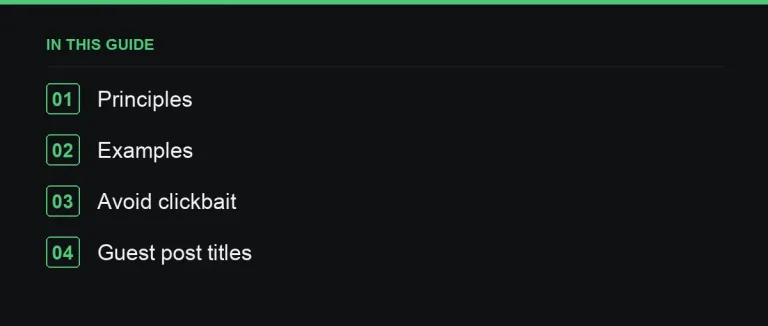
Principles that hold up across niches
- Match search intent — a “how to” query needs a how-to title, a comparison query needs a comparison title (see search intent).
- Lead with the topic — put the main phrase near the start rather than burying it after a brand name or a vague framing.
- Be specific — “12 red flags to check before you pay” beats “some signs to watch for” because it sets a concrete, checkable expectation.
- Give a reason to click — a year, a format, a clear benefit that distinguishes the result from ten similar-looking ones on the same page.
- Keep it readable in the results — roughly 50–60 characters for title tags keeps most of the title visible rather than truncated.
Before and after: weak titles rewritten
| Weak | Stronger |
|---|---|
| Guest Posts | How to Evaluate a Guest Post Site Before You Pay |
| Anchor Text Tips | Anchor Text for Guest Posts: A Safe, Natural Mix |
| Link Building Guide | Link Building Checklist: Before, During and After a Campaign |
Notice the pattern: the stronger version names the actual outcome or format, rather than describing the topic in the abstract.
Avoid clickbait
Titles that overpromise raise clicks briefly and then lose trust the moment the page doesn’t deliver, which shows up as high bounce rates and, over time, weaker rankings as search engines register that mismatch between promise and content. Search engines may also rewrite titles that don’t accurately reflect the page, in which case your carefully written title never even gets shown.
Writing titles for guest post pitches specifically
When pitching a guest post, suggest a title that fits the host site’s existing style rather than your own house style — editors are more likely to accept a piece that already reads like it belongs on their site (see choosing topics that get accepted). A title that works well on your own blog can look out of place, or even off-brand, dropped into someone else’s publication.
Testing titles without guesswork
If a page’s rankings are reasonable but click-through rate looks low relative to its position in Search Console, the title is one of the first things worth testing. Rewrite it to be more specific or to better match the phrasing searchers actually use, then give it a few weeks before checking whether click-through improved — title changes need time to show a stable trend, the same as any other change measured through organic traffic analytics.
A short checklist before publishing
- Does the title match the actual intent of the page’s content?
- Is the primary keyword phrase present and near the front?
- Is there something specific — a number, a format, an outcome — that isn’t generic?
- Would you personally click this over a similar-looking competing result?
H1 versus title tag
They don’t have to be identical. The title tag is written for the search results page; the H1 is written for the reader who has already arrived. It’s fine for the H1 to be slightly more conversational as long as it still accurately reflects the page and doesn’t confuse someone who clicked expecting the title tag’s promise.
Writing headlines for different content types
Glossary and definition pages
A direct “What Is X?” phrasing tends to outperform a cleverer alternative, since it mirrors exactly how people search and sets up a snippet-friendly answer immediately below it.
List and roundup content
A specific number in the title (“12 red flags”, not “several red flags”) sets a concrete, checkable expectation that tends to earn more trust than a vague quantity, and gives you a natural structure to fulfil in the body.
Opinion or analysis pieces
These can afford a slightly more distinctive voice than a strict how-to title, since the reader is looking for a perspective rather than a literal set of steps — but the topic still needs to be clear from the title alone.
How headline quality interacts with the rest of the page
A strong title earns the click, but a page that doesn’t deliver on its specific promise loses the reader within seconds and teaches search engines that the match was weaker than the title suggested. Treat headline writing as a promise you then have to keep in the opening paragraph, not a separate marketing exercise disconnected from the content underneath it.
Where to go next
Pair strong titles with the broader structure covered in content clusters and links, and revisit weak-performing titles as part of your next content audit. If you’re preparing content specifically to pitch for placements, browse https://successtoroad.com/marketplace/ to see how publishers in your niche typically title their own articles.
Frequently asked questions
How long should a title tag be?
Around 50–60 characters is a common guide, since longer titles are more likely to be truncated or rewritten in search results.
Should the title tag and H1 be the same?
They can differ. The title tag targets the search results page; the H1 addresses the reader who has already arrived and can be more conversational.
Why does Google rewrite my titles?
It may rewrite titles that don't accurately reflect the page's content, are too long, or don't match how people phrase the underlying query.
Does a specific number in a title actually help?
It tends to set a clearer, checkable expectation than a vague phrase, which can improve click-through even without changing the ranking position.
Put it into practice
Filter 54,483 websites by DR, traffic, niche and price, and order with escrow — you pay only after the link is live.
Browse the marketplace