Writing Introductions That Earn the Read
The first three sentences decide whether a guest post gets read or bounced; here is how to write ones that work.
Editors and readers both make a keep-or-leave decision inside the first three sentences. If your introduction spends that time warming up, restating the title, or promising value it hasn’t delivered yet, you lose both audiences before the argument even starts. A guest post intro has a narrower job than a personal blog intro: it has to satisfy an editor scanning for fit in ten seconds, and a reader who arrived from a search query with a specific question in mind.
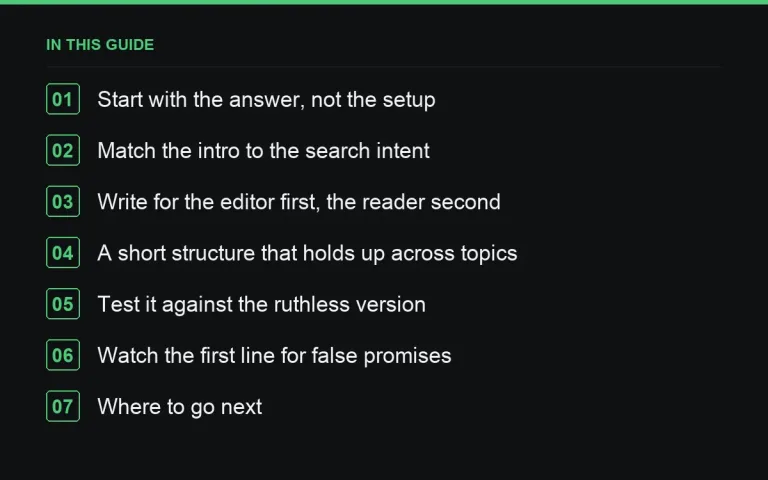
Start with the answer, not the setup
The most reliable opening move is to answer the implied question in the first sentence, then use the next two to add the nuance that makes the rest of the article worth reading. If someone searched “how to write an author bio for a guest post,” the opening line should tell them what a good bio contains, not explain why bios matter in the abstract. Save the context for paragraph two, once you’ve proven you’re going to be useful.
Cut the throat-clearing
Phrases like “in the world of content marketing” or “these days, more than ever” add nothing a reader can use. They exist because the sentence needs a subject and the writer hasn’t decided on one yet. Read your opening paragraph and delete any sentence that would still be true if you published it in 2015 or 2035 — if a sentence is timeless in that lazy way, it’s usually filler.
Match the intro to the search intent
An intro for a “what is” query should define the term plainly in sentence one. An intro for a “how to” query should state the outcome the steps produce. An intro for a comparison piece should name the two things being compared and hint at the deciding factor. Writers who template every intro the same way — a rhetorical question, then a statistic, then “in this article” — produce openings that read as filler because they are filler; the shape is decided before the topic is.
The rhetorical question trap
“Have you ever wondered how top brands get featured in major publications?” is a sentence that could open almost any article on almost any topic. If your opening question could be swapped into a competitor’s article without editing, it isn’t doing any work specific to your piece. Use a question only if the answer that follows is genuinely surprising or specific.
Write for the editor first, the reader second
When you’re pitching https://successtoroad.com/blog/writing-for-publishers/, remember the editor reads the intro before anyone else does, often as the only thing they read before accepting or rejecting a draft. An intro that’s vague, generic, or padded signals a vague, generic, padded article to follow — editors have seen enough drafts to read that signal accurately. Tightening the first paragraph is often the highest-leverage edit you can make to a submission.
A short structure that holds up across topics
- Sentence one: the direct answer or the core claim, stated plainly.
- Sentence two: the complication, exception, or “but it depends on” that earns the rest of the article.
- Sentence three: what the reader will be able to do or decide once they finish reading.
This isn’t a formula to fill in mechanically — it’s a checklist for what an intro needs to contain, in roughly that order, before you let yourself write anything more decorative.
Test it against the ruthless version
A useful exercise: write the most boring, literal, three-sentence version of your intro first. Then decide what, if anything, needs to be added for voice or personality. Most writers do the opposite — they write the clever version first and never check whether the substance underneath actually holds. Building up from a plain answer is more reliable than stripping down from a flourish, especially when you’re https://successtoroad.com/blog/matching-tone-to-a-host-publication/ you don’t know well.
Watch the first line for false promises
An intro can accidentally promise something the article doesn’t deliver — naming five methods when the body only covers three, or implying a beginner-friendly piece before diving into jargon two paragraphs later. Read your finished intro against your finished body once both are drafted, not just against your outline, since the two tend to drift apart during writing. If the intro promises a specific number, count the actual items in the body and make them match exactly.
One anecdote can outperform three abstractions
A short, concrete scene — a specific pitch that got rejected, a specific editor’s actual feedback, paraphrased without inventing detail — grounds an intro faster than a paragraph of general claims about why the topic matters. This works because a reader can picture a scene immediately, while an abstract claim needs to be processed and evaluated before it lands. Use this sparingly; not every intro needs a story, but when the topic risks feeling dry, a well-chosen concrete moment does more than another sentence of explanation.
Where to go next
Once your opening earns the read, the rest of the piece needs to keep that promise — see our guides to https://successtoroad.com/blog/writing-for-skimmers/ and https://successtoroad.com/blog/writing-conclusions-that-convert/ for the middle and the close. If you’re placing the piece as part of a paid campaign, browse https://successtoroad.com/services/writing/ for writers who already understand editor expectations, or check https://successtoroad.com/marketplace/ for publications in your niche before you start drafting so the tone target is clear from sentence one.
Frequently asked questions
How long should a guest post introduction be?
Two to four sentences is usually enough. The intro's job is to state the answer and the stakes, not to summarise the whole article — save the detail for the body sections that follow.
Is it ever fine to open with a statistic?
Yes, if the number is real, sourced, and specific to your claim — not a rounded, unsourced figure used as decoration. If you can't verify it, use a concrete example instead; see {{post:using-examples-instead-of-statistics}}.
Should I write the introduction first or last?
Many experienced writers draft the body first, then write the intro once they know exactly what the article delivers. It's easier to write an accurate opening line when you're not guessing at your own conclusion.
How do I know if my intro matches a publication's style?
Read three recent articles on the target site and note how they open — question, statement, anecdote, or definition. Copy the pattern, not the words, and adjust once you've placed a few posts there.
Put it into practice
Filter 54,483 websites by DR, traffic, niche and price, and order with escrow — you pay only after the link is live.
Browse the marketplace