Writing for Skimmers Without Dumbing Down the Content
Most readers skim before they decide to read; structure your posts so both behaviours get something worth their time.
Most people don’t read a web article top to bottom on a first pass — they scroll, scan headings, and decide in a few seconds whether to slow down. Writing for skimmers doesn’t mean simplifying your argument; it means making the structure carry meaning on its own, so a reader who only reads headings and bolded phrases still walks away with something accurate, and a reader who commits to the full piece finds the depth waiting underneath.
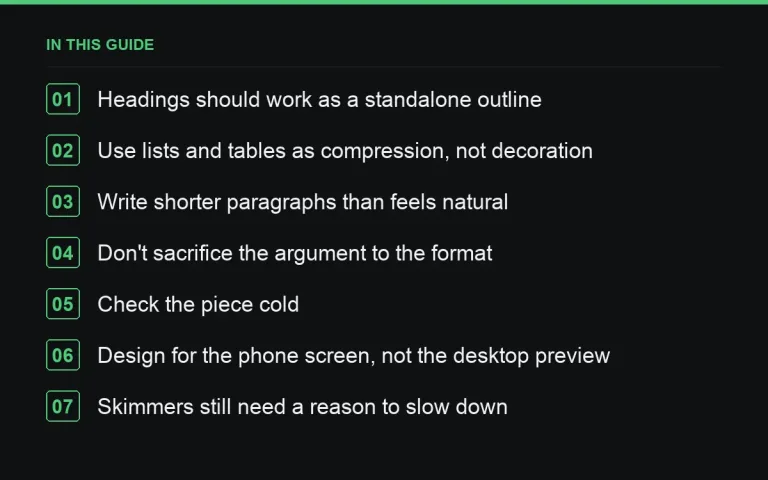
Headings should work as a standalone outline
If you strip out every paragraph and read just the H2s and H3s, they should form a coherent, specific summary of the argument — not a vague sequence like “Introduction,” “Benefits,” “Conclusion.” Compare “Benefits of Guest Posting” with “Why Guest Posts Outperform Directory Links for Referral Traffic.” The second heading tells a skimmer something even if they read nothing else.
Front-load the point in every section
Under each heading, put the main claim in the first sentence, then support it. Readers scanning down a page read the first line of each paragraph far more often than the rest; if that line is a lead-in (“There are several factors to consider here…”) rather than the actual point, skimmers miss the content entirely and full readers have to wait for the payoff.
Use lists and tables as compression, not decoration
A list is appropriate when items are genuinely parallel — steps in a sequence, criteria in a decision, items in a set. Converting a paragraph into a list purely to look scannable, when the ideas don’t have that parallel structure, produces choppy fragments that lose the connecting logic. Reserve https://successtoroad.com/blog/writing-comparison-tables/ for genuine side-by-side comparisons, and use bullet points when each item really could stand alone.
Bold text is a spotlight, not a highlighter
Bolding one phrase per section to mark the key takeaway helps skimmers; bolding several phrases per paragraph trains the eye to ignore bold text altogether. If everything is emphasised, nothing is — pick the single sentence per section that a skimmer most needs and leave the rest in plain text.
Write shorter paragraphs than feels natural
Three to four sentences per paragraph is a reasonable ceiling for web content, even when a longer paragraph would read fine in print. Long unbroken blocks of text look like more effort than a skimmer is willing to spend, regardless of how good the writing is inside them — see https://successtoroad.com/blog/readability-and-sentence-length/ for more on this.
Don’t sacrifice the argument to the format
The risk of writing for skimmers is flattening every idea into bullet points and losing the reasoning that connects them. Keep the connective tissue — the “because,” “however,” “which means” — in the prose sections, and use lists only where they genuinely compress information without losing an argument. A skimmer-friendly post and a shallow post are not the same thing; the goal is accessible structure around real substance, which matters as much when you’re https://successtoroad.com/blog/writing-for-expert-audiences/ as when you’re writing for a general reader.
Check the piece cold
Before you submit a draft, scroll through it quickly the way a first-time reader would — headings, bold text, list items only. If that pass leaves you with an accurate, if incomplete, picture of the argument, the structure is doing its job. If it leaves you confused or with a misleading impression, the headings or topic sentences need rework, not just the paragraphs underneath them.
Design for the phone screen, not the desktop preview
Most guest post traffic arrives on a phone, where a paragraph that looks reasonably short in a desktop editor can stretch across six or seven lines on a small screen. Preview your draft at mobile width before submitting, if the platform allows it, and shorten anything that turns into a dense block once wrapped that narrow. A heading that sits three lines below the last one on desktop can end up eight lines below on mobile, which changes how skimmable the piece actually feels to most readers.
Subheadings are also a promise to the search engine
Beyond the human skimmer, headings are frequently what search engines and AI summarisers extract to represent a page’s structure. A vague heading undersells the section to both audiences at once, while a specific one does double duty — it’s worth treating heading-writing as seriously as sentence-writing rather than an afterthought added once the paragraphs are finished.
Skimmers still need a reason to slow down
The end goal of skim-friendly structure isn’t to keep every reader skimming forever — it’s to give a fast-moving reader enough signal, in the parts they do read, to recognise when a section is worth slowing down for. A heading and topic sentence that clearly flag “this is the part with the actual trade-off” pull a skimmer into careful reading exactly where it matters, rather than leaving that decision to chance.
Where to go next
Pair this with our guide to https://successtoroad.com/blog/writing-introductions-that-earn-the-read/ so the scanning reader is hooked from line one, and https://successtoroad.com/blog/writing-checklists-that-get-used/ for when a full checklist format is the better call. If you’re commissioning this kind of structured writing at volume, https://successtoroad.com/services/writing/ lists writers who build for skimmers by default, and https://successtoroad.com/marketplace/ has publishers across every niche if you need a placement that matches the piece’s tone.
Frequently asked questions
Does writing for skimmers mean using shorter sentences everywhere?
Not necessarily — it means the structure (headings, first lines, lists) carries the meaning on its own. Sentence length matters too, but structure is the bigger lever for scanning readers.
How many headings should a 1,000-word post have?
Four to six H2s is typical for that length, each covering one distinct idea. Fewer and sections get bloated; more and the piece feels chopped into fragments too small to develop.
Is it bad to repeat the main point in the intro and again in a heading?
No — skimmers often only see one of the two, so restating the core claim in different words at different points in the structure is intentional redundancy, not repetition.
Should every guest post include a bulleted list?
Only if the content has genuinely parallel items. Forcing a list into a post that's really one continuous argument makes the piece harder to follow, not easier.
Put it into practice
Filter 54,483 websites by DR, traffic, niche and price, and order with escrow — you pay only after the link is live.
Browse the marketplace