Writing for Expert Audiences Without Losing General Readers
Expert readers bounce fast from content that explains the obvious; here is how to write for them without alienating everyone else.

An expert reader can tell within a paragraph whether a piece was written by someone who understands the field or someone summarising it from outside. Writing for that audience means skipping the explanations they already have and spending your word count on the parts they don’t — the judgment calls, trade-offs, and edge cases that only show up with real experience.
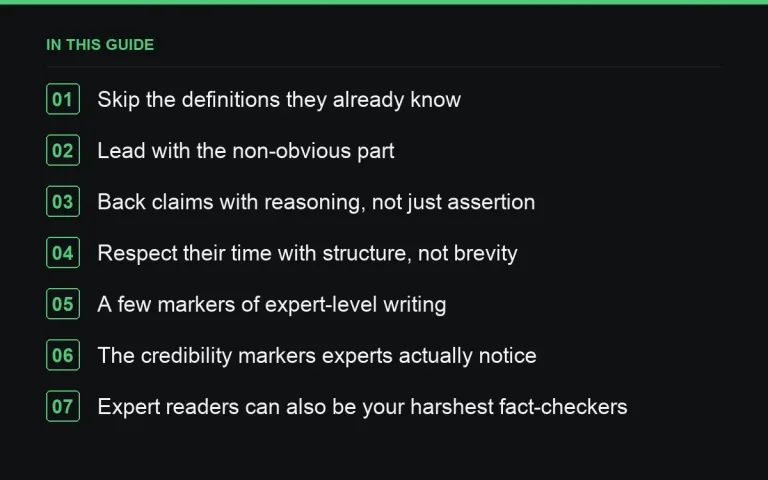
Skip the definitions they already know
A guest post for a marketing operations audience doesn’t need to explain what a CRM is. A post for developers doesn’t need to explain what an API is. Every sentence spent defining a basic term is a sentence an expert reader skips, and enough of them will make the reader assume the whole piece is introductory and leave. If you’re unsure whether a term needs defining, check how the host publication’s own recent articles handle it — see https://successtoroad.com/blog/matching-tone-to-a-host-publication/.
Assume shared vocabulary, not shared context
Experts know the terms but don’t know your specific situation, numbers, or constraints — that’s exactly what they’re reading for. Spend the space you saved on basic definitions describing the actual scenario, the decision you faced, and why the obvious answer wasn’t the right one.
Lead with the non-obvious part
Expert content earns attention by disagreeing with, complicating, or narrowing a piece of conventional wisdom the reader already holds. “Do X” is not interesting to someone who already does X. “Do X, except when Y, and here’s how to tell the difference” is. Structure the piece around the exceptions and judgment calls rather than the standard procedure.
Use precise, not simplified, language
Where a consumer piece might round a concept off to something approximate for clarity, an expert piece should use the precise term even if it’s slightly more technical, because precision is itself a signal of credibility to this audience. This is one of the clearest differences from https://successtoroad.com/blog/writing-for-consumer-audiences/, where the opposite instinct usually applies.
Back claims with reasoning, not just assertion
Expert readers push back mentally on unsupported claims far more than general readers do. Where you’d get away with “this approach works better” for a general audience, an expert audience wants the mechanism — why it works better, under what conditions it doesn’t, and what you’d expect to see if it failed. This is also where https://successtoroad.com/blog/using-examples-instead-of-statistics/ becomes especially useful: a concrete, specific example of the mechanism in action is more convincing to a specialist than a vague claim of superiority.
Respect their time with structure, not brevity
Expert audiences aren’t necessarily looking for shorter content — a genuinely detailed technical piece can run long and still hold attention if every paragraph earns its place. What they won’t tolerate is padding: restated points, obvious caveats, or introductory throat-clearing before the substance starts. Apply https://successtoroad.com/blog/writing-for-skimmers/ principles for structure, but don’t confuse structure with dumbing down the content itself.
A few markers of expert-level writing
- Named exceptions and edge cases, not just the general rule.
- Precise terminology used consistently, without simplification for its own sake.
- Reasoning shown, not just conclusions asserted.
- Specific scenarios and numbers where they can be verified, not rounded generalities.
The credibility markers experts actually notice
Beyond vocabulary and structure, expert readers pick up on small signals that a writer has real hands-on experience rather than researched familiarity: mentioning a tool’s specific limitation rather than just its features, noting a step that commonly gets skipped in practice even though documentation says otherwise, or naming the situation where standard advice actually backfires. These details are hard to fake convincingly, which is exactly why they carry so much weight — a piece full of them reads as written by a practitioner, and a piece missing them reads as written by someone who read about the topic rather than lived it.
Don’t perform expertise you don’t have
If you’re writing for an expert audience on a topic where your own experience is more limited than the brief assumes, it’s better to narrow the piece’s scope to what you genuinely know well than to pad it with confident-sounding claims you can’t actually back up under scrutiny. Expert readers are unusually good at detecting this, and the reputational cost of being caught overstating expertise tends to outweigh the benefit of covering a broader topic than you’re equipped for.
Expert readers can also be your harshest fact-checkers
An expert audience is disproportionately likely to notice a subtly wrong claim, a misapplied term, or an outdated recommendation, since they have the background to catch what a general reader would take at face value. This raises the stakes on the sourcing and verification discipline in https://successtoroad.com/blog/citing-sources-in-guest-posts/ specifically for this audience — a single caught error can undermine trust in everything else the piece claims, even the parts that were accurate.
Where to go next
For the audience-tone balance from the other direction, read https://successtoroad.com/blog/writing-for-consumer-audiences/, and pair this with https://successtoroad.com/blog/citing-sources-in-guest-posts/ since expert readers are the quickest to check your sourcing. If you need writers with genuine subject-matter depth for a technical vertical, browse https://successtoroad.com/services/writing/, and check https://successtoroad.com/niche/technology/ or https://successtoroad.com/niche/business/ on https://successtoroad.com/marketplace/ for publications whose existing audience already skews expert.
Frequently asked questions
How do I know if a publication's audience counts as expert?
Read the comments, the depth of the articles themselves, and whether the site explains basic terms or assumes them. Trade publications and vertical-specific blogs usually signal this clearly within a few articles.
Is jargon acceptable for expert audiences?
Field-standard terminology is fine and often expected; jargon invented to sound sophisticated, or acronyms without any context on first use, is not. The test is whether a genuine practitioner in that field would use the term naturally.
Should expert content still have an introduction and conclusion?
Yes, but shorter and more direct — skip generic framing and get to the specific claim or scenario the piece addresses, since that audience decides quickly whether to keep reading.
Can a guest post be written for both experts and general readers at once?
It's difficult to do well. Usually one audience is primary and the piece should commit to serving them properly rather than diluting the content trying to satisfy both equally.
Put it into practice
Filter 54,483 websites by DR, traffic, niche and price, and order with escrow — you pay only after the link is live.
Browse the marketplace