Writing for Consumer Audiences in Guest Posts
Consumer audiences need clarity and relevance, not less intelligence; here is how to write for them well.

Writing for a general consumer audience is often mistaken for writing “simpler” content, and that mistake produces guest posts that talk down to readers without actually helping them. Consumer readers aren’t less intelligent than expert readers — they simply don’t share the same background context, so the job is to supply the context efficiently, not to strip out the substance.
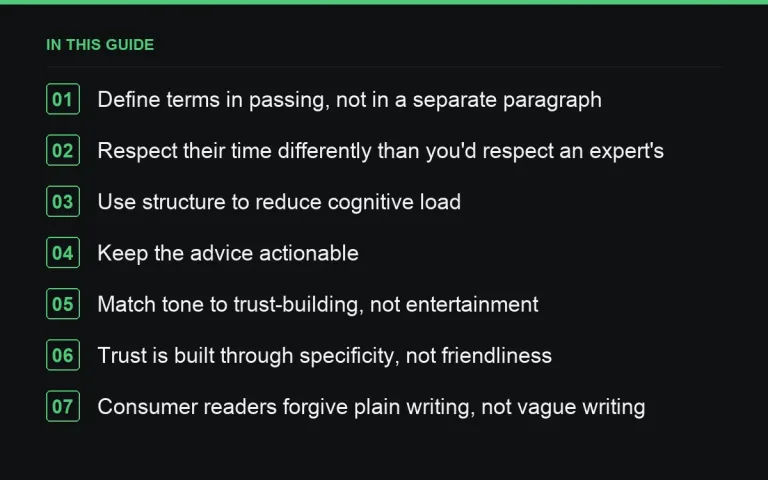
Define terms in passing, not in a separate paragraph
The most efficient way to handle unfamiliar terms for a consumer audience is a short in-line clarification rather than a standalone definition paragraph that interrupts the flow. “A chargeback — when a bank reverses a payment on a customer’s behalf — can take weeks to resolve” keeps momentum while still supplying the needed context. Compare this with https://successtoroad.com/blog/definitions-and-glossaries-in-guest-posts/ for when a fuller glossary treatment is actually the better format.
Anchor abstract ideas in concrete situations
Consumer readers engage far more with a specific, relatable scenario than with an abstract principle. “Choosing the wrong hosting plan” is abstract; “signing up for shared hosting and then watching your site slow down during a product launch” is concrete and immediately understandable. This is the same instinct behind https://successtoroad.com/blog/using-examples-instead-of-statistics/ — a vivid example does more work than a precise but bloodless statement of the general rule.
Respect their time differently than you’d respect an expert’s
A consumer reader’s attention is fragile not because they’re impatient by nature but because they usually arrived with a narrow, specific question and will leave the moment the content stops addressing it. Keep the piece tightly scoped to that question rather than expanding into adjacent territory that feels more like it belongs in https://successtoroad.com/blog/writing-for-expert-audiences/ content.
Avoid patronising qualifiers
Phrases like “as you probably know” or “it’s simple, really” don’t make content friendlier — they can read as condescending, especially if the reader in fact did not know. State things plainly and let the clarity itself do the work of feeling accessible, rather than adding a verbal pat on the head around it.
Use structure to reduce cognitive load
Consumer content benefits heavily from the techniques in https://successtoroad.com/blog/writing-for-skimmers/ — short paragraphs, clear headings, and lists for anything with distinct steps or options. This isn’t about intelligence; it’s about the reality that consumer readers are often reading on a phone, in a spare moment, without the dedicated attention an expert reader researching their field might give a piece.
Keep the advice actionable
- State what the reader should actually do, not just what’s generally true.
- Include at least one concrete scenario per major section.
- Avoid nested caveats — one clear exception is fine, three stacked ones aren’t.
- End sections with the practical implication, not just the observation.
A consumer audience reading about, say, choosing a web host wants to know which plan fits their situation, not an exhaustive taxonomy of hosting architecture.
Match tone to trust-building, not entertainment
Consumer content sometimes over-corrects into forced casualness — excessive exclamation points, forced humour, or an overly chatty voice that doesn’t match the topic’s seriousness. Warmth and clarity build trust; performed enthusiasm usually undermines it. This matters even more for https://successtoroad.com/blog/writing-ymyl-topics-responsibly/, where consumer trust is directly tied to how measured the tone is.
Trust is built through specificity, not friendliness
A common misconception is that consumer content builds trust mainly through a warm, approachable tone. Tone helps, but the bigger trust driver is specificity: a piece that names the exact situation a reader is in, the exact trade-off they’re weighing, and the exact next step for their case reads as more trustworthy than a warmer piece that stays general throughout. This matters especially for topics readers approach with genuine uncertainty, where https://successtoroad.com/blog/writing-ymyl-topics-responsibly/ sets out a stricter version of the same principle.
Test your draft against a specific reader, not an average one
Before finalising a consumer-facing draft, picture one plausible reader in a specific situation — not a demographic average, but someone with a particular budget, particular constraint, or particular level of prior knowledge — and check whether the piece genuinely helps that person make a decision. Writing for an imagined average reader tends to produce vaguer, less useful advice than writing for one specific, plausible person.
Consumer readers forgive plain writing, not vague writing
A common fear is that unpolished, plain-spoken content will look amateurish to a consumer audience, so writers over-compensate with elaborate phrasing that ends up muddying the actual point. In practice, consumer readers are far more forgiving of plain, unpolished sentences that are clear than they are of polished sentences that leave them unsure what to actually do — clarity, not sophistication, is what consumer content is judged on.
Where to go next
Pair this with https://successtoroad.com/blog/writing-conclusions-that-convert/ so the piece ends with a next step a consumer reader can actually act on, and https://successtoroad.com/blog/meta-descriptions-for-guest-posts/ since that’s often the first consumer-facing text a reader ever sees. For placements on general-audience sites, https://successtoroad.com/services/writing/ covers commissioning this style directly, and https://successtoroad.com/niche/lifestyle/ or https://successtoroad.com/niche/general/ on https://successtoroad.com/marketplace/ are good starting points for browsing publishers.
Frequently asked questions
Is consumer content just simpler expert content?
No — it's differently scoped, not lower quality. It answers a narrower, more specific question with concrete examples rather than covering the same ground with fewer technical terms.
How much explanation of basic terms is too much?
If a definition takes more than a sentence or two, consider whether the reader needed that background at all for this particular article, or whether it belongs in a separate glossary piece instead.
Should consumer content avoid all technical terms?
Not entirely — use the term with a brief clarification rather than avoiding it altogether, since readers will encounter the real term elsewhere and benefit from recognising it.
Does consumer writing need to be shorter than expert writing?
Not necessarily in word count, but it should stay tightly scoped to one specific question rather than exploring tangents, which keeps it feeling shorter even at a similar length.
Put it into practice
Filter 54,483 websites by DR, traffic, niche and price, and order with escrow — you pay only after the link is live.
Browse the marketplace