Writing FAQs That Answer Real Questions People Ask
A weak FAQ section restates the article in question form; a strong one answers what readers actually search next.
The easiest way to spot a low-effort FAQ section is that every question is a thin rephrasing of a heading already in the article, and every answer just repeats a sentence from the body. A genuinely useful FAQ section answers the questions a reader forms after reading the article — the follow-ups, edge cases, and practical “but what about” questions the main piece didn’t have room for.
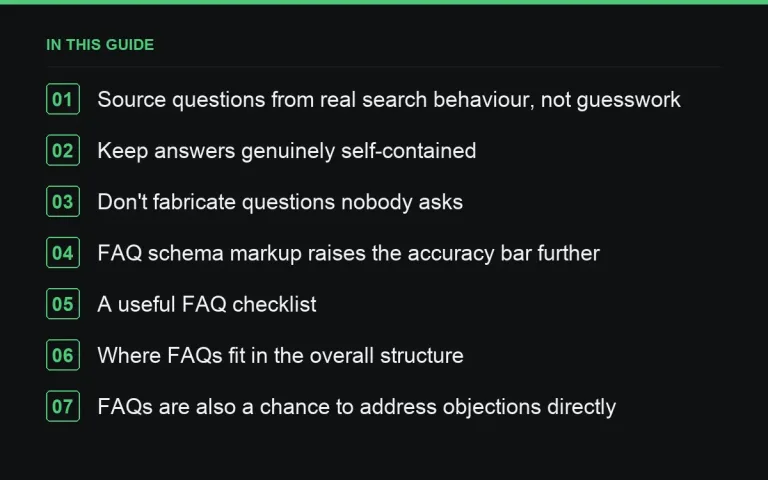
Source questions from real search behaviour, not guesswork
Look at what people actually type into search engines around your topic — the autocomplete suggestions and the related-question panels are a genuine reflection of real curiosity, not invented for the sake of the format. Writing FAQs this way makes the section useful for readers and for search visibility at the same time, which is part of why https://successtoroad.com/blog/faq-pages-and-seo/ treats this format as more than decoration.
Include the awkward or edge-case questions
The most valuable FAQ entries often address situations the main article’s structure couldn’t accommodate — what happens if a common assumption doesn’t hold, or what to do in an unusual but real scenario. These are exactly the questions a reader is left with after finishing the piece, and answering them is what makes an FAQ section feel like it was written for the reader rather than for the format.
Keep answers genuinely self-contained
An FAQ answer should make sense to someone who skipped straight to it without reading the article above. Referring back to “the method described above” without restating what that method is fails this test — briefly restate the necessary context within the answer itself, even at the cost of a small amount of repetition.
Match answer length to the question’s complexity
Not every FAQ answer needs the same length. A yes or no question with a simple qualifier might need one sentence; a genuinely nuanced question might need three or four. Padding a simple answer to hit a word count, or cramming a complex answer into one sentence, both produce a worse FAQ section than answering each question at its natural length.
Don’t fabricate questions nobody asks
It’s tempting to invent a flattering question purely to work in a promotional answer — why is a given service the best choice for this. This reads as an obvious plant and undermines the credibility of the genuine questions around it. Keep every FAQ entry an honest reflection of something a real reader would actually wonder.
FAQ schema markup raises the accuracy bar further
Where a platform supports structured FAQ markup that can surface answers directly in search results, the accuracy and self-containment of each answer matters even more, since it may be read entirely out of context from the article around it. Write every FAQ answer as though it might be the only piece of your content a particular reader ever sees, which is a genuinely useful discipline whether or not structured markup is actually applied.
A useful FAQ checklist
- Each question reflects something a real reader would search or wonder, not a rephrased heading.
- Each answer stands alone without requiring the article above it.
- Answer length matches the question’s actual complexity.
- No question exists purely as a vehicle for a promotional answer.
Where FAQs fit in the overall structure
Place the FAQ section after the main body and before or alongside the closing section, so it reads as a genuine supplement rather than a replacement for a weak conclusion — see https://successtoroad.com/blog/writing-conclusions-that-convert/ for how the two sections should divide labour rather than duplicate each other.
FAQs are also a chance to address objections directly
A reader who’s read the whole article and still hasn’t acted often has an unspoken objection — a cost concern, a time concern, a doubt about whether the advice applies to their specific situation. A well-chosen FAQ question can surface and answer that objection directly: “is this worth it if I only publish a few guest posts a year?” This works precisely because it names the hesitation a reader might feel but wouldn’t otherwise see addressed anywhere in the piece.
Avoid stacking too many similar questions
Several FAQ entries that are really the same question phrased slightly differently dilute the section rather than strengthening it. Before finalising, check whether any two questions could be merged into one more complete answer without losing anything — a tighter set of genuinely distinct questions serves readers better than a longer list padded with near-duplicates.
Review your FAQ section the way you’d review a colleague’s
Applying the same skeptical, specific-feedback mindset from https://successtoroad.com/blog/reviewing-a-writers-draft/ to your own FAQ section — asking whether each question and answer genuinely earns its place, rather than assuming the format automatically adds value — catches the weakest, most generic entries before publication, leaving only the ones that actually serve a real reader’s remaining curiosity.
Where to go next
Pair this with https://successtoroad.com/blog/faq-pages-and-seo/ for the search-visibility angle on this format, and https://successtoroad.com/blog/definitions-and-glossaries-in-guest-posts/ for when a question is really just asking for a definition. If you’re commissioning FAQ-rich content at scale, https://successtoroad.com/services/writing/ covers finding writers who research real search questions rather than inventing them, and https://successtoroad.com/marketplace/ lists publishers across niches where this format performs consistently well.
Frequently asked questions
How many FAQ questions should a guest post include?
Three to five is typical — enough to cover genuine follow-up questions without turning the section into a second article.
Should FAQ answers repeat content already in the article?
A brief restatement of necessary context is fine so the answer stands alone, but the answer should add something the main body didn't fully cover, not just copy a sentence verbatim.
Where do I find the actual questions readers are asking?
Search engine autocomplete and related-question panels around your topic are a reasonably reliable, low-effort way to see genuine search behaviour rather than guessing.
Is it fine to include a promotional question in the FAQ?
Only if it's a question a real reader would plausibly ask and the answer is honest rather than purely a pitch. An obviously invented flattering question undermines the rest of the section.
Put it into practice
Filter 54,483 websites by DR, traffic, niche and price, and order with escrow — you pay only after the link is live.
Browse the marketplace