Writing Conclusions That Convert Without Feeling Like a Pitch
A strong close turns an engaged reader into a click; here is how to write one that does not feel bolted on.
Most guest post conclusions do one of two things badly: they either restate the introduction almost word for word, adding nothing, or they lurch into an unrelated sales pitch that has nothing to do with the argument the reader just followed. A conclusion that converts does neither — it answers the reader’s natural next question, “so what do I do with this,” and points them toward exactly that.
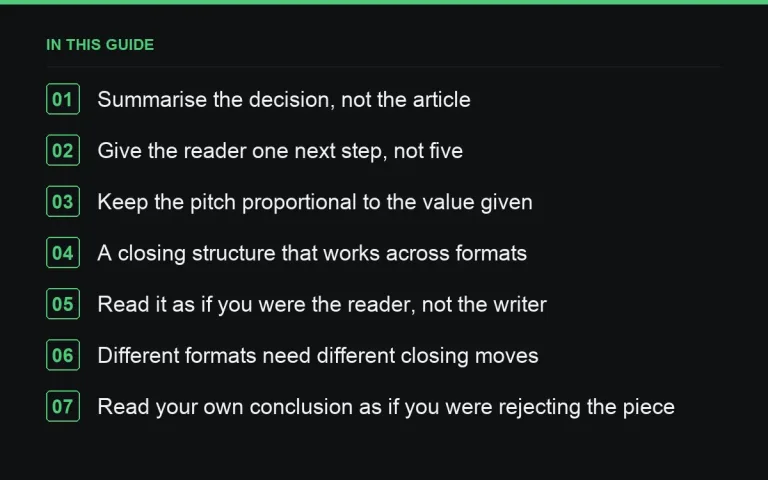
Summarise the decision, not the article
A weak conclusion recaps every section in order: “We covered X, then Y, then Z.” A strong conclusion distils the piece into the one decision or action the reader should now be equipped to make. If the article compared two approaches, the conclusion should say which one fits which situation — not just remind the reader that two approaches exist.
Avoid the word “conclusion” as a heading
Headings like “Final Thoughts” or “Wrapping Up” signal to a skimming reader that nothing new is coming, which is often true and often the problem. A heading that names the actual takeaway — “Which Approach Fits a Small Team” — keeps the section earning attention right to the last line.
Give the reader one next step, not five
Guest posts commonly end with a scattershot list of links and calls to action: read this, subscribe to that, try this tool, follow us here. A reader facing five options usually takes none. Pick the single most relevant next step for the specific reader this article was written for, and make that the one clear link in the closing paragraph.
Match the ask to the intent
Someone who just read a tutorial on outreach templates is ready for a related tactical piece, not a generic “contact us” pitch. Someone who read a strategic overview piece might be closer to a service or tool. Writing conclusions that convert means diagnosing where the reader is in their decision and offering the next logical step from there, not the next step that’s most convenient for you.
Keep the pitch proportional to the value given
A 1,000-word article that delivers genuinely useful detail has earned the right to a closing mention of a relevant service. A thin article that pivots hard into a pitch in the last two paragraphs reads as exactly what it is. Editors reviewing guest posts for https://successtoroad.com/blog/writing-for-publishers/ are especially alert to this imbalance, and it’s one of the most common reasons a otherwise-acceptable draft gets sent back for revision.
A closing structure that works across formats
- One sentence restating the core decision or takeaway in fresh words.
- One sentence acknowledging the exception or edge case, so the advice doesn’t read as absolute.
- One sentence with a single, relevant next step or link.
This holds for tutorials, opinion pieces, and comparison posts alike, though the specific next step will differ — see https://successtoroad.com/blog/step-by-step-tutorials-that-work/ for how this changes when the article’s whole point was the steps themselves.
Read it as if you were the reader, not the writer
The best check for a conclusion is to read only the last paragraph in isolation. If it makes sense as a standalone piece of advice and it’s obvious what to do next, it’s working. If it only makes sense in light of everything before it, or it feels like a separate ad that got appended, revise before you submit.
Different formats need different closing moves
A tutorial’s conclusion should confirm the reader can now do the thing the steps described, often with a one-line reminder of the outcome rather than a fresh argument. An opinion piece’s conclusion can restate the position more forcefully now that the reasoning is behind it. A comparison piece should close by matching reader situations to options rather than declaring a single winner. Treating every conclusion the same way, regardless of format, is one of the more common reasons closings feel bolted on rather than earned by what came before.
Don’t undercut your own ending with hedging
A conclusion weakened by excessive qualification — “this might work for some people in some situations” stacked three times over — leaves the reader without a clear takeaway even if the body of the article made a confident, well-supported case. Save the hedging for where it’s genuinely needed earlier in the piece, and let the conclusion state the takeaway plainly.
Read your own conclusion as if you were rejecting the piece
A useful discipline before submitting is to reread only the last paragraph and ask, deliberately skeptically, whether it earns the reader’s trust or whether it reads as a template ending swapped in regardless of the article’s actual content. If it could be lifted wholesale and pasted onto a different article on a different topic without anyone noticing, it’s too generic and needs to be tied more specifically back to what this particular piece actually argued.
Where to go next
For more on shaping the piece around a specific goal, read https://successtoroad.com/blog/writing-for-consumer-audiences/ and https://successtoroad.com/blog/writing-introductions-that-earn-the-read/ so the opening and close match in tone. When you’re ready to place a piece with a strong, converting close, https://successtoroad.com/services/writing/ covers commissioning that kind of writing directly, and https://successtoroad.com/marketplace/ lets you find publishers whose audience fits the action you’re driving toward.
Frequently asked questions
Should every guest post end with a call to action?
A relevant, single next step is fine and often expected, but it should follow naturally from the article's content. A conclusion that's purely a sales pitch with no connection to the piece reads poorly to both readers and editors.
How long should a conclusion be?
Three to five sentences is typical for an 800-1,200 word post — long enough to land the takeaway, short enough not to repeat the whole article.
Is it fine to link to a product in the conclusion?
Yes, if it's relevant to the specific reader and topic, and it's one option among the article's substance rather than the article's real purpose. Disproportionate pitching is the most common reason editors reject an otherwise good draft.
What if the article doesn't have an obvious single next step?
Pick the most common reader intent and write for that. Some ambiguity is fine — a well-written, relevant option beats five vague ones every time.
Put it into practice
Filter 54,483 websites by DR, traffic, niche and price, and order with escrow — you pay only after the link is live.
Browse the marketplace