Writing Checklists That Actually Get Used
A checklist that gets bookmarked and reused is doing more for your byline than most standard articles.

Checklists are one of the most reused content formats because they compress a process into something a reader can return to without rereading the surrounding article. But most published checklists are just bullet points restating the article’s headings, which makes them redundant rather than genuinely useful as a standalone reference.
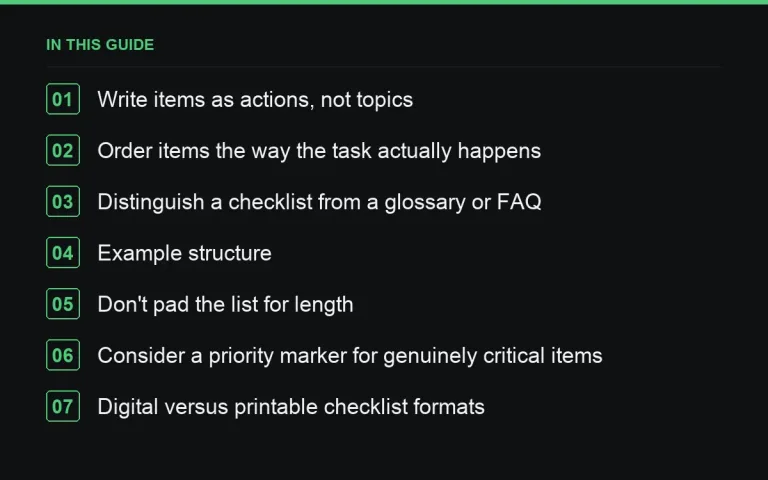
Write items as actions, not topics
“Author bio” as a checklist item tells the reader nothing they can act on. “Confirm your author bio includes one relevant credential and a working link” is something they can check off with a clear yes or no. Every item on a working checklist should be phrased so completing it is unambiguous.
Keep items independently checkable
If an item depends on context from three paragraphs earlier in the article, it fails as a standalone checklist item, because the whole point of a checklist is that someone can use it without rereading the article each time. Write each line so it makes sense in isolation.
Order items the way the task actually happens
A checklist for pitching a guest post should follow the real sequence — research the site, find the right editor, draft the pitch, follow up — rather than the order the ideas occurred to the writer. Readers use checklists sequentially far more often than they read articles sequentially, so getting the order right matters more here than almost anywhere else in the piece.
Group long checklists into short sections
A single unbroken list of twenty items is hard to use as a working reference. Group items under two or three subheadings — before you pitch, in the pitch, after acceptance — so a returning reader can jump straight to the stage they’re at instead of scanning the whole list every time.
Distinguish a checklist from a glossary or FAQ
A checklist verifies that steps were taken; it isn’t the place to explain concepts in depth. If an item needs a full paragraph of explanation to make sense, that explanation belongs in the article body or in https://successtoroad.com/blog/definitions-and-glossaries-in-guest-posts/, with the checklist item itself staying short and action-focused.
Example structure
- Confirm the target publication has covered your topic area before.
- Read five recent articles to gauge tone and typical length.
- Identify the specific editor, not a generic submissions inbox, where possible.
- Draft a subject line that states the article’s angle, not just the topic.
- Follow up once, after a reasonable interval, if you hear nothing back.
Notice each item is a single, completable action in the order a real pitch would follow — this is the pattern to replicate regardless of topic.
Don’t pad the list for length
Adding weak, obvious, or redundant items to make a checklist look more comprehensive undermines its usefulness — readers start skimming past items once they learn some of them aren’t worth their attention. A shorter, tighter checklist that’s fully useful beats a longer one padded with filler.
Consider a priority marker for genuinely critical items
Not every item on a checklist carries equal weight, and a reader under time pressure benefits from knowing which few items matter most if they can’t complete every single one. A simple bolded or starred subset of two or three non-negotiable items, distinct from the fuller list, helps a rushed reader triage rather than treating every line as equally essential when in practice some clearly aren’t.
Digital versus printable checklist formats
A checklist embedded in a web article is scanned on screen, often while switching tabs to complete the actual task; a checklist meant to be printed or saved as a reference has slightly different needs, such as clearer visual grouping and less reliance on links to other sections of the article. If you know readers are likely to want a standalone reference version, consider whether the checklist section should be fully self-contained, repeating the small amount of necessary context rather than relying on the surrounding article.
Test the checklist against someone unfamiliar with the process
The best validation for a checklist is handing it to someone who hasn’t done the task before and watching where they hesitate or ask a clarifying question. Every hesitation point is a candidate for rewording an item to be more specific or splitting one item into two. This kind of testing catches ambiguity that’s invisible to the person who wrote the checklist, since they already know what each item means.
A checklist can outlive the article around it
Readers frequently bookmark or screenshot a genuinely useful checklist and return to it long after they’ve forgotten the surrounding article’s other details, which is a strong argument for making sure the checklist section could stand entirely on its own if extracted — a small amount of self-contained repetition here pays off in exactly the reuse that makes this format worth writing carefully in the first place.
Where to go next
Checklists pair naturally with https://successtoroad.com/blog/step-by-step-tutorials-that-work/ as a compressed companion to a fuller tutorial, and with https://successtoroad.com/blog/writing-a-guest-post-brief/ if you’re documenting a repeatable process for a team. For placing practical, reference-style content, https://successtoroad.com/services/writing/ and https://successtoroad.com/marketplace/ both support finding the right home for this format across niches.
Frequently asked questions
How long should a checklist be?
Long enough to cover the real steps, short enough to scan in under a minute — five to twelve items is typical, grouped into sections if it runs longer.
Should a checklist replace the article's prose sections?
No, it complements them. The prose explains reasoning and context; the checklist is the compressed, reusable version a reader returns to later.
Is it fine to reuse a checklist format across multiple guest posts?
The format can repeat, but the items themselves should be specific to each article's actual process — a generic, copy-pasted checklist is easy for readers to spot and dismiss.
What's the difference between a checklist and a numbered tutorial?
A tutorial explains how to do each step; a checklist verifies a step was done. Many topics benefit from both, with the checklist as a shorter companion to the fuller tutorial.
Put it into practice
Filter 54,483 websites by DR, traffic, niche and price, and order with escrow — you pay only after the link is live.
Browse the marketplace