Working With Translators on Guest Post Content
A good translation of a guest post needs a proper brief, not just a source file handed over.
Handing a finished guest post to a translator without context or guidance is one of the most common ways translated content ends up technically accurate but stylistically flat, or worse, subtly wrong in a way that only shows up once native readers see it. Treating translation as a collaborative process with a proper brief produces noticeably better results than a simple handoff.
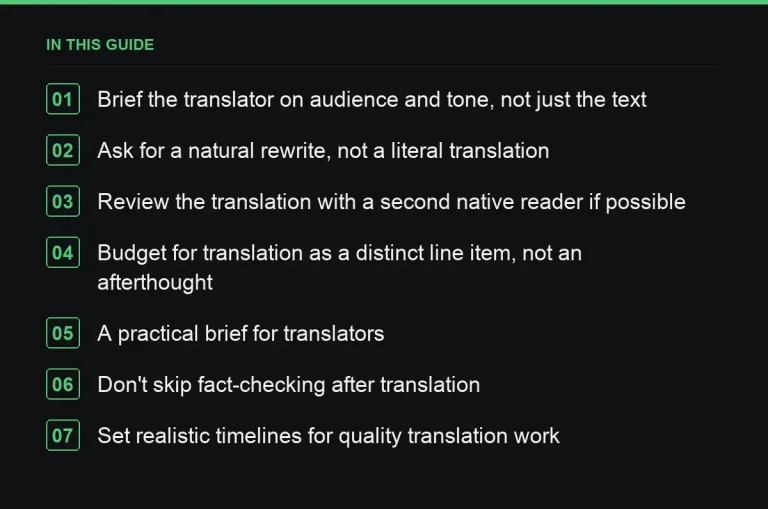
Brief the translator on audience and tone, not just the text
A translator working purely from the source text has no way of knowing whether the target publication is formal or casual, expert-facing or consumer-facing, unless you tell them. Give the same tone brief described in https://successtoroad.com/blog/matching-tone-to-a-host-publication/ to your translator, adapted for the target language’s publication landscape rather than just the source article’s original context.
Flag terms that shouldn’t be translated literally
Industry terminology, brand names, and technical jargon sometimes have an accepted term in the target language that differs from a literal translation, and sometimes the English term is used as-is by native speakers in that field. Provide a short glossary of key terms and your preference for each, rather than leaving the translator to guess or default to the most literal option.
Ask for a natural rewrite, not a literal translation
The best guest post translations often diverge somewhat from the source sentence structure, because a sentence that flows naturally in the original language may need restructuring to flow naturally in the target one. Make clear to the translator that natural readability in the target language takes priority over matching sentence-for-sentence structure with the source.
Watch for lost nuance in idioms and examples
An example or turn of phrase that lands well for an English-speaking audience may not translate meaningfully for another culture — a sports metaphor, a cultural reference, or a joke can all fall flat or confuse. Ask the translator to flag anything that doesn’t translate well conceptually, not just linguistically, so you can swap in an equivalent that works for the target audience.
Review the translation with a second native reader if possible
Even a skilled, professional translator can miss something, and a second native-speaking reviewer catches errors the original translator’s own blind spots might let through — the same logic behind why https://successtoroad.com/blog/reviewing-a-writers-draft/ matters even for experienced writers working in their first language.
Budget for translation as a distinct line item, not an afterthought
Quality translation work, done with a proper brief and review cycle, takes genuine time and skill and should be budgeted and scheduled as its own distinct phase of a content project, rather than squeezed into whatever time is left after the original drafting is finished. Projects that treat translation as an inconvenient extra step tend to produce exactly the flat, literal results this whole process is designed to avoid.
A practical brief for translators
- Target publication and its general tone (formal, casual, technical, consumer-facing).
- A short glossary of key terms and preferred renderings.
- Explicit permission to restructure sentences for natural flow rather than literal accuracy.
- A note on any examples, idioms, or references that may need cultural adaptation.
Don’t skip fact-checking after translation
Numbers, dates, and named claims can shift subtly during translation — a decimal point moved, a date format misread, a name spelled differently. Re-verify these specific details in the translated version rather than assuming accuracy carried over automatically from the source, applying the same discipline covered in https://successtoroad.com/blog/fact-checking-without-fabricating/.
Set realistic timelines for quality translation work
Good translation, especially with the back-and-forth review this process describes, takes real time, and rushing it tends to produce exactly the flat, overly literal results a proper brief is meant to avoid. Build translation into your project timeline as its own distinct phase with adequate time, rather than treating it as a quick final step that happens after the “real” writing work is already done.
Build a long-term relationship rather than one-off jobs
A translator who’s worked with your content repeatedly builds up implicit knowledge of your voice, your typical topics, and your preferred terminology that a new translator starts without every time. Where budget and volume allow, favour continuity with one or two trusted translators over spreading work across many different people for each new piece, since the ramp-up cost of a first project with someone new is real and repeats each time you switch.
Give feedback on translations the way you would on original drafts
Even without speaking the target language fluently, you can give useful feedback based on what a native reviewer reports back — specific notes about tone, clarity, or terminology preference help a translator calibrate for future work, just as https://successtoroad.com/blog/reviewing-a-writers-draft/ argues specific, reasoned feedback improves a writer’s next piece too.
Where to go next
Pair this with https://successtoroad.com/blog/writing-in-a-second-language/ for when drafting directly in the target language might work better than translating at all, and https://successtoroad.com/blog/citing-sources-in-guest-posts/ for handling sourcing correctly across the language switch. For placements in specific language markets, browse https://successtoroad.com/language/german/, https://successtoroad.com/language/italian/, or https://successtoroad.com/language/portuguese/ on https://successtoroad.com/marketplace/, and https://successtoroad.com/services/writing/ for translators experienced with guest content specifically.
Frequently asked questions
Should I use machine translation as a starting point for a guest post?
It can work as a rough first draft for a human translator to refine, but publishing machine-translated content without thorough human review risks unnatural phrasing and factual errors that a skilled translator would catch.
How do I evaluate a translator's work if I don't speak the target language?
Ask a native-speaking colleague or a second reviewer to read it for natural flow and accuracy, since you can't reliably judge quality in a language you don't read yourself.
Should the translator also adapt examples for the local audience?
Where an example, idiom, or cultural reference wouldn't land the same way for the target audience, yes — ask the translator to flag these so you can approve an appropriate substitute together.
Is it more efficient to hire a bilingual writer instead of a translator?
For some topics yes, since a bilingual subject-matter writer can draft directly in the target language with full context, avoiding the handoff issues translation sometimes introduces.
Put it into practice
Filter 54,483 websites by DR, traffic, niche and price, and order with escrow — you pay only after the link is live.
Browse the marketplace