Writing Step-by-Step Tutorials That Actually Work
A tutorial fails the moment a reader hits a step they can't complete with what you gave them.
A tutorial’s only real success metric is whether a reader can follow it start to finish without getting stuck. That sounds obvious, but most tutorial failures come from the same handful of avoidable gaps: skipped setup steps, assumed prior knowledge, and steps that combine two actions into one instruction.
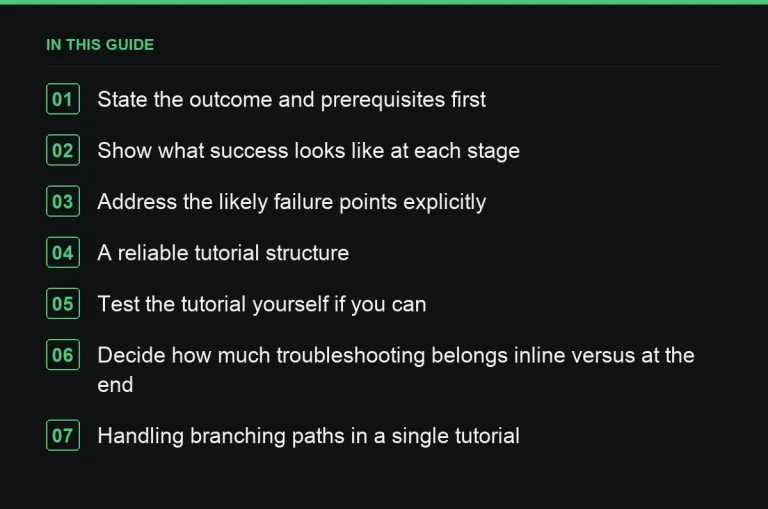
State the outcome and prerequisites first
Before step one, tell the reader exactly what they’ll have at the end and what they need before they start — access, an account, a tool, or a prior piece of knowledge. A reader who discovers a missing prerequisite at step six has wasted their time and yours, and they won’t finish the tutorial or trust the next one you write.
One action per step
“Open your account settings and update your billing details” is two actions disguised as one step. Split it. Readers following a tutorial move at the pace of the smallest actionable unit, and combining actions is one of the most common ways a step becomes unfollowable for someone less familiar with the interface or process than the writer.
Show what success looks like at each stage
After a meaningful step, briefly describe what the reader should now see or have — “you should now see a confirmation message” — so they can confirm they’re on track before moving forward. Without this, an error early in the process can go unnoticed for several more steps, compounding the confusion.
Use numbered lists, not prose, for the actual steps
Steps buried in paragraph form are much harder to follow along with than a numbered list, because a reader following along needs to find their place again after switching between the article and whatever they’re doing. This is one of the clearest cases where https://successtoroad.com/blog/writing-for-skimmers/ formatting isn’t just a nice-to-have — it’s functionally necessary.
Address the likely failure points explicitly
If you know from experience that a particular step commonly trips people up, say so directly rather than assuming everyone will sail through it: “if you don’t see this option, check that you’re on the correct account tier first.” This kind of anticipatory troubleshooting is what separates a tutorial written by someone with real hands-on experience from one assembled from documentation.
A reliable tutorial structure
- What you’ll accomplish and what you need before starting.
- Numbered steps, one action each, with expected outcomes noted.
- Common pitfalls or troubleshooting notes at the relevant step, not bundled at the end.
- A brief close confirming the outcome and pointing to a logical next task.
This structure holds whether you’re writing a technical how-to or a process guide like https://successtoroad.com/blog/writing-a-guest-post-brief/, which is itself a kind of tutorial for a different audience.
Test the tutorial yourself if you can
Walking through your own steps in the actual interface, right before submitting, catches outdated screenshots, renamed buttons, and steps that made sense in your head but don’t map to what’s actually on screen. This single check prevents most of the “this doesn’t match what I see” complaints tutorials attract.
Decide how much troubleshooting belongs inline versus at the end
A short, common gotcha is best handled right at the step where it occurs, since a reader stuck on step four won’t necessarily scroll down to a general troubleshooting section at the very end of the article. Reserve a dedicated troubleshooting section for less common issues that would clutter the main flow if placed inline, and use judgment about which category each potential snag falls into rather than defaulting to one approach for everything.
Handling branching paths in a single tutorial
Not every process is a single straight line — sometimes step four differs depending on an earlier choice the reader made. Rather than writing one tutorial that silently assumes a single path, flag the branch explicitly: “if you chose option A in step two, do this; if you chose option B, do this instead.” Readers following an inaccurate straight-line tutorial through a branching process are the ones most likely to get stuck and give up partway through.
Version and platform changes break tutorials quietly
A tutorial accurate at publication can become subtly wrong within months if the underlying tool or platform changes its interface, even slightly. Note the date or version the tutorial applies to, where the format allows it, so readers encountering a mismatch understand why and aren’t left assuming they’ve done something wrong themselves.
Tutorials benefit from being tested by someone else
Just as https://successtoroad.com/blog/reviewing-a-writers-draft/ argues a second reader catches what the original writer’s familiarity hides, having someone genuinely unfamiliar with the process follow your tutorial exactly as written is one of the most reliable ways to catch a gap before publication. Watch where they hesitate, ask a question, or get a different result than expected — each of those moments points to a step that needs more detail or a different order.
Where to go next
Pair this with https://successtoroad.com/blog/writing-checklists-that-get-used/ for condensing a tutorial into a quick-reference version, and https://successtoroad.com/blog/writing-conclusions-that-convert/ for closing a tutorial well. If you’re commissioning technical how-to content at scale, https://successtoroad.com/services/writing/ lists writers experienced with this format, and https://successtoroad.com/niche/software-development/ or https://successtoroad.com/niche/technology/ on https://successtoroad.com/marketplace/ are natural placements for tutorial-style guest posts.
Frequently asked questions
How detailed should tutorial steps be for an expert audience?
Less granular than for beginners, but still one clear action per step — expert readers skip explanation, not structure. See {{post:writing-for-expert-audiences}} for more on this balance.
Should a tutorial include screenshots?
Guest post formats often don't allow images, so describe what the reader should see in words instead, precisely enough that they can confirm they're on the right screen.
How long is too long for a tutorial-format guest post?
If it's genuinely covering every necessary step without padding, length is less important than completeness — but consider splitting an especially long process into two linked posts.
What's the most common reason tutorials fail for readers?
Skipped prerequisites or combined steps are the two most frequent culprits — both come from the writer's own familiarity making a gap invisible to them.
Put it into practice
Filter 54,483 websites by DR, traffic, niche and price, and order with escrow — you pay only after the link is live.
Browse the marketplace