Seasonal PR Calendars: Planning Coverage Around the Year
How to plan a year of PR around recurring seasonal moments instead of working purely reactively.

Certain topics and story angles recur predictably every year: back-to-school spending, holiday shopping trends, new year planning behaviour, tax season, summer travel. A seasonal PR calendar plans your pitching around these known moments in advance, instead of scrambling reactively each time one arrives.
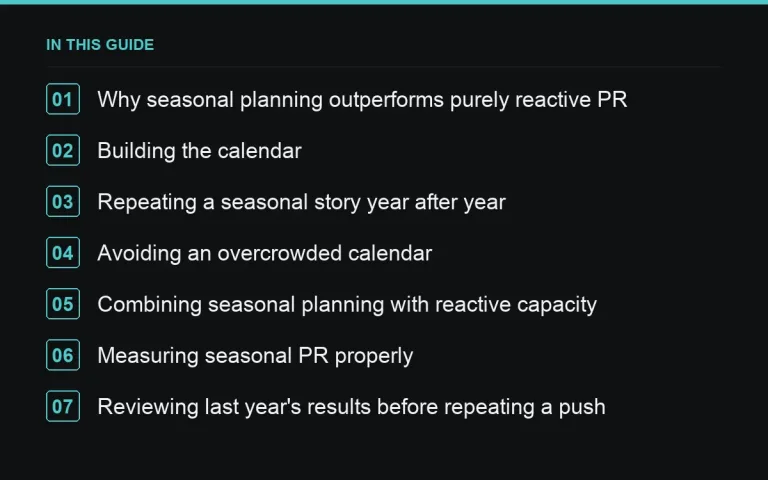
Why seasonal planning outperforms purely reactive PR
Journalists plan seasonal coverage well ahead of the actual date, which means a pitch arriving the week a seasonal story is due to run is usually too late; the piece is already assigned or in production. Building your outreach around the same lead times journalists actually work to dramatically improves your hit rate on seasonal stories.
Building the calendar
- List every seasonal moment genuinely relevant to your industry, not just generic calendar holidays.
- Work backward from each date using realistic lead times — often four to eight weeks for a considered feature, longer for major seasonal packages at bigger outlets.
- Assign a specific angle and a specific data point or expert take to each moment well in advance, rather than improvising close to the date.
- Note which outlets and journalists covered similar seasonal stories in previous years as a starting pitch list.
Repeating a seasonal story year after year
A survey or data piece tied to a specific seasonal moment (see https://successtoroad.com/blog/surveys-and-polls-as-pr-stories/) can become an annual fixture that journalists come to expect and actively request each year once it is established, reducing the pitching effort required over time even as the coverage compounds.
Avoiding an overcrowded calendar
Do not try to pitch every seasonal moment that could conceivably connect to your business; a forced seasonal tie-in reads as opportunistic in the same way a poorly judged newsjacking attempt does (see https://successtoroad.com/blog/newsjacking-for-links/). Pick two or three genuinely strong seasonal moments each year and do them well, rather than a dozen done thinly.
Combining seasonal planning with reactive capacity
A seasonal calendar should not consume all your PR capacity; keep some capacity in reserve for genuinely reactive opportunities that a calendar cannot predict. The two work together: the calendar handles the predictable half of the year, reactive process handles the rest.
Measuring seasonal PR properly
Compare each seasonal push year over year rather than judging it against unrelated campaigns run at other times, since seasonal stories have their own baseline hit rates and outlet appetite that differ from general pitching. See https://successtoroad.com/blog/measuring-pr-coverage/ for the wider measurement approach this fits into.
Reviewing last year’s results before repeating a push
Before repeating a seasonal campaign, review what worked and what did not in the previous cycle: which outlets responded, which angle landed best, and where the timing could have been better. A seasonal campaign repeated without this review tends to plateau, while one refined each year based on actual results tends to compound.
Coordinating seasonal PR with other departments
Seasonal moments often matter to marketing, sales and product teams as well as PR, and coordinating timing across departments avoids a situation where a PR push lands weeks before or after a related marketing campaign it should have supported. A shared seasonal calendar across departments, even a simple one, reduces this kind of avoidable mismatch.
Building in flexibility for a slow news year
Some years, a usually reliable seasonal story competes with unusually large unrelated news, reducing pickup regardless of how well the pitch was prepared. Build enough flexibility into your calendar to shift a pitch by a few days if a major unrelated story is dominating coverage on your planned date, rather than sending directly into a news cycle that has no room for it.
Starting small in the first year
If you have never run a seasonal calendar before, start with a single well-chosen moment rather than attempting a full year of coverage immediately. A well-executed first attempt builds the habit and the evidence needed to expand the calendar in future years.
Balancing global and local seasonal moments
If you operate across multiple markets, remember that not every seasonal moment translates directly; a back-to-school angle, for example, follows a different calendar in different countries. Build market-specific variations into a global seasonal calendar rather than applying one region’s schedule everywhere.
Archiving past seasonal pitches for reuse
Keep past seasonal releases and pitch material archived and organised by year, so preparing the next cycle involves updating existing material rather than starting from a blank page each time the same season comes back around.
Sharing the calendar with your whole team
Make the seasonal calendar visible to everyone involved in content and marketing, not just PR, so a seasonal PR push can be supported by aligned content and messaging elsewhere rather than working in isolation from the rest of the organisation.
Where to go next
Read https://successtoroad.com/blog/building-a-media-list/ for organising contacts by beat ahead of a seasonal push, and https://successtoroad.com/blog/media-relations-guide/ for the overall relationship-building approach a calendar supports. For placements to complement seasonal earned coverage, consider https://successtoroad.com/niche/news-and-media/ or https://successtoroad.com/marketplace/.
Frequently asked questions
How far ahead should a seasonal pitch be sent?
Often four to eight weeks before the relevant date, since journalists plan seasonal coverage well in advance and a pitch arriving too close to the date is usually already too late.
How many seasonal moments should I plan for each year?
Two or three genuinely strong, relevant moments done well tend to outperform a crowded calendar of a dozen thin, forced tie-ins across the year.
Can the same seasonal story be pitched every year?
Yes, and an established annual survey or data piece often becomes easier to place over time as journalists come to expect and request the update each year.
Should all PR capacity go into the seasonal calendar?
No. Keep some capacity reserved for genuinely reactive opportunities, since a seasonal calendar only covers the predictable half of the news cycle.
Put it into practice
Filter 54,483 websites by DR, traffic, niche and price, and order with escrow — you pay only after the link is live.
Browse the marketplace