PR for B2B: Making an Unglamorous Product Newsworthy
How to find a genuine news angle for a B2B business that has no obvious consumer-facing hook.
B2B PR faces a specific challenge: the product or service itself is often not inherently interesting to a general audience, and the buyers who matter are a narrower, more specialised readership than a consumer brand’s audience. This changes both where you pitch and what counts as a usable story.
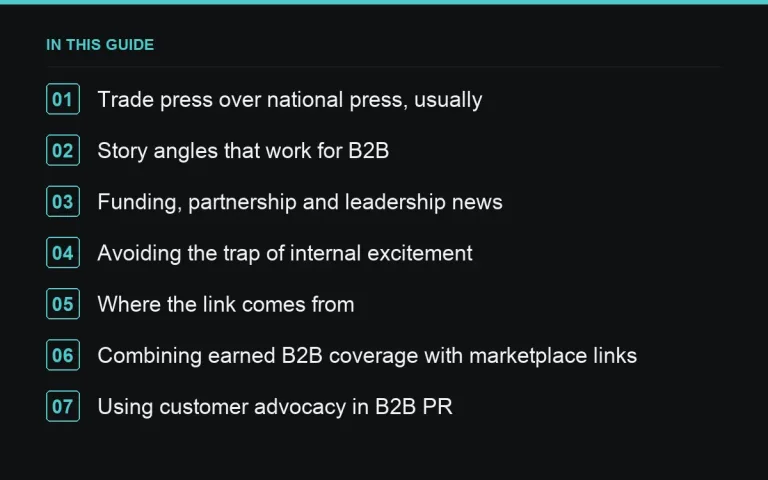
Trade press over national press, usually
For most B2B businesses, trade press covering the specific industry your customers work in matters more than national consumer press, both for direct business impact and for realistic hit rate. See https://successtoroad.com/blog/pitching-trade-press/ for the specific approach that outlet type demands, including longer lead times and a higher tolerance for technical depth.
Story angles that work for B2B
- Industry trend data drawn from your own customer base, presented as a genuine market signal rather than a sales pitch.
- Practical, specific how-to expertise offered as thought leadership (see https://successtoroad.com/blog/thought-leadership-articles/), aimed at practitioners rather than a general audience.
- Customer outcome stories, told through the customer’s own perspective rather than framed around your product’s feature list.
- Workforce and hiring trend commentary, which often crosses over into broader business and even general news coverage.
Funding, partnership and leadership news
These are among the more reliably pitchable B2B story types, since they carry inherent news value independent of how interesting your day-to-day product is. Time these announcements carefully and consider an embargo for a stronger initial story (see https://successtoroad.com/blog/embargoes-and-exclusives/).
Avoiding the trap of internal excitement
A feature update that is a genuinely big deal internally is often not news externally, and pitching it as such wastes journalist goodwill. Be honest about which announcements clear the bar for outside interest and which are better handled through your own channels or a customer newsletter instead of a press pitch.
Where the link comes from
B2B trade press links tend to be well-targeted and relevant even when the outlet’s overall traffic is modest, which is usually a reasonable trade-off given the specificity of the audience. Byline and contributed thought-leadership placements (see https://successtoroad.com/blog/op-eds-and-contributed-articles/) are often more attainable in B2B trade press than in general consumer media, since editors are actively looking for genuine practitioner expertise.
Combining earned B2B coverage with marketplace links
Given how narrow and slow-building B2B trade relationships can be, marketplace placements in relevant business or technology niches (see https://successtoroad.com/niche/business/ or https://successtoroad.com/marketplace/) are a reasonable way to maintain link volume while a longer-term trade press relationship programme develops.
Using customer advocacy in B2B PR
A willing customer prepared to speak publicly about a genuine outcome is one of the strongest assets available in B2B PR, since third-party validation carries more weight with a skeptical trade audience than any amount of company-authored messaging. Building a small roster of customers open to this kind of visibility, with clear internal agreement on what they are comfortable sharing, pays off repeatedly across multiple pitches over time.
Navigating longer B2B sales cycles in your PR timing
B2B coverage often needs to be timed carefully around procurement cycles, budget periods, or industry events relevant to your buyers, since a story landing at the wrong point in a typical buying cycle may generate interest without translating into meaningful business impact. Align major PR pushes with known patterns in your buyers’ own planning calendar where possible.
Executive visibility as a long-term B2B PR asset
A senior executive who becomes a recognised, quotable voice in trade press over several years builds a form of institutional credibility that is difficult for a competitor to replicate quickly. Investing consistently in this kind of executive visibility, through commentary, contributed pieces and event appearances, compounds in a way a single strong announcement cannot.
Aligning PR messaging with sales conversations
Share planned PR angles and coverage with the sales team ahead of publication where practical, since a salesperson caught off guard by a public statement that contradicts what they have been telling prospects creates an avoidable, easily prevented problem.
Working with analysts and industry commentators
Independent analysts covering your specific sector are often a distinct and valuable audience alongside trade journalists, since analyst commentary and reports can themselves become a source of media coverage. Building a relationship with relevant analysts is a worthwhile parallel effort to traditional media relations in many B2B categories.
Handling technical accuracy under media simplification
Journalists writing for a broader audience sometimes simplify technical detail in a way a B2B spokesperson finds frustrating. Decide in advance how much simplification is acceptable before an interview, so the spokesperson is not caught trying to correct minor imprecision live in a way that derails the interview.
Recognising when a story has crossed over
Occasionally a genuinely B2B story, such as a workplace trend or a supply chain shift, resonates with a general audience too. Recognise this crossover potential and be ready to adapt the pitch for broader outlets rather than assuming it only belongs in trade press.
Where to go next
Read https://successtoroad.com/blog/pitching-trade-press/ and https://successtoroad.com/blog/thought-leadership-articles/ for the two channels most central to B2B PR, and https://successtoroad.com/blog/media-relations-guide/ for the wider relationship-building approach this all sits inside.
Frequently asked questions
Should a B2B company prioritise trade press over national press?
Usually yes, since trade press reaches the specialised buyers who actually matter for most B2B businesses, with a realistically higher hit rate than general national press.
What kind of B2B news is most pitchable?
Funding, partnerships, leadership changes, and genuine industry trend data tend to carry inherent news value, more reliably than routine feature updates that are mainly interesting internally.
Is thought leadership more effective in B2B than consumer PR?
Often yes, since trade press editors are actively looking for genuine practitioner expertise, making contributed thought-leadership pieces more attainable than in general consumer media.
Should B2B companies use marketplace links alongside PR?
Yes, particularly while slower-building trade press relationships are still developing, using relevant business or technology niche placements to maintain link volume in the meantime.
Put it into practice
Filter 54,483 websites by DR, traffic, niche and price, and order with escrow — you pay only after the link is live.
Browse the marketplace