PR for E-commerce: Coverage That Drives Traffic and Links
What actually works in PR for an online retailer, as distinct from a services or B2B business.
E-commerce PR has a different set of natural story hooks than a services or B2B business: product reviews, gift guides, seasonal shopping trends, and founder or brand-origin stories all have a more direct route to coverage than a typical software company’s roadmap update. The trade-off is that competition for those same story types is often intense.
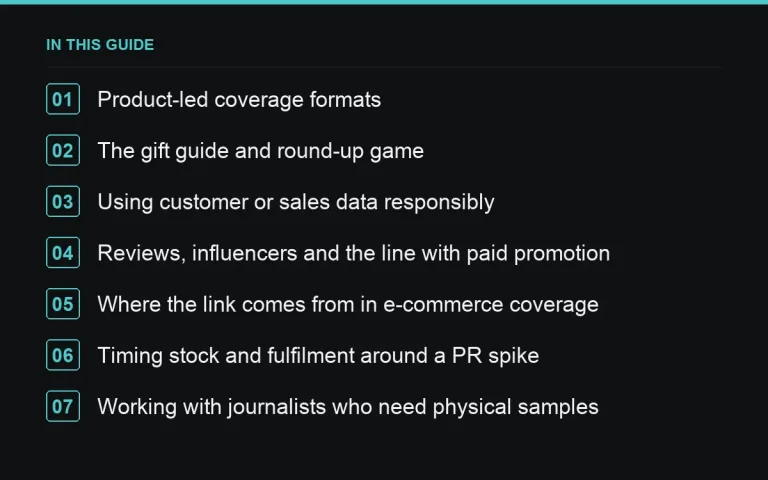
Product-led coverage formats
- Gift guides and seasonal round-ups, which recur predictably and are worth pitching well ahead of time (see https://successtoroad.com/blog/seasonal-pr-calendars/).
- Independent product reviews, which depend on relationships with relevant journalists or publications rather than a one-off pitch.
- Founder or brand-origin stories, particularly for businesses with a genuinely distinctive founding angle rather than a generic one.
- Data on shopping behaviour drawn from your own sales or customer data, presented carefully and without overreaching claims about broader market trends.
The gift guide and round-up game
Round-up and gift guide inclusion is one of the more link-reliable formats in e-commerce PR, since these pieces typically link directly to the product page for each item featured. Pitching for these requires long lead times, often months ahead of the relevant season, and usually a sample or clear product information sent proactively rather than waiting to be asked.
Using customer or sales data responsibly
Aggregated, anonymised trends from your own sales data can make a genuinely interesting pitch, particularly around seasonal shopping behaviour, provided the sample is representative of what you are claiming and you avoid extrapolating a niche customer base into a sweeping statement about all shoppers. See https://successtoroad.com/blog/surveys-and-polls-as-pr-stories/ for the wider principles of using data honestly in a pitch.
Reviews, influencers and the line with paid promotion
Independent editorial reviews carry more credibility than paid or sponsored placements, but blur into paid territory quickly once free products, commissions or sponsorship are involved; disclosure expectations from outlets vary and should be respected rather than assumed away. This is a separate discipline from traditional media relations but overlaps with it enough to be worth understanding before pitching a reviews-focused publication.
Where the link comes from in e-commerce coverage
Product-focused coverage, particularly online round-ups and reviews, tends to link directly and consistently to the specific product page, more reliably than general company mentions in other PR formats. This makes e-commerce PR, when it lands, unusually efficient for driving both traffic and links to a specific commercial page.
Timing stock and fulfilment around a PR spike
A successful piece of coverage, particularly a gift guide inclusion or a well-timed review, can produce a genuine spike in demand for a specific product. Coordinate with operations before a planned PR push around a specific item to make sure stock and fulfilment can handle a sudden increase, since a coverage win that leads to a sold-out or delayed product creates a worse customer experience than no coverage at all.
Working with journalists who need physical samples
Many product-focused pitches, particularly reviews and gift guides, require sending a physical sample ahead of the required lead time. Build this logistics step into your planning calendar explicitly, since a strong pitch that arrives too late for the journalist to receive and test a sample in time is effectively wasted.
Distinguishing a strong product story from a routine one
Not every product needs or deserves a dedicated pitch; save direct outreach for products with a genuinely distinctive angle, a strong seasonal fit, or standout design or functionality, and handle more routine catalogue additions through your own channels instead of diluting journalist goodwill with a constant stream of minor product pitches.
Tracking which products get pitched and why
Keep a simple record of which products were pitched, to which outlets, and with what result, so that seasonal planning in future years can build on what is already known to work rather than starting the guesswork over each time.
Coordinating PR timing with promotional calendars
Major shopping periods often see a flood of competing pitches from other retailers seeking the same round-up placements. Pitching slightly ahead of the busiest window, when journalists are still assembling their seasonal content, tends to produce better results than competing in the final rush.
Using customer reviews as PR material, carefully
Genuine, verifiable customer reviews can support a pitch about product reception, but only when represented honestly and without cherry-picking in a way that misrepresents the overall pattern of feedback, which a diligent journalist may check independently.
Keeping packaging and unboxing in mind for reviews
A reviewer’s experience with packaging and first impressions can shape the tone of the resulting coverage as much as the product itself. Treat what you send for review as a small piece of the pitch, not an afterthought.
Where to go next
Read https://successtoroad.com/blog/pitching-online-only-publications/ for the outlets often most active in gift guides and round-ups, https://successtoroad.com/blog/media-relations-guide/ for the underlying relationship approach, and https://successtoroad.com/blog/pr-for-small-businesses/ if you are running this with limited time. For placements to complement earned e-commerce coverage, browse https://successtoroad.com/niche/e-commerce/ or https://successtoroad.com/marketplace/.
Frequently asked questions
How far ahead should I pitch for a holiday gift guide?
Often months ahead of the relevant season; gift guides and seasonal round-ups are usually planned and written well before the shopping period itself begins.
Is using my own sales data in a PR pitch a good idea?
Yes, if presented honestly and without overreaching; aggregated, representative trends from your own data can make a genuinely interesting and defensible pitch, particularly around seasonal behaviour.
Do product round-ups usually link to the product page?
Yes, this is one of the more consistently link-reliable e-commerce PR formats, since these pieces are structured around linking to each featured item directly.
What is the difference between an editorial review and a sponsored placement?
An editorial review reflects independent journalistic judgment, while a sponsored placement involves payment or commission; disclosure expectations differ and should be respected rather than blurred together.
Put it into practice
Filter 54,483 websites by DR, traffic, niche and price, and order with escrow — you pay only after the link is live.
Browse the marketplace