Writing Product-Adjacent Content Without It Reading as an Ad
The line between useful product mention and disguised advertising is thinner than most writers assume.
Product-adjacent content — an article that discusses a category of tool or service and naturally mentions specific options within it — is one of the most common guest post formats, and also one of the easiest to get wrong by tipping too far into promotion. Readers and editors alike are quick to spot content that’s really an ad wearing an educational article’s clothing.
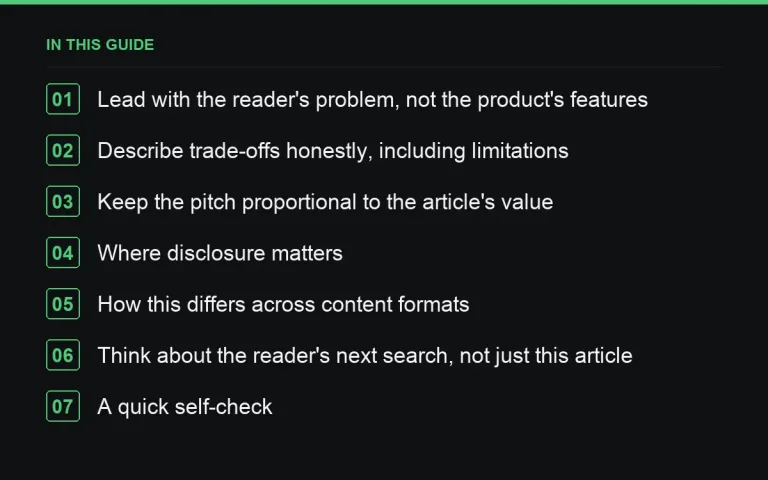
Lead with the reader’s problem, not the product’s features
An article that opens by describing a product’s capabilities has already signalled its priorities. An article that opens by describing a real problem a reader faces, and only introduces relevant tools once the problem is well established, reads as genuinely helpful content that happens to mention products, rather than promotion disguised as an article.
Mention multiple options where genuinely relevant
Discussing several legitimate options for solving a problem, rather than a single one, signals the piece is genuinely comparative rather than a pitch for one specific product. This doesn’t mean every product-adjacent article needs a full comparison, but a piece that only ever mentions one option, especially the client’s own, is more likely to read as sponsored content even if it isn’t formally labelled as such.
Describe trade-offs honestly, including limitations
A product mention that includes a genuine limitation or a scenario where it isn’t the best fit reads as far more credible than an unqualified endorsement. This mirrors the honesty principle in https://successtoroad.com/blog/using-examples-instead-of-statistics/ — specific, balanced detail builds more trust than confident, one-sided praise.
Avoid feature-list language
Phrases like “packed with powerful features” or “the ultimate solution for” are marketing copy patterns that readers recognise instantly and that editors at reputable publications often reject or heavily edit. Describe what a tool actually does and for whom, in the same plain, specific language you’d use to describe anything else in an informational article.
Keep the pitch proportional to the article’s value
A thorough, genuinely useful 1,000-word article that mentions a relevant product once or twice reads very differently from a thin 400-word article built entirely around driving a click to that product. This is the same proportionality principle from https://successtoroad.com/blog/writing-conclusions-that-convert/, applied across the whole piece rather than just the closing paragraph.
Where disclosure matters
If a mention is part of a paid or sponsored arrangement, disclosure requirements in your jurisdiction and the host publication’s own policy typically apply regardless of how the content is written — good writing doesn’t substitute for required disclosure, and pretending otherwise is a legal and trust risk, not just a stylistic one.
How this differs across content formats
A comparison-format piece per https://successtoroad.com/blog/writing-comparison-tables/ naturally accommodates multiple honest product mentions within its structure, while a narrative how-to article has to work product mentions in more carefully so they don’t derail the actual instructional content. Recognising which format you’re working in helps decide how much product mention the piece can naturally absorb before it starts to feel forced.
Think about the reader’s next search, not just this article
A reader satisfied by genuinely useful product-adjacent content is more likely to seek out more of your writing on related topics, while a reader who feels sold to on this piece is less likely to trust the next one, even if it’s written more carefully. Weighing the long-term relationship with a readership against the short-term benefit of a harder pitch is usually the right way to resolve any doubt about how far to push a product mention.
A quick self-check
- Would this article still be useful if the product mention were removed entirely?
- Does it acknowledge at least one limitation or alternative honestly?
- Is the language descriptive rather than promotional in tone?
- Is the product mention proportional to the rest of the article’s substance?
Editors are increasingly trained to spot this pattern
Because product-adjacent content is such a common guest post format, many editors at established publications have developed a fast eye for the specific tells — an unusually confident, feature-heavy paragraph in the middle of an otherwise measured article, or a suspiciously convenient conclusion that happens to favour one product. Writing this format well isn’t just an ethical choice; it’s increasingly a practical requirement for getting the piece accepted at all on reputable sites.
Consider whether disclosure would actually strengthen the piece
In cases where a genuine relationship exists between the writer and a mentioned product, being upfront about it, where the format and platform allow, can sometimes build more trust than trying to write around it invisibly — readers often respond better to honest disclosure paired with genuinely balanced content than to an undisclosed piece they later suspect wasn’t neutral.
Where to go next
Pair this with https://successtoroad.com/blog/writing-ymyl-topics-responsibly/ where product-adjacent content in health or finance carries extra responsibility, and https://successtoroad.com/blog/writing-for-consumer-audiences/ since this format is especially common in consumer content. For placements where this balance matters, https://successtoroad.com/services/writing/ and https://successtoroad.com/marketplace/ both support finding writers and publishers comfortable with product-adjacent content done well.
Frequently asked questions
Is it ever acceptable to only mention one product in an article?
Yes, if the article is genuinely and transparently about that one product or is disclosed as sponsored where required. Problems arise when a single-product mention is disguised as a neutral, comparative piece.
How do I avoid sounding like marketing copy when describing a product I like?
Describe what it does and for whom in plain, specific terms, and include at least one limitation or trade-off, rather than using superlative marketing language.
Does this apply to services as well as physical products?
Yes — the same principles apply to mentioning a service, a platform, or a marketplace within an article; the goal is genuine usefulness to the reader first.
What's the biggest red flag editors look for in product-adjacent submissions?
An article that reads as thin cover for a single product mention, with little independent value if that mention were removed, is the most common reason these submissions get rejected or heavily edited.
Put it into practice
Filter 54,483 websites by DR, traffic, niche and price, and order with escrow — you pay only after the link is live.
Browse the marketplace