PR in Non-English Markets: What Changes and What Doesn’t
What actually changes about media relations once you move outside an English-language market.

The fundamentals of media relations — building relationships, offering genuinely newsworthy material, respecting a journalist’s time — hold across markets. What changes is the practical detail: how outlets are structured, what counts as an acceptable pitch, and how translation and localisation affect whether your material is usable at all.
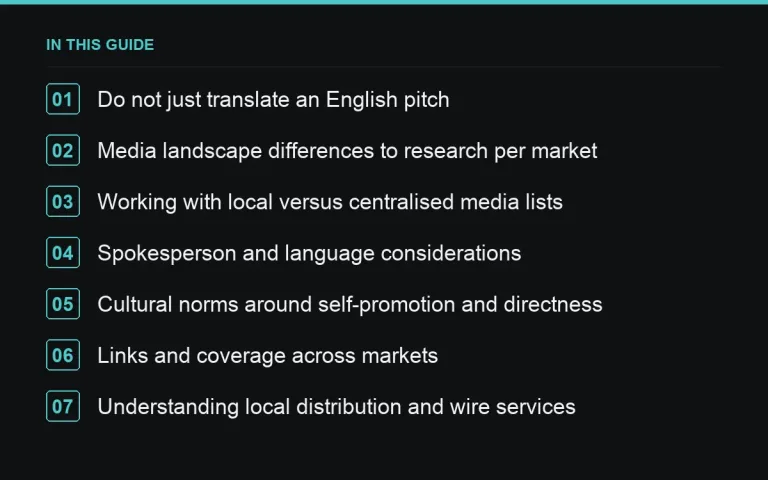
Do not just translate an English pitch
A pitch translated directly from English often reads as stiff or oddly phrased to a native journalist, and worse, may miss a local news angle entirely. Local market knowledge, ideally from someone who works in that market rather than a translation tool alone, materially changes the hit rate.
Media landscape differences to research per market
- Whether trade press, national press or regional press carries more relative weight in that specific country’s media culture.
- Typical response times and preferred contact methods, which vary by market and by generation of journalist.
- Local embargo and exclusivity norms, which are not universal and can differ from what is standard in an English-language market.
- Whether press release distribution wires common in one market have genuine reach and credibility in another, since coverage varies significantly by region.
Working with local versus centralised media lists
A single global media list rarely works well across multiple non-English markets; build or commission separate, market-specific lists researched by people fluent in that market’s media landscape (see https://successtoroad.com/blog/building-a-media-list/ for the underlying process, applied locally).
Spokesperson and language considerations
A spokesperson fluent in the local language, or working with a skilled interpreter comfortable with press interviews specifically, produces noticeably better results than a translated statement read by a native English speaker. See https://successtoroad.com/blog/spokesperson-preparation/ for the broader preparation principles, which apply with added weight when language is not shared natively.
Cultural norms around self-promotion and directness
What counts as an appropriately confident pitch in one market can read as arrogant in another, and what counts as appropriately modest in one market can read as weak or unconvincing elsewhere. This is one of the harder things to get right without direct local experience or a trusted local partner reviewing your material before it goes out.
Links and coverage across markets
Link and attribution norms also vary by market and by outlet; some non-English markets link out from news coverage more consistently than others. If you are building a genuinely international link profile, a marketplace with language-specific filtering, such as https://successtoroad.com/language/german/, https://successtoroad.com/language/french/ or https://successtoroad.com/language/spanish/, can complement local earned coverage where relationships are still being built.
Understanding local distribution and wire services
A press distribution wire with strong reach in one market may have little genuine reach or credibility in another, since local journalists in different regions rely on different networks and databases to source stories. Research locally trusted distribution options for each target market rather than assuming a single global wire covers all of them equally well.
Legal and regulatory differences in claims and disclosures
Rules around advertising claims, data privacy references, and disclosure requirements in press materials vary by jurisdiction, sometimes significantly. Have local material reviewed by someone familiar with that market’s specific requirements before distribution, rather than assuming a claim acceptable in one market is automatically fine in another.
Timing around local public holidays and news cycles
National holidays, election periods, and locally significant events can dominate a market’s news cycle in ways that are not obvious from outside that market. Check a local calendar before scheduling a major push in an unfamiliar market, since a well-planned pitch can still land poorly if it coincides with a period when local newsrooms are focused elsewhere entirely.
Building a small local advisory relationship
Even without a full local team, a single trusted local contact who can review pitches and flag cultural missteps before they go out is often enough to avoid the most common and avoidable mistakes when entering a new non-English market.
Adapting spokesperson availability to local time zones
A spokesperson based in one time zone may struggle to respond quickly enough for a market operating many hours ahead or behind. For markets where you expect ongoing coverage, consider whether a locally based or at least locally available spokesperson materially improves your responsiveness.
Respecting different attitudes toward directness
Communication norms around how directly to state a claim, disagree with a premise, or press a point vary across cultures and markets. A pitch style that reads as confidently normal in one market can read as overly aggressive or evasively vague in another, so calibrate accordingly with local input.
Testing a small market before committing fully
Running a modest pilot in a new market, with a small number of pitches and a willingness to learn from what does not work, is usually wiser than committing a large budget to an unfamiliar media landscape before understanding its norms.
Where to go next
Read https://successtoroad.com/blog/media-relations-guide/ for the fundamentals that still apply everywhere, and https://successtoroad.com/blog/pitching-regional-press-for-links/ for related thinking on tailoring a pitch to a specific, narrower audience. For marketplace placements by language, browse https://successtoroad.com/marketplace/ filtered to your target market.
Frequently asked questions
Can I just translate my English press release for another market?
Direct translation usually reads stiffly to a native journalist and can miss the local news angle entirely; a pitch adapted by someone fluent in that market's media culture performs noticeably better.
Do embargo and exclusivity norms work the same in every market?
No. Practices vary by country and media culture, so confirm local norms rather than assuming a convention standard in an English-language market applies universally.
Should I build one global media list or separate lists per market?
Separate, market-specific lists researched by people fluent in that market's media landscape almost always outperform a single centralised global list.
Is it worth using a marketplace to supplement PR in markets where I have no relationships yet?
Yes, language-filtered marketplace placements can provide a baseline presence in a new market while local media relationships are still being built over time.
Put it into practice
Filter 54,483 websites by DR, traffic, niche and price, and order with escrow — you pay only after the link is live.
Browse the marketplace