Link Outreach for SaaS and Software Companies
How SaaS companies can approach outreach through tool roundups, comparisons, and genuine product data.

SaaS outreach benefits from a few structural advantages other business types do not have as easily: usage data, free-tool angles, and a natural fit for “best tools for X” roundup content that publishes constantly across the internet. This post covers how to use those advantages well.
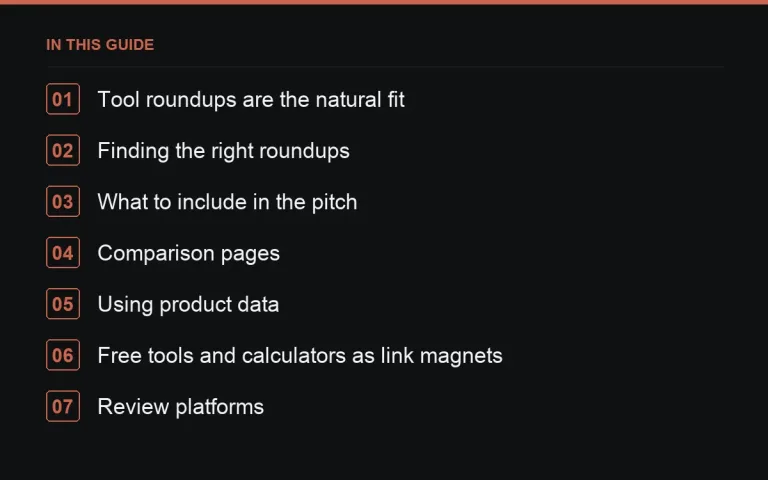
Tool roundups are the natural fit
“Best [category] tools” articles are published and updated regularly across most software niches, and getting included is one of the more approachable outreach asks for a SaaS product, since it does not require the outlet to write anything new, just add an entry to an existing list.
Finding the right roundups
Search for existing “best tools for X” and “X software compared” articles in your specific category, and check how recently they were updated; an actively maintained roundup is far more likely to add a new entry than a stale one that has not been touched in years.
What to include in the pitch
- A concise, accurate description of what the tool does and who it is for, matching the format the roundup already uses.
- What makes it distinct from tools likely already on the list, without disparaging competitors by name.
- An offer of a trial account or demo access if the outlet wants to verify claims before including it.
Comparison pages
Being included in a “[Competitor] alternatives” or head-to-head comparison page can be a strong source of relevant, high-intent traffic alongside the link itself. These pages are often maintained by review sites or by competitors themselves, so the pitch needs to be factually accurate about your own product’s actual capabilities to hold up to scrutiny.
Using product data
If your product produces genuine, non-sensitive aggregate data, anonymised usage patterns, industry benchmarks drawn from real customers, this can be a strong basis for a data-driven pitch to journalists and bloggers covering your space; see https://successtoroad.com/blog/pitching-data-and-original-research/ for how to prepare and pitch this kind of asset properly and without overstating what the data shows.
Free tools and calculators as link magnets
A genuinely useful free tool or calculator related to your core product can attract links on its own merit over time, separate from direct outreach; see building free tools and calculators that earn links for more on this approach, which pairs well with SaaS product data.
Review platforms
Independent software review platforms are not outreach in the traditional sense, but genuine customer reviews there can indirectly support outreach efforts by giving journalists and bloggers a credible third-party source to reference when writing about your product.
Preparing a straightforward one-page fact sheet
A brief, factual sheet covering what the product does, pricing tiers, founding date, and key differentiators saves back-and-forth with journalists and roundup maintainers who need the basics quickly rather than digging through a full website to piece the same information together themselves.
Handling requests for extended trial access
Reviewers and comparison-site maintainers will often ask for extended or full-feature trial access beyond a standard free tier in order to write a fair, complete review. Having a simple, repeatable process for granting this, rather than negotiating access terms freshly for every single request, saves meaningful time as this becomes a recurring part of your outreach pipeline.
Timing pitches around product milestones
A significant product update, a funding announcement, or a notable customer milestone can give a SaaS outreach pitch a timely hook that a generic “please review our tool” email lacks. Building outreach around these moments, rather than treating outreach as a constant, undifferentiated background activity, tends to produce a stronger response since there is a genuine reason to write right now rather than at any other time.
Working with technical and developer-focused publications
If your product has a genuine developer or technical audience, technical blogs and community sites often have different expectations than general business publications, valuing depth, accuracy, and genuine usefulness to a practitioner audience over polished marketing language. A pitch written in a more technical, direct register tends to perform better with this specific audience than a standard marketing-style pitch would.
Faster routes for SaaS link building
https://successtoroad.com/niche/software-development/ and https://successtoroad.com/niche/startups/ on https://successtoroad.com/marketplace/ list publishers relevant to software and technology audiences specifically, which can supplement or substitute for slower roundup outreach, particularly for newer products without an established press profile yet.
Balancing outbound outreach with inbound interest
A well-maintained changelog, a public roadmap, or an active technical blog can generate inbound interest from bloggers and journalists who discover your product on their own, reducing how much of your link growth needs to come from active outreach over time. This is a slower-building channel than direct pitching, but it compounds, and pairs well with the more active outreach tactics covered above rather than replacing them entirely.
Where to go next
See https://successtoroad.com/blog/outreach-for-ecommerce/ for the equivalent playbook for product-based businesses, and https://successtoroad.com/blog/link-outreach-guide/ for the full process. See also https://successtoroad.com/blog/pitching-expert-comment-and-quotes/ if your team includes people with genuine subject-matter expertise worth offering to journalists.
Frequently asked questions
How do I find tool roundups worth pitching?
Search for common phrasings like best tools for your category, and prioritise pages updated recently over ones that look stale.
Is it okay to compare my product directly to a competitor in a pitch?
State factual differences plainly, but avoid disparaging language about a named competitor; accurate, neutral comparison holds up better with editors than an obviously biased pitch.
Do I need a large user base before pitching data-driven content?
Not necessarily large, but the data needs to be genuine and clearly described; do not extrapolate broad claims from a very small sample.
What is the fastest way to get listed in a comparison page?
Directly emailing the page's maintainer with an accurate, concise description of your product, offering trial access, is usually the most effective single approach.
Put it into practice
Filter 54,483 websites by DR, traffic, niche and price, and order with escrow — you pay only after the link is live.
Browse the marketplace