Managing Publisher Relationships After Placement
What happens after publication that determines whether a publisher relationship stays healthy or quietly sours.
Most outreach guidance focuses on getting to yes. Fewer cover what happens after the content is live, which is where a genuinely good long-term publisher relationship is either built or, through neglect, allowed to fade. This post covers the after-placement side.
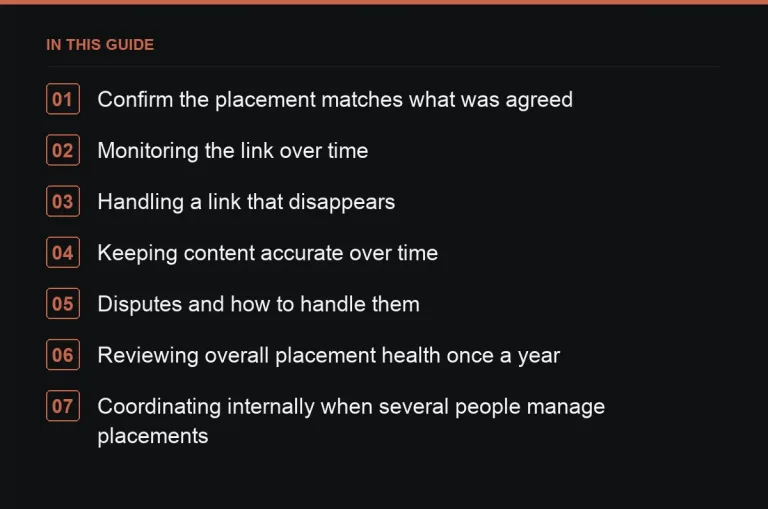
Confirm the placement matches what was agreed
Check the live link promptly: correct anchor text, correct destination, correct placement in the content, and do-follow status if that was part of the agreement. Raise any discrepancy quickly and politely rather than letting it sit unaddressed; most publishers will correct a genuine error if flagged soon after publication.
Monitoring the link over time
Links can disappear through site redesigns, content pruning, or ownership changes, often without any notice to you. Periodic monitoring, not necessarily constant, catches this before too much time has passed. See monitoring lost backlinks and getting them back for a practical approach to this across your whole link profile, not just recent placements.
Handling a link that disappears
A polite, non-accusatory email noting the link seems to have gone missing, referencing the original agreement if one was made in writing, usually resolves the issue without conflict. Most disappearances are the result of a site change unrelated to you, not a deliberate decision, so approach the conversation assuming good faith initially.
Keeping content accurate over time
If the linked content on your side changes substantially, a product is discontinued, information becomes outdated, it is worth notifying the publisher and offering an updated link or note, which is both good etiquette and protects the value of the placement for their readers too.
Disputes and how to handle them
If a genuine dispute arises, over payment, over content changes made without agreement, over a link removed shortly after payment, stay factual and refer back to whatever terms were agreed at the time; see https://successtoroad.com/blog/negotiating-price-and-terms/ for why getting terms in writing at the outset makes this conversation far easier later. Escalating emotionally rarely resolves these situations faster and can permanently end a relationship worth keeping.
Reviewing overall placement health once a year
Beyond individual checks after each placement, an annual review of every active placement together, are they all still live, still relevant, still worth the relationship, gives a clearer picture of your overall link portfolio’s health than piecemeal checks alone, and surfaces patterns, a particular type of site tending to remove links faster than others, that individual checks would miss.
Coordinating internally when several people manage placements
If placements are managed by more than one person over time, keep the after-placement checklist and tracker updates centralised rather than left to individual memory, so a change in staffing does not result in a relationship or a monitored link quietly falling through the cracks. A shared, consistently updated record is what makes this process resilient to normal team changes over time.
When a publisher asks for something extra after payment
Occasionally a publisher will request an additional fee after content is already live, for continuing to host the link, for a “renewal”, or for some other after-the-fact charge not discussed at the outset. Treat this cautiously; if it was not part of the original agreement, it is reasonable to push back and reference what was actually agreed, and to weigh carefully whether this is a site worth continuing to work with going forward given this pattern.
Updating your tracker with long-term status
Beyond the initial placement record, add a periodic status field, still live, link changed, link removed, so that a glance at your tracker shows not just what was placed but its current state. This turns your tracker into a genuinely useful record of your actual, current link profile, not just a log of past outreach activity.
A simple after-placement checklist
- Verify the live link matches what was agreed, within a few days of publication.
- Thank the contact and, where relevant, promote the piece.
- Add the placement details to your tracker for future reference.
- Set a periodic reminder to re-check the link’s status over the following months.
Building toward a repeat relationship
Handled well, this after-placement period is exactly what turns a single transaction into the kind of ongoing relationship covered in https://successtoroad.com/blog/building-relationships-for-repeat-placements/. Handled poorly, or ignored entirely, it is often the reason a publisher quietly declines to work with you again.
Treating each placement as part of a growing portfolio
Over a year or more, the after-placement discipline covered here compounds: a portfolio of well-monitored, well-maintained placements is a genuinely more valuable and stable asset than the same number of links secured but never checked on again. The extra effort of following through after publication is small relative to the cost of quietly losing links you already worked to secure.
Where to go next
See https://successtoroad.com/blog/monitoring-lost-links/ for the ongoing monitoring side, and https://successtoroad.com/blog/link-outreach-guide/ for the wider outreach process. Placements made through https://successtoroad.com/marketplace/ include a weekly link monitor on completed orders, which handles much of this checking automatically.
Frequently asked questions
How soon should I check that a new placement matches what was agreed?
Within a few days of publication, while any needed correction is still simple to request and fresh in the editor's mind.
What should I do if a link disappears months later?
Reach out politely, referencing the original agreement if you have one in writing, and assume good faith; most disappearances are unrelated site changes rather than deliberate removal.
Is it normal for anchor text to be changed slightly by the publisher?
Some publishers reserve final editorial discretion over exact wording; raise it if it materially changes the meaning or your agreed terms, but expect minor phrasing adjustments to be common.
Does monitoring placements need special software?
Not necessarily for a small number of placements; periodic manual checks work, though dedicated link-monitoring tools help at larger scale.
Put it into practice
Filter 54,483 websites by DR, traffic, niche and price, and order with escrow — you pay only after the link is live.
Browse the marketplace