Outreach Follow-Up Cadence: How Many and When
A simple, non-pushy follow-up cadence for outreach emails, with what to say at each stage.
Most people who eventually say yes to an outreach request do not reply to the first email. They are busy, the email arrived at a bad moment, or it slipped down the inbox. A short, well-spaced follow-up sequence recovers a meaningful share of those eventual yeses, without becoming the reason you get blocked. This post covers cadence and wording.
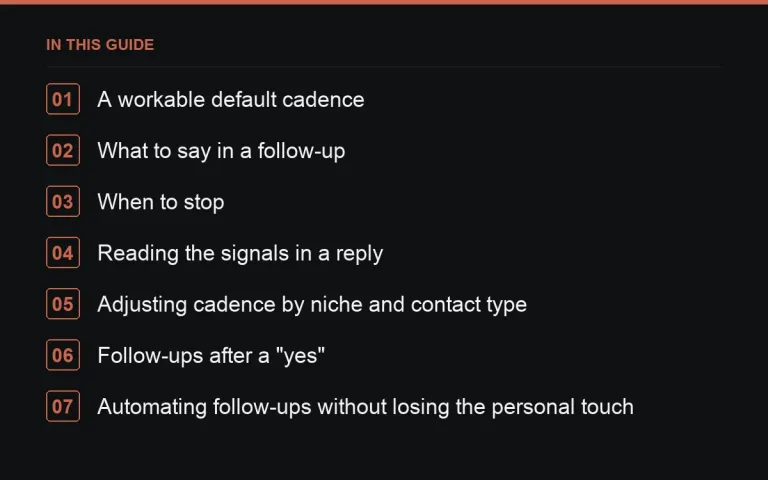
A workable default cadence
- First email — day 0.
- First follow-up — day 7 to 10, a short nudge, not a repeat of the pitch.
- Second follow-up — day 18 to 21, a final, low-pressure check-in.
- Stop. Two follow-ups is usually the right ceiling for a cold contact.
Adjust spacing for your own list, some niches move faster than others, but the shape, a short gap then a longer one, holds broadly.
What to say in a follow-up
A follow-up should be shorter than the first email, not longer. Restating the whole pitch reads as pushy; a brief line acknowledging they are busy and re-asking the single question does the job. Something like referencing the original email date, adding one new sentence of context if genuinely relevant, and closing with the same simple question works better than a full re-pitch.
Do not apologise excessively
“Sorry to bother you again” repeated across two follow-ups reads as self-undermining. A neutral, brief tone holds up better than an apologetic one.
When to stop
After two follow-ups with no response, stop. Continuing to email an unresponsive contact past that point risks annoyance and, at volume, complaints that can damage your sender reputation (see deliverability basics). Mark the contact as unresponsive in your tracker and move on; you can always revisit in a future campaign months later with a genuinely new reason to write.
Reading the signals in a reply
| Reply | What it usually means |
|---|---|
| “Not right now, maybe later” | A genuine soft no; note the date and follow up in a few months, not weeks. |
| No reply at all after two follow-ups | Treat as a no for this campaign; do not add a third follow-up. |
| “Please stop emailing me” | Stop immediately and remove the contact from all future lists. |
Adjusting cadence by niche and contact type
A busy journalist on a live story may need a same-day follow-up or none at all, since the window is short and a second message risks arriving after the story has already run. A smaller independent blogger who posts irregularly may reasonably need a longer gap between follow-ups, since they may check their inbox in batches rather than daily. There is no single cadence that fits every contact; use the default sequence as a starting point and adjust based on what you already know about how that type of contact typically operates.
What a good follow-up email actually contains
Beyond brevity, an effective follow-up references the original date briefly, restates the single question in different words rather than copy-pasting the same sentence, and closes with the same easy, low-effort path to a reply. Avoid introducing a second, different ask in a follow-up; that is a new email, not a follow-up, and deserves its own subject line and thread.
Follow-ups after a “yes”
Cadence is not only for chasing a first reply. Once someone agrees, a gentle nudge if a draft or payment stalls is reasonable, but give more benefit of the doubt here since a relationship has already started; see https://successtoroad.com/blog/building-relationships-for-repeat-placements/ for keeping that relationship healthy long after the first placement.
Automating follow-ups without losing the personal touch
Scheduled follow-up emails are fine as long as each one is checked before it sends, in case the recipient already replied or the situation changed. Sending an automated follow-up to someone who already said no is one of the fastest ways to damage a relationship, and is covered further in https://successtoroad.com/blog/outreach-mistakes-that-get-you-blacklisted/.
Follow-ups that add a small new reason to reply
A follow-up does not have to be purely a repeat of the original ask; if something genuinely new and relevant has happened since the first email, a related piece of content published, a small update to your offer, mentioning it briefly can give the recipient an additional reason to engage without turning the message into a full second pitch. Use this sparingly, since manufacturing a new reason artificially for every follow-up quickly starts to feel transparent.
Recording follow-up outcomes for future reference
When a follow-up does produce a reply, note in your tracker which stage it came at, first email, first follow-up, second follow-up, since this tells you over time roughly how much of your eventual placements depend on persistence versus a strong first email alone. Many campaigns discover that a meaningful share of yeses arrive only after the second contact, which is a useful data point for deciding how much follow-up effort to budget into future campaigns.
Where to go next
For the message that starts this whole sequence, see https://successtoroad.com/blog/outreach-first-email-structure/, and for the overall process, https://successtoroad.com/blog/link-outreach-guide/. If chasing replies over three weeks per contact is more time than your project allows, https://successtoroad.com/marketplace/ gives you a way to secure placements on a fixed, known timeline instead.
Frequently asked questions
How many follow-ups is too many?
More than two, for a cold contact who has not engaged at all, usually crosses into pushy territory and risks a spam complaint rather than a reply.
Should follow-ups go in the same email thread?
Yes, replying in the same thread keeps context for the recipient and is generally read as more considerate than a fresh, unconnected email.
What if someone opens the email repeatedly but never replies?
Treat it the same as any other non-reply; opens without a reply do not warrant a different cadence, since you cannot know why they did not respond.
Is it rude to follow up on a weekend?
Emails sent on a weekend simply sit until Monday for most business contacts, so timing rarely matters much, but scheduling for a weekday morning is a safe default.
Put it into practice
Filter 54,483 websites by DR, traffic, niche and price, and order with escrow — you pay only after the link is live.
Browse the marketplace