Measuring PR Coverage: What to Track Beyond Clip Counts
A practical framework for measuring PR beyond a simple count of mentions.

Counting mentions is the easiest way to measure PR and also the least useful one on its own. Ten mentions in low-authority sites with no links do not equal one strong mention in a credible outlet with a followed link and real referral traffic, yet a raw clip count treats them the same.
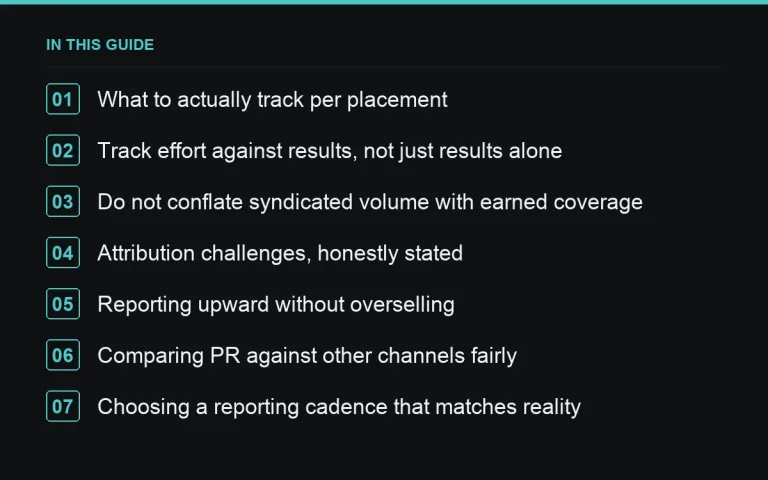
What to actually track per placement
| Metric | Why it matters |
|---|---|
| Domain authority or a comparable metric of the outlet | Distinguishes a meaningful placement from a low-value one |
| Link presence and attribute | Whether a link was given at all, and whether it was followed or nofollow |
| Referral traffic from the placement | The direct business value independent of any link at all |
| Prominence | Whether you are the subject of the piece or a minor mention within it |
| Sentiment | Whether the coverage frames you positively, neutrally, or unfavourably |
Track effort against results, not just results alone
Pitches sent, replies received, and coverage landed, tracked over time by channel, tells you which parts of your media relations programme are actually worth the effort. This is the only way to fairly compare, for example, a labour-intensive national press push against a lower-effort but higher-hit-rate regional campaign (see https://successtoroad.com/blog/pitching-national-press/ and https://successtoroad.com/blog/pitching-regional-press-for-links/).
Do not conflate syndicated volume with earned coverage
Wire-distributed releases that get picked up across dozens of syndication partners will inflate a raw mention count without reflecting genuine editorial coverage. Report these separately from original, independently reported coverage, as discussed in https://successtoroad.com/blog/syndication-and-canonical-links/, so stakeholders are not misled about what the numbers represent.
Attribution challenges, honestly stated
PR’s business impact is genuinely harder to attribute directly to revenue than a paid channel with clean click tracking. Rather than forcing a false precision onto this, be upfront with stakeholders that PR’s value includes authority-building and reputation effects that show up gradually and indirectly, alongside the more measurable metrics above.
Reporting upward without overselling
Resist the temptation to report every mention as equally significant to make a programme look more successful than it is. A credible, honestly qualified report — distinguishing strong placements from minor ones, earned from syndicated, followed from nofollow — builds more long-term trust with stakeholders than an inflated headline number that later gets questioned.
Comparing PR against other channels fairly
When comparing PR results against paid placements or marketplace link building, use consistent metrics on both sides rather than judging PR only on relationship value and paid placements only on measurable output. A curated marketplace such as https://successtoroad.com/marketplace/ gives you the predictable, controllable side of that comparison.
Choosing a reporting cadence that matches reality
Reporting PR results weekly often shows too little movement to be meaningful, since coverage lands unevenly and some weeks will show nothing at all even during an active programme. A monthly or quarterly cadence usually gives a fairer picture of whether the underlying effort is working, while still being frequent enough to catch a genuinely failing approach before too much time is invested.
Benchmarking against your own history, not industry averages
Because so much of PR’s output depends on relationships and story quality specific to your organisation, comparing your own results over time is usually more useful than comparing against a generic industry benchmark, which may not reflect your specific niche, resources, or media list maturity.
Presenting results to non-specialist stakeholders
Stakeholders unfamiliar with media relations may fixate on a single large placement and ignore steadier, smaller wins that are actually more representative of the programme’s health. Frame reporting around trends and patterns across several placements, using a few strong examples as illustration rather than the entire basis for judging success.
Keeping a simple, consistent spreadsheet
A basic spreadsheet tracking pitch date, outlet, outcome, link presence and attribute is enough for most teams; elaborate reporting dashboards add polish but rarely improve the underlying decisions if the raw data behind them is inconsistent or incomplete.
Avoiding vanity metrics that mislead decision-making
A large raw impression or reach number sourced from an outlet’s overall traffic can look impressive while telling you almost nothing about whether the specific placement drove any real interest or link value. Prioritise metrics tied to your actual goals over broad, borrowed traffic figures that inflate results without reflecting genuine impact.
Setting goals before a campaign, not after
Agree on what a successful outcome looks like before a campaign starts, including a realistic range for expected placements, rather than defining success retroactively based on whatever result happens to land. This avoids the temptation to reframe a disappointing result as a success after the fact.
Sharing credit fairly across a team
When more than one person contributes to landing a placement, from research to pitching to spokesperson availability, reflect that shared effort in reporting rather than crediting the result to whoever happened to send the final email.
Where to go next
Read https://successtoroad.com/blog/media-relations-guide/ for the programme this measurement supports, and https://successtoroad.com/blog/combining-pr-with-marketplace-placements/ for combining earned coverage tracking with marketplace placement data from sources like https://successtoroad.com/marketplace/ or https://successtoroad.com/niche/news-and-media/.
Frequently asked questions
Is a raw count of mentions a good PR metric?
Not on its own. It treats a strong, authoritative placement the same as a minor, low-value one, so it should always be paired with quality metrics like link presence and prominence.
How do I measure PR's impact on revenue?
Direct attribution is genuinely harder than for paid channels; be upfront with stakeholders that PR's value includes gradual authority and reputation effects alongside more directly measurable referral traffic.
Should syndicated pickups count the same as original coverage in reporting?
No. Report them separately, since syndicated volume from a distribution wire reflects reach rather than genuine independent editorial coverage.
What is the most useful single thing to track over time?
Reply and hit rate per pitching channel, tracked consistently over months, since it tells you where your effort is actually paying off rather than judging any single campaign in isolation.
Put it into practice
Filter 54,483 websites by DR, traffic, niche and price, and order with escrow — you pay only after the link is live.
Browse the marketplace